- Foreign B2B SaaS vendors must comply with the Australian Consumer Law (ACL) because businesses purchasing services under $100,000 AUD are legally classified as consumers.
- Unfair contract terms in standard form B2B agreements are strictly prohibited in Australia and carry severe financial penalties for non-compliance.
- International software providers must adhere to the Australian Privacy Principles (APPs) when transferring Australian user data across borders.
- Governing law clauses choosing a foreign jurisdiction will not shield a vendor from mandatory Australian statutory obligations.
- Localizing an international Master Services Agreement (MSA) for Australia typically requires a dedicated legal review budget ranging from $2,500 to $6,000 AUD.
Australian B2B SaaS Compliance Checklist
Localizing a standard software agreement for the Australian market requires adjusting your standard terms to meet specific statutory thresholds. This checklist provides the exact contractual elements foreign vendors must update to ensure enforceability and compliance in Australia.
Consumer Law and Liability
- Assess whether your service pricing falls under the $100,000 AUD threshold, which triggers mandatory consumer guarantees.
- Remove blanket liability exclusions that attempt to contract out of the Australian Consumer Law.
- Insert the mandatory statutory wording required for goods or services that come with guarantees under the ACL.
Unfair Contract Terms (UCT)
- Identify and revise any unilateral right to change the software features or pricing without giving the customer a right to terminate.
- Ensure automatic renewal clauses include adequate notice periods and a clear opt-out mechanism.
- Balance indemnification clauses so they do not disproportionately penalize the Australian business customer.
Data Privacy and Security
- Map your data flows to determine if Australian user data is stored or processed offshore.
- Update your privacy policy to reference the Privacy Act 1988 and the Australian Privacy Principles.
- Add contractual warranties ensuring that any offshore data sub-processors comply with Australian privacy standards.
Dispute Resolution and Jurisdiction
- Select a clear governing law, keeping in mind that Australian courts will still apply mandatory local statutes regardless of your choice.
- Specify a dispute resolution mechanism, such as arbitration through a recognized body, before allowing court litigation.
Aligning SaaS Terms with the Australian Consumer Law
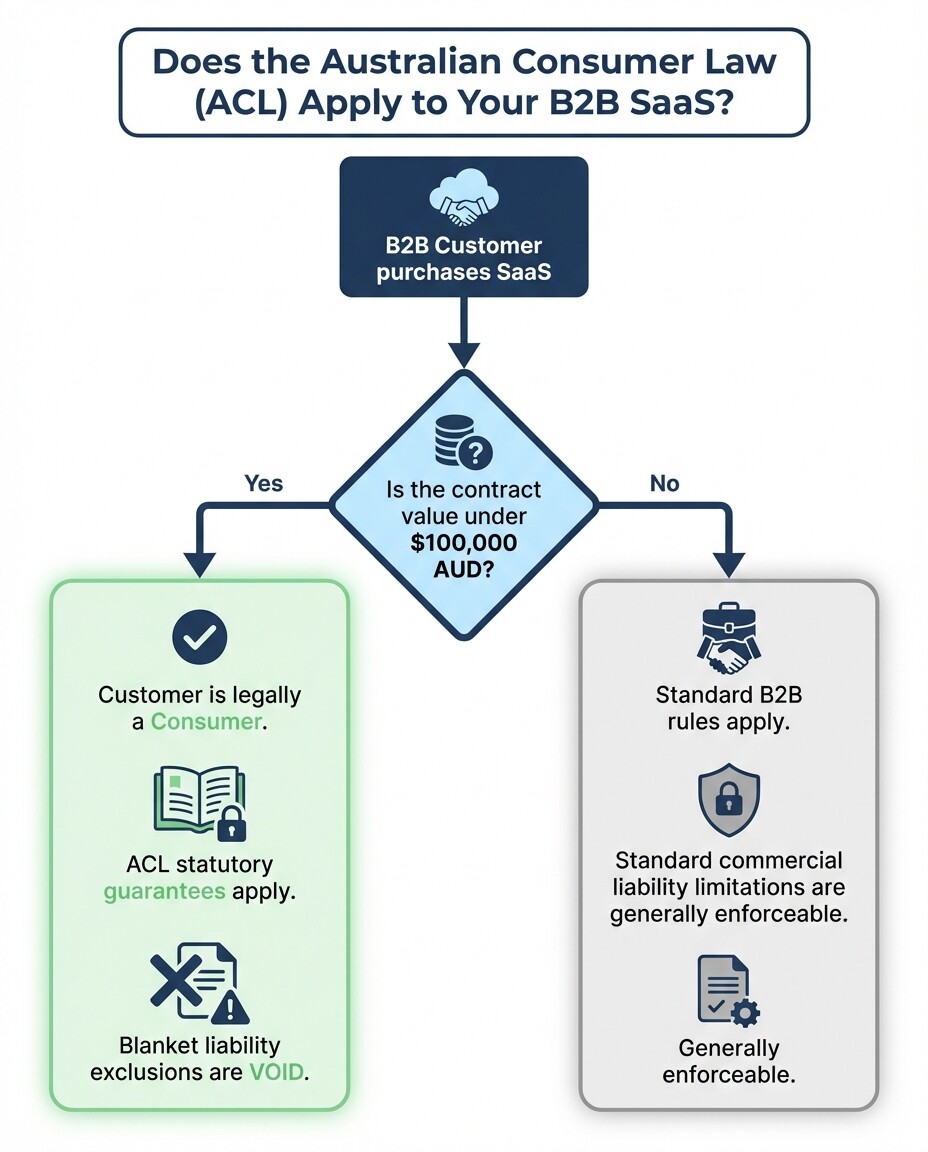
Many foreign tech vendors wrongly assume that B2B contracts are exempt from consumer protection laws. Under the Australian Consumer Law, any business purchasing software or services priced under $100,000 AUD is legally considered a consumer and is entitled to non-excludable statutory guarantees.
To align your terms of service with the ACL, you must carefully adjust your liability limitations. Foreign Master Services Agreements frequently contain absolute disclaimers of liability or blanket "as is" warranty exclusions. In Australia, these blanket exclusions are unenforceable and can trigger regulatory action. Instead, you must include specific limitation of liability language that caps your liability to the resupply of the services or the cost of having the services resupplied, which is legally permissible for business software.
You must also ensure that service level agreements (SLAs) do not inadvertently conflict with the statutory guarantee that services will be rendered with due care and skill. If your SaaS platform experiences severe outages, the ACL may grant the Australian business customer the right to terminate the contract and seek a refund, regardless of what your SLA states about offering service credits as a sole remedy. You can review the exact definitions and guarantees directly through the Australian Competition and Consumer Commission (ACCC).
Avoiding Unfair Contract Terms in B2B Agreements
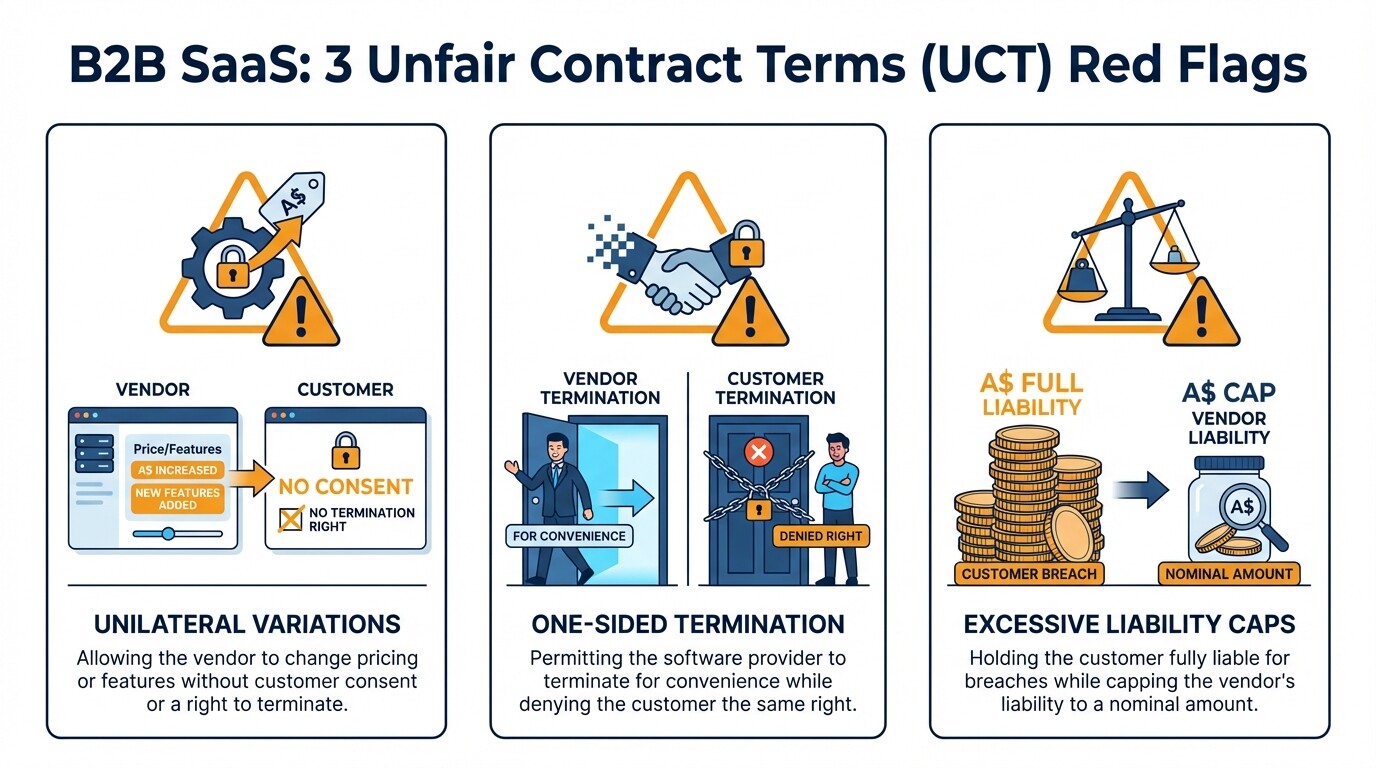
Including unfair contract terms in standard form B2B agreements is a direct violation of Australian law and attracts substantial financial penalties. The regime protects small businesses employing fewer than 100 people or generating less than $10 million AUD in annual turnover, which covers a significant portion of the Australian B2B SaaS market.
A contract term is generally considered unfair if it causes a significant imbalance in the parties' rights, is not reasonably necessary to protect legitimate business interests, and would cause financial or operational detriment to the customer. Foreign vendors frequently fall into this trap by importing aggressive, one-sided clauses from their home jurisdictions.
Common clauses that Australian courts routinely strike down as unfair include:
- Unilateral variations: Clauses allowing the vendor to change pricing, service features, or terms without customer consent or a right to terminate.
- One-sided termination: Terms that allow the software provider to terminate the agreement for convenience while denying the customer the same right.
- Excessive limitations of liability: Holding the customer fully liable for any breach while capping the software vendor's liability to a nominal amount.
Complying with Australian Privacy Principles for Data Transfers
SaaS platforms handling the personal information of Australians must comply with the Privacy Act 1988 and its cross-border data transfer rules. If your software servers or support teams are located outside of Australia, you are executing a cross-border disclosure of personal information.
Under Australian Privacy Principle (APP) 8, before an organization discloses personal information to an overseas recipient, it must take reasonable steps to ensure that the recipient does not breach the APPs. For foreign SaaS vendors, this means your contracts must explicitly state how data is handled, stored, and protected offshore. You remain legally accountable for the mishandling of Australian data by your offshore sub-processors unless you obtain explicit, informed consent from the user to waive this protection.
To maintain compliance, vendors should build robust data processing addendums (DPAs) into their standard terms. These addendums must outline breach notification procedures that align with Australia's Notifiable Data Breaches scheme. You can find the detailed framework for these requirements on the Office of the Australian Information Commissioner (OAIC) website.
Drafting Dispute Resolution and Choice of Law Clauses
Selecting the right governing law and dispute resolution mechanism is critical for foreign entities wanting predictability while operating in Australia. While you can nominate your home country's laws to govern the contract, Australian courts will still apply mandatory local legislation like the ACL to the transaction.
A highly effective strategy for foreign vendors is to implement a tiered dispute resolution clause culminating in international arbitration. Arbitration awards are widely enforceable in Australia under the New York Convention, offering foreign vendors a more neutral and private enforcement mechanism than local court litigation.
Sample B2B SaaS Arbitration Clause Structure:
Any dispute, controversy, or claim arising out of, relating to, or in connection with this Agreement, including any question regarding its existence, validity, or termination, shall be resolved by arbitration in accordance with the ACICA Arbitration Rules. The seat of arbitration shall be Sydney, Australia (or vendor's preferred neutral jurisdiction). The language of the arbitration shall be English. The number of arbitrators shall be one.
Budgeting for Local Legal Review Costs
Adapting an international software agreement for the Australian market requires specialized legal review, and vendors must allocate an appropriate budget for this localization process. Bypassing this step often leads to voided contracts and regulatory fines that far exceed the initial cost of legal advice.
For a standard B2B SaaS Master Services Agreement and accompanying Data Processing Agreement, foreign vendors should budget between $2,500 and $6,000 AUD for a comprehensive local review. The exact cost depends on the complexity of the software, the sensitivity of the data being processed, and the level of customization required.
Typical cost breakdown for SaaS contract localization in Australia:
| Service | Estimated Cost (AUD) |
|---|---|
| Standard Terms of Service Review | $1,500 to $3,000 |
| Privacy Policy & DPA Localization | $1,000 to $2,000 |
| Custom Service Level Agreement (SLA) Review | $500 to $1,500 |
| Comprehensive Enterprise MSA Drafting | $4,000 to $8,000 |
Common Misconceptions About Selling SaaS in Australia
A foreign choice of law clause bypasses Australian regulations Many international vendors believe that explicitly choosing US or UK law in their contract means Australian laws do not apply. Mandatory Australian statutes, including consumer guarantees and privacy obligations, apply to transactions occurring in Australia regardless of the governing law chosen in the agreement.
B2B contracts are exempt from consumer laws Vendors frequently assume the word "consumer" only applies to individuals buying personal items. In Australia, any business purchasing your software for less than $100,000 AUD is classified as a consumer, meaning consumer protection laws heavily restrict how you draft liability and warranty clauses.
Frequently Asked Questions
Do foreign SaaS companies need an Australian Business Number (ABN)?
Foreign companies are not strictly required to have an ABN simply to sell software online to Australian customers. However, registering for an ABN and for the Goods and Services Tax (GST) is generally required if your sales into Australia exceed $75,000 AUD over a 12-month period.
Can we charge automatic renewal fees to Australian businesses?
Yes, automatic renewals are permitted, but the contract must provide clear, advance notice before the renewal triggers. Failing to notify a customer of an upcoming renewal or making the cancellation process overly difficult can be deemed an unfair contract term and invalidated.
What happens if our SaaS agreement violates the Australian Consumer Law?
If your agreement contains void or unfair terms, Australian regulators can impose severe financial penalties. Furthermore, the problematic clauses are legally severed from the contract, meaning you cannot rely on those limitations of liability or termination rights in a dispute.
When to Hire an Australian Contract Lawyer
You should hire local legal counsel before officially launching your software services to the Australian market or before signing an enterprise agreement with an Australian corporation. Attempting to use a standard template from another jurisdiction leaves your company exposed to significant regulatory risk and renders key protective clauses unenforceable.
An experienced lawyer will review your existing terms, strip out void clauses, and insert the mandatory statutory language required for compliance. If you need assistance localizing your agreements, you can easily find qualified contract lawyers in Australia who specialize in technology and SaaS compliance.
Next Steps
- Review your current software pricing tiers to identify which business customers fall under the $100,000 AUD threshold triggering mandatory consumer guarantees.
- Audit your standard terms of service for common unfair contract terms, specifically looking for unilateral rights to change pricing or service features.
- Update your privacy policy and data processing addendums to explicitly address cross-border data transfers under the Australian Privacy Principles.