Malaysia Expats' Guide to Residential Tenancy Disputes and Rights
Key Takeaways
Renting property as an expatriate in Malaysia involves navigating distinct legal frameworks and market practices that safeguard your residency. Recent regulatory shifts leading into 2026 emphasize standardized protections for both local and foreign renters.
- Foreigners must negotiate a "diplomatic clause" in their tenancy agreements to allow early termination without severe penalties in case of job relocation.
- Landlords cannot legally evict you by changing locks or cutting utilities; they must secure a formal court order.
- Security deposit structures typically equal two and a half months' rent, and landlords must have documented proof of damage to withhold these funds.
- You can represent yourself in the Malaysian Magistrates' Court for tenancy disputes involving RM 5,000 or less.
Sample Diplomatic Clause for Expat Tenancies
A diplomatic clause allows foreign tenants to terminate a lease prematurely without forfeiting their security deposits if their employment status changes. This provision is standard in expatriate rentals but typically requires a minimum residency period before it can be activated.
Standard Diplomatic Clause Example: Notwithstanding anything to the contrary contained herein, in the event the Tenant, who is an expatriate, is transferred out of Malaysia by their employer, ceases to be employed, or has their employment pass revoked, the Tenant shall be entitled to terminate this Tenancy Agreement. This termination requires providing the Landlord with two (2) months' prior written notice, or two (2) months' rent in lieu of notice, provided that such notice shall only be given after the expiration of the first twelve (12) months of the Tenancy Period. The Tenant must provide documentary evidence from their employer or the Immigration Department of Malaysia to substantiate the early termination. Upon valid termination under this clause, the Landlord shall refund the Security Deposit and Utility Deposit in full, subject to lawful deductions for damages or outstanding bills.
Interpreting Diplomatic Clauses in High-End Leases
Luxury residential agreements often contain strict documentation requirements and timelines to trigger a diplomatic release. Landlords usually require official employer letters and a mandatory two-month notice period before the termination legally takes effect.
To successfully execute a diplomatic clause, you must carefully follow your contract's specific procedural steps:
- The One-Year Lock-in: Most luxury leases demand that you complete at least 12 months of the tenancy before issuing a termination notice. Attempting to invoke the clause earlier generally results in forfeiting your security deposit.
- Evidentiary Burden: You cannot simply state you are leaving the country. You must provide official proof, such as a formal transfer letter on corporate letterhead or a visa cancellation notice from the Malaysian Immigration Department.
- Notice Period and Rent: You are still legally obligated to pay rent during the two-month notice period. Do not attempt to use your security deposit as your final two months of rent unless explicitly permitted by your landlord in writing.
Security Deposit Recovery for Foreign Tenants
Recovering a security deposit in Malaysia requires a formal written demand and documented proof of the property's condition at handover. Under the current and 2026 tenancy frameworks, landlords must return standard deposits within an agreed timeframe, minus legitimate deductions for actual damages or unpaid utilities.
Protect your security deposit by taking proactive measures throughout your tenancy:
- The Inventory Check: Always conduct a joint inspection with your landlord or their agent before moving in. Take date-stamped photographs of existing damages, especially to expensive air conditioning units, marble flooring, or high-end appliances common in Malaysian condos.
- Fair Wear and Tear: Malaysian courts recognize that standard property deterioration-like faded paint or minor scuffs-is not the tenant's responsibility. Landlords cannot legally deduct from your deposit to upgrade or fully renovate the unit.
- Formal Letter of Demand: If your landlord refuses to return the deposit within the contracted timeline (usually 14 to 30 days after moving out), issue a formal Letter of Demand. This outlines the exact amount owed and sets a strict deadline for payment before you initiate legal action.
Eviction Procedures and Tenant Protections in 2026
Malaysian landlords are legally prohibited from changing locks or cutting off utilities to force an eviction, even if your rent is heavily in arrears. Under Section 7 of the Specific Relief Act 1950, property owners must obtain a formal court order to reclaim possession of the premises.
If a landlord attempts a self-help eviction, you have substantial legal protections:
- Prohibition of Lockouts: Landlords who padlock doors or remove your access cards are committing an illegal act. You have the right to report this to the Royal Malaysia Police (PDRM) and seek an injunction.
- Utility Disconnections: Landlords cannot instruct management offices in condominium developments to cut your water or electricity. Only the official utility providers (like Tenaga Nasional Berhad) can terminate services for unpaid bills.
- Formal Court Process: To evict a tenant legally, landlords must issue a Notice to Quit, file a civil suit for possession, and wait for the court bailiff to execute the eviction-a process that typically takes three to six months.
Handling Landlord Breach of Contract in Luxury Developments
When landlords fail to maintain luxury property standards or fix major structural issues, tenants can issue a formal notice of breach. If the landlord ignores the notice, tenants may have grounds to terminate the lease or seek specific performance through the courts.
High-end condominiums in areas like KLCC or Mont Kiara often suffer from specific maintenance issues. Handle them legally by following these steps:
- Review Repair Clauses: Most luxury agreements state that tenants cover minor repairs (often up to RM 150 - RM 300), while landlords are strictly responsible for major issues like roofing leaks, internal pipe bursts, or central air conditioning failures.
- Written Notice and Grace Period: Do not immediately stop paying rent if the landlord fails to make repairs. Issue a written notice giving them a reasonable timeframe (typically 7 to 14 days) to rectify the issue.
- The "Repair and Deduct" Strategy: If the contract allows, and the landlord remains unresponsive, you may hire a contractor, pay out of pocket, and deduct the cost from your next rent payment. You must keep all receipts and correspondence as proof.
Accessing Small Claims Court for Rental Dispute Resolution
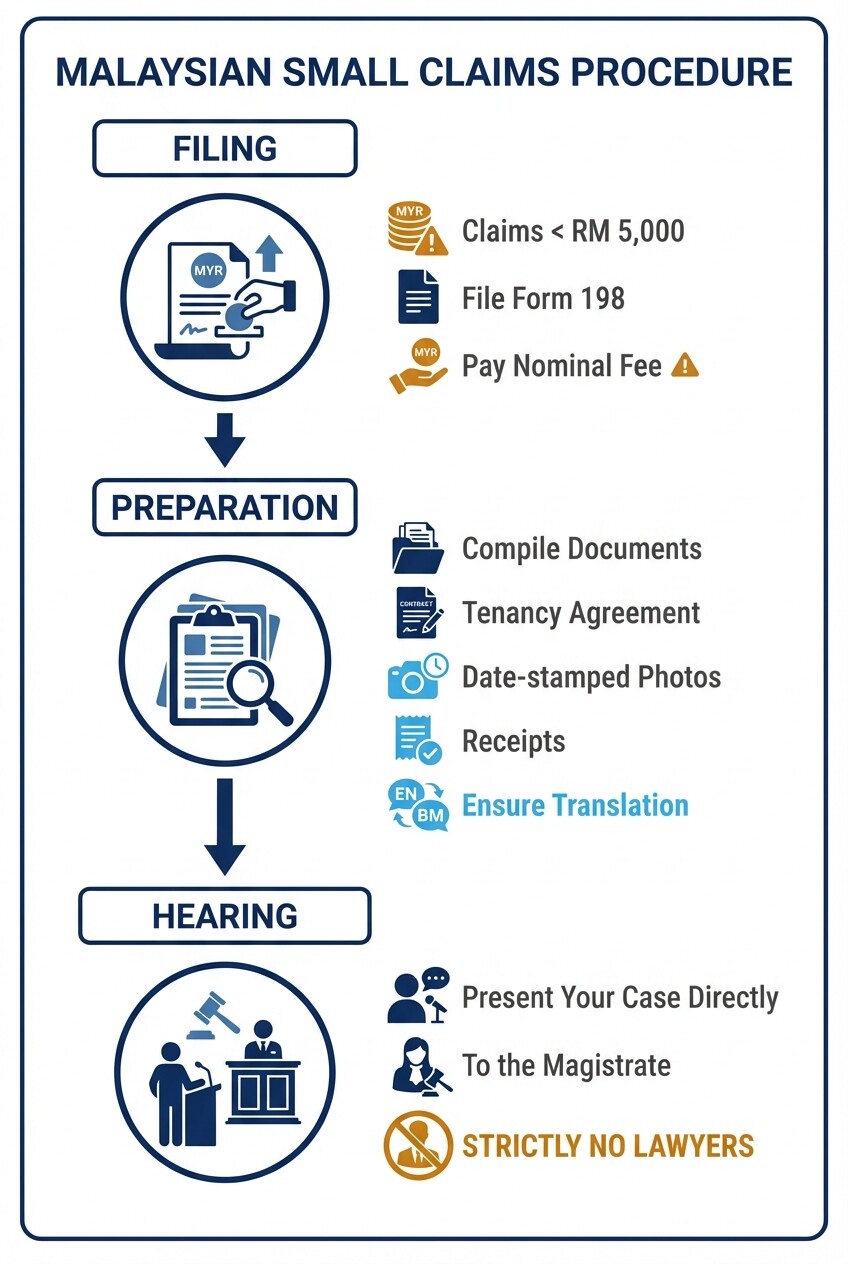
The Malaysian Small Claims Court provides a fast and cost-effective way for individuals to recover unreturned deposits or damages up to RM 5,000 without needing a lawyer. You must file a specific form at the Magistrates' Court where the dispute occurred or where the landlord resides.
The Small Claims Procedure is highly accessible for expatriates facing uncooperative landlords over smaller sums:
- Filing Form 198: You initiate the process by completing Form 198 (Writ of Summons) and paying a nominal filing fee (typically around RM 20).
- No Lawyers Allowed: Neither you nor your landlord can be represented by legal counsel in a small claims hearing, leveling the playing field.
- The Hearing: You will present your tenancy agreement, proof of payment, handover photographs, and correspondence directly to the Magistrate. Ensure all documents are translated into Bahasa Malaysia or English, as these are the accepted languages in court.
Common Misconceptions About Malaysian Tenancies
Many foreign tenants unknowingly waive their rights due to widespread myths about local tenancy laws. Understanding the legal reality prevents costly mistakes during lease negotiations and disputes.
- Misconception: You can use your security deposit as the last two months of rent.
Reality: Tenancy agreements explicitly forbid this practice. The deposit is strictly held against damages and unpaid utilities, and you must pay rent until your final month. - Misconception: If you sign an agreement without paying stamp duty, the contract is invalid.
Reality: An unstamped tenancy agreement is still a valid contract between you and the landlord. However, it cannot be submitted as evidence in a Malaysian court until it is stamped by the Inland Revenue Board (LHDN) and late penalties are paid.
Frequently Asked Questions
Who is responsible for air conditioning servicing in Malaysia?
Most Malaysian tenancy agreements require the tenant to pay for routine air conditioning servicing (usually cleaning and gassing) every six to twelve months. However, the landlord is generally responsible for replacing broken compressors or completely failed units.
Can my landlord arbitrarily increase rent during my tenancy?
Your landlord cannot increase the rent before your current tenancy agreement expires. Any rent increase must be negotiated and agreed upon when renewing the lease for a subsequent term.
Is the utility deposit refundable?
Yes, the utility deposit (typically half a month's rent) is fully refundable. The landlord holds this to cover outstanding electricity, water, or sewerage bills (Indah Water) after you vacate the property.
When to Hire a Lawyer
You should seek legal representation when disputes exceed the RM 5,000 threshold of the Small Claims Court or when facing an illegal lockout. Complex situations involving luxury properties with high-value security deposits, or landlords attempting to seize your personal assets (under the Distress Act 1951), require professional intervention to file injunctions or handle High Court litigation.
Next Steps
If you are currently facing a tenancy dispute or preparing to sign a high-value lease in Malaysia, start by thoroughly organizing all communications, receipts, and photographic evidence of the property. Review your contract specifically for the diplomatic clause and repair obligations. If your landlord is withholding a significant deposit or threatening illegal eviction, consult with experienced Malaysia contract lawyers to draft a formal Letter of Demand or explore your litigation options.