


- Intellectual property (IP) in Canada is governed by a "first-to-file" system, meaning the first person to file a patent application generally has priority over earlier inventors who did not file.
- Patents offer a 20-year legal monopoly in exchange for public disclosure, while trade secrets provide indefinite protection as long as the information remains confidential and holds commercial value.
- Startups must avoid any public disclosure of their invention before filing a patent application, as Canada and many other jurisdictions have strict novelty requirements.
- Effective IP strategy often involves a "hybrid approach," patenting the core hardware or process while keeping specific algorithms or manufacturing methods as trade secrets.
- Cross-border protection between Canada and the United States is essential for most Canadian startups, often facilitated through the Patent Cooperation Treaty (PCT).
What are the criteria for patentability under the Canadian Patent Act?
To be eligible for a patent in Canada, an invention must satisfy four primary criteria: it must be patentable subject matter, novel, useful, and non-obvious. According to the Patent Act, an invention is defined as any new and useful art, process, machine, manufacture, or composition of matter.
The Canadian Intellectual Property Office (CIPO) evaluates applications based on these specific pillars:
- Novelty: The invention must be the first of its kind in the world. It cannot have been publicly disclosed by anyone else before your filing date. Canada provides a 12-month grace period for disclosures made by the inventor themselves, but relying on this is risky for international protection.
- Utility: The invention must work. It must have a practical application and perform the function it claims to perform. Theoretical concepts without a functional output do not qualify.
- Non-Obviousness (Inventive Step): A "person skilled in the art" should not have been able to easily bridge the gap between existing technology and your invention. It must involve a creative step that is not a simple logical progression.
- Subject Matter: Certain things cannot be patented in Canada, such as scientific principles, abstract theorems, or methods of medical treatment (though the medications and devices used in those treatments often can be).
When should a startup choose trade secret protection over a public patent filing?
Choosing between a patent and a trade secret depends on the nature of the technology, the product's expected lifecycle, and the startup's ability to maintain confidentiality. While a patent provides a powerful legal right to exclude others, it requires you to publish your "secret sauce" for the world to see, and it expires after 20 years.
A trade secret is often the superior choice in the following scenarios:
- The invention is hard to reverse-engineer: If a competitor cannot figure out how your product works by looking at it or taking it apart (e.g., a complex software algorithm or a chemical formula), a trade secret may last forever.
- The product has a short or very long lifecycle: For software that will be obsolete in two years, the three-year patent prosecution process might not be worth the cost. Conversely, for a formula like Coca-Cola, a 20-year patent would have expired a century ago.
- Budget constraints: Patents are expensive, costing thousands in filing fees and legal costs. Trade secrets cost nothing to "register" but require investment in internal security and legal contracts.
| Feature | Patent | Trade Secret |
|---|---|---|
| Duration | 20 years from filing | Indefinite (as long as secret) |
| Cost | High (filing, legal, maintenance) | Low (internal security, NDAs) |
| Disclosure | Required (public record) | Forbidden (must stay secret) |
| Protection | Strong (against independent discovery) | Weak (no protection against independent discovery) |
What is the role of Non-Disclosure Agreements (NDAs) in IP protection?
Non-Disclosure Agreements (NDAs) are the primary legal mechanism for protecting trade secrets and preserving the "novelty" required for future patent applications. In the Canadian startup ecosystem, an NDA ensures that employees, contractors, and potential partners are legally bound to keep your proprietary information confidential.
Without a signed NDA, sharing your invention with a third party-even a potential investor-can be legally construed as a "public disclosure." This disclosure can immediately disqualify you from obtaining a patent in most of the world and destroy the legal status of a trade secret.
Essential Components of a Startup NDA:
- Definition of Confidential Information: Clearly state what is protected, including source code, customer lists, and technical drawings.
- Standard of Care: Define how the receiving party must handle the data (e.g., using the same level of care they use for their own secrets).
- Exclusions: Explicitly state what is not confidential, such as information already in the public domain.
- Term of Confidentiality: For startups, this should ideally be "perpetual" for trade secrets or at least several years for general business information.
How do you navigate the CIPO filing process?
Navigating the Canadian Intellectual Property Office (CIPO) involves a multi-stage process that typically takes three to five years from filing to grant. Canada follows a "request for examination" system, meaning your application does not move forward until you specifically ask CIPO to look at it and pay the associated fee.
Step-by-Step Filing Process:
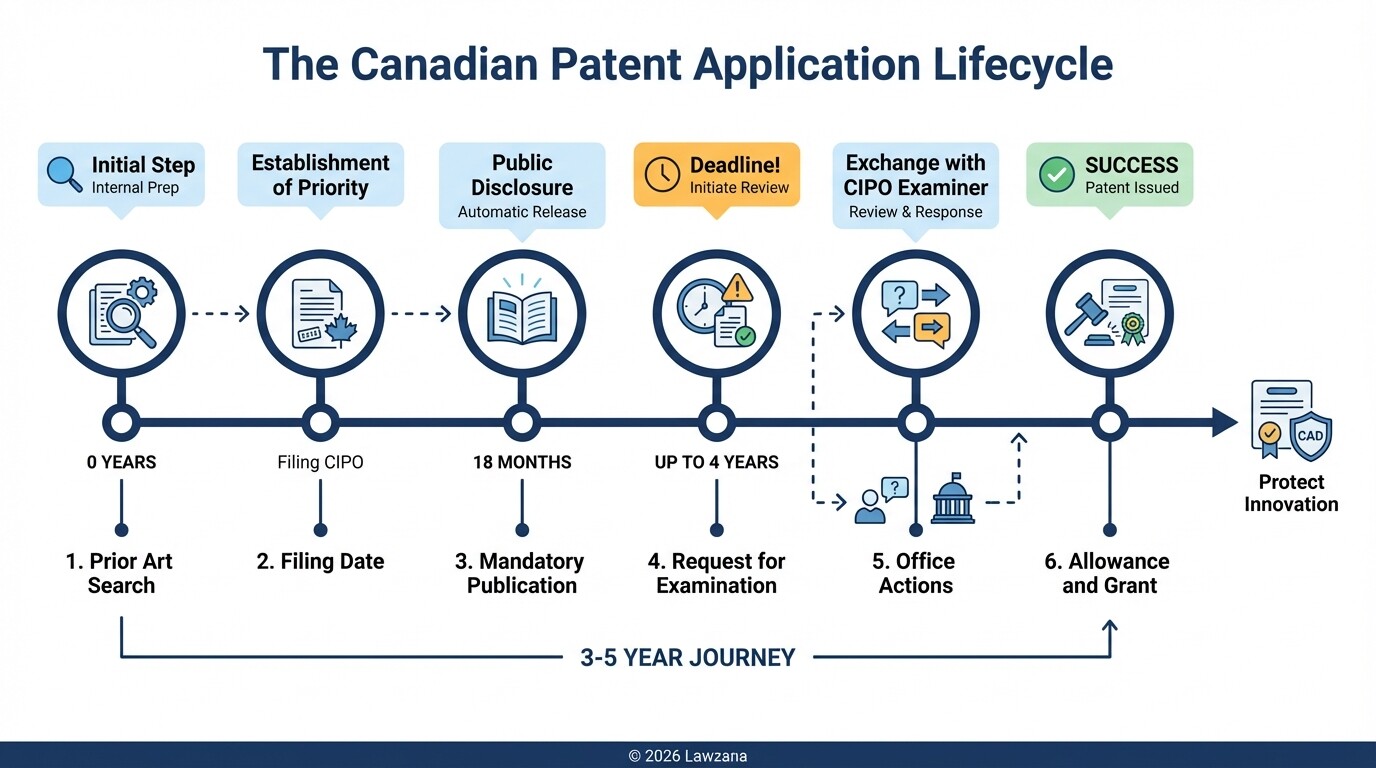
- Prior Art Search: Before filing, conduct a thorough search of existing patents to ensure your invention is actually new.
- Formal Application: Submit your description, claims, drawings, and abstract. You must pay the filing fee ($455 CAD for standard entities, or $225 CAD for small entities with fewer than 100 employees).
- Request for Examination: You have up to four years from your filing date to request an examination. Many startups delay this to preserve capital or see if the product gains market traction.
- Office Actions: A CIPO examiner will likely send "Office Actions" (letters) rejecting certain claims. Your patent agent must respond with arguments or amendments.
- Allowance and Grant: Once the examiner is satisfied, you pay a final fee, and the patent is issued.
How should startups manage cross-border IP enforcement between Canada and the USA?
Because the Canadian market is relatively small, most Canadian startups look to the United States for growth. IP rights are territorial, meaning a Canadian patent provides zero protection in New York or California. To protect your innovation across the border, you must file for protection in each jurisdiction.
Strategies for the North American Market:
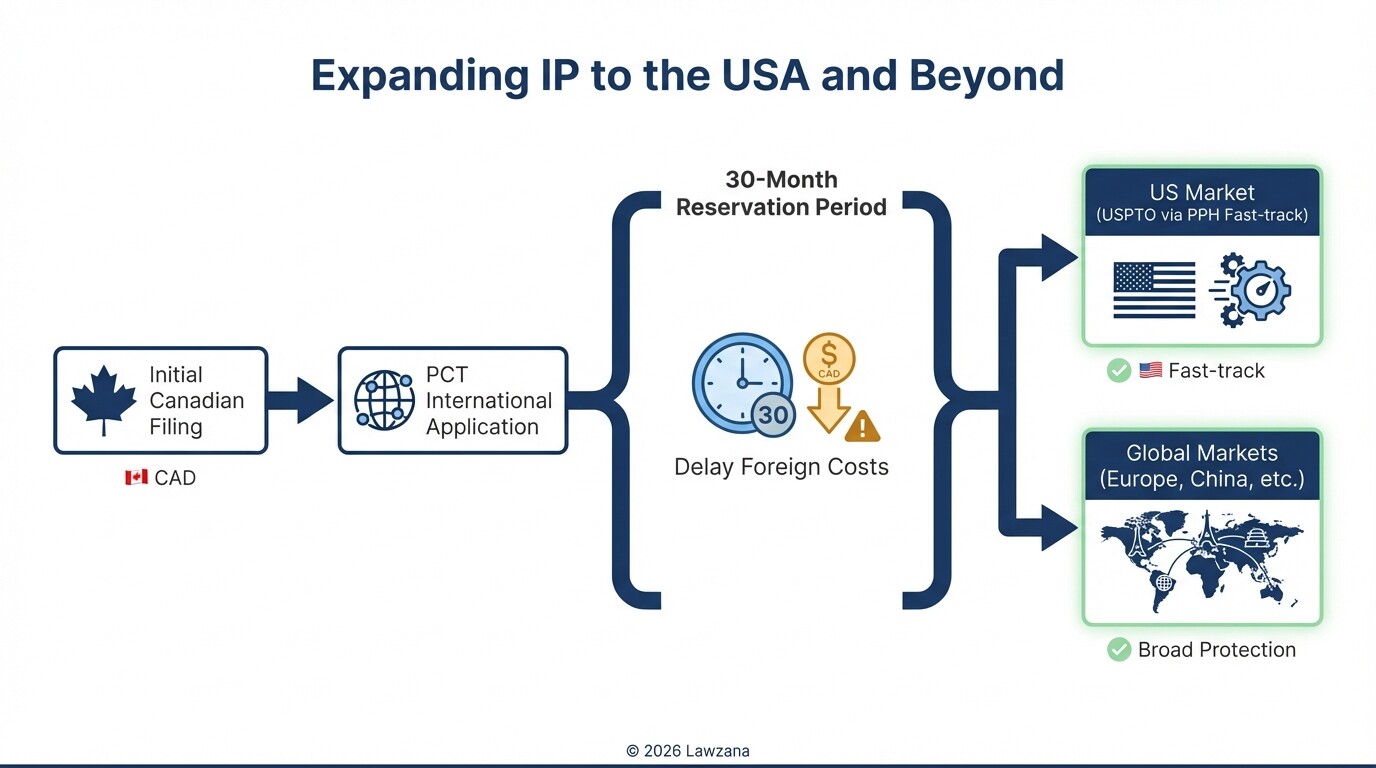
- The Patent Cooperation Treaty (PCT): By filing a PCT application, a Canadian startup can "reserve their spot" in over 150 countries, including the USA, for up to 30 months. This defers the high costs of individual foreign filings while you seek funding.
- PPH (Patent Prosecution Highway): If you get your patent approved in Canada first, you can use the PPH to fast-track your application at the United States Patent and Trademark Office (USPTO). This can save months of waiting and thousands in legal fees.
- Enforcement Considerations: If a US competitor infringes on your Canadian patent, you must sue them in Canadian Federal Court. Conversely, to stop them in the US, you must hold a US patent and litigate in US District Court.
Common Misconceptions About Canadian IP
Myth 1: "A patent protects me globally."
A patent granted by CIPO only gives you rights within Canada. There is no such thing as a "world patent." You must file in every country where you want protection.
Myth 2: "I can't patent software in Canada."
While you cannot patent a pure mathematical formula or "code" (which is protected by copyright), you can patent "computer-implemented inventions." If your software solves a technical problem in a new and non-obvious way, it is likely patentable.
Myth 3: "I have a year to file after I launch."
While Canada has a one-year grace period for your own disclosures, many other major markets (like Europe and China) have "absolute novelty" rules. If you launch your product in Toronto today, you may lose the right to patent it in London or Beijing tomorrow.
FAQ
How much does it cost to get a patent in Canada?
For a small entity, the government fees are roughly $800 to $1,500 CAD from filing to grant. However, when you include professional fees for a patent agent to draft and prosecute the application, the total cost typically ranges from $10,000 to $20,000 CAD.
Can I file a "provisional patent" in Canada?
Canada does not have a formal "provisional application" like the US. However, you can file an "incomplete" application or a regular application without requesting examination immediately. This establishes your priority date at a lower initial cost.
How long does trade secret protection last?
Trade secret protection lasts forever, provided the information remains secret and the owner takes reasonable steps to protect it. If the information is leaked or independently discovered by a competitor, the protection vanishes instantly.
What is a "Small Entity" in the eyes of CIPO?
A small entity is defined as a business with fewer than 100 employees or a university. Qualifying for small entity status reduces most CIPO government fees by 50%.
When to Hire a Lawyer
While you can technically file your own IP applications, doing so is highly discouraged for startups. IP law is a combination of technical engineering and strict legal deadlines. You should consult a patent agent or IP lawyer if:
- You are preparing for a funding round (investors will perform "IP due diligence").
- You are about to launch a product or present at a trade show.
- You have received a "cease and desist" letter from a competitor.
- You are hiring contractors or employees who will be creating core technology.
- You need to decide between patenting a process or keeping it as a trade secret.
Next Steps
- Audit your Innovation: Identify every piece of technology, brand name, and process your company uses.
- Implement NDAs Immediately: Ensure every employee, founder, and contractor has signed an agreement that assigns IP ownership to the company.
- Conduct a Preliminary Search: Use the CIPO and USPTO databases to see if similar inventions already exist.
- Consult an IP Professional: Schedule a strategy session to determine which innovations require patents and which should be guarded as trade secrets.
- Set an IP Budget: Allocate funds for filing fees and legal maintenance as part of your early-stage capital planning.