How to Resolve Real Estate Contract Disputes in Greece
Key Takeaways
Resolving a property dispute in Greece requires acting quickly to preserve your deposit and using out-of-court mediation before pursuing litigation. Foreign buyers have the exact same legal protections as Greek citizens under local property laws.
- Mediation saves time: Greek law mandates formal mediation for many real estate disputes before you can file a civil lawsuit.
- Deposits are protected: If a seller breaches a preliminary agreement, Article 402 of the Greek Civil Code requires them to refund double the deposit amount.
- Remote resolution: You do not need to be in Greece to handle a dispute. A local lawyer can represent you using a Special Power of Attorney.
- Act fast: An "extrajudicial notice" is the first step to establish a contract breach and demand a refund.
Common Causes of Real Estate Disputes
Disputes often arise when preliminary contracts lack specific penalty clauses or when sellers fail to clear registry obligations before the final deed transfer. Foreign buyers frequently encounter issues with delayed construction or hidden structural defects.
The most frequent triggers for conflicts include:
- Title discrepancies: Issues often emerge between the seller's claims and the official records held by the Hellenic Cadastre. This frequently involves unresolved inheritance disputes or unregistered property borders.
- Construction delays: Developers fail to meet agreed milestones. They may also hand over properties that deviate from the architectural plans attached to the contract.
- Structural defects: Buyers discover illegal extensions, forestry zoning violations, or structural damage after signing the preliminary agreement.
- Deposit retention: Sellers attempt to keep the initial reservation fee or deposit (arrabonas) when a deal falls through because of financing issues or newly discovered property burdens.
Pre-Litigation Alternatives: Mediation
Mediation is often faster and cheaper than going straight to court. Under Greek Law 4640/2019, certain real estate disputes require a mandatory initial mediation session (YAS) before a judge will hear your case.
Mediation in Greece involves a state-accredited mediator who helps both parties negotiate a legally binding settlement. The process includes:
- Mandatory initial session: Your lawyer must inform you in writing about the mandatory mediation session before filing a lawsuit.
- Voluntary negotiation: The mediator facilitates discussions to find an agreement. This might involve renegotiating the purchase price due to a defect or setting a deposit refund timeline.
- Binding resolution: The mediator drafts a settlement document. Once filed with the local Court of First Instance, this document has the same legal weight as a court judgment and is immediately enforceable.
Step-by-Step Guide to Recovering Deposits
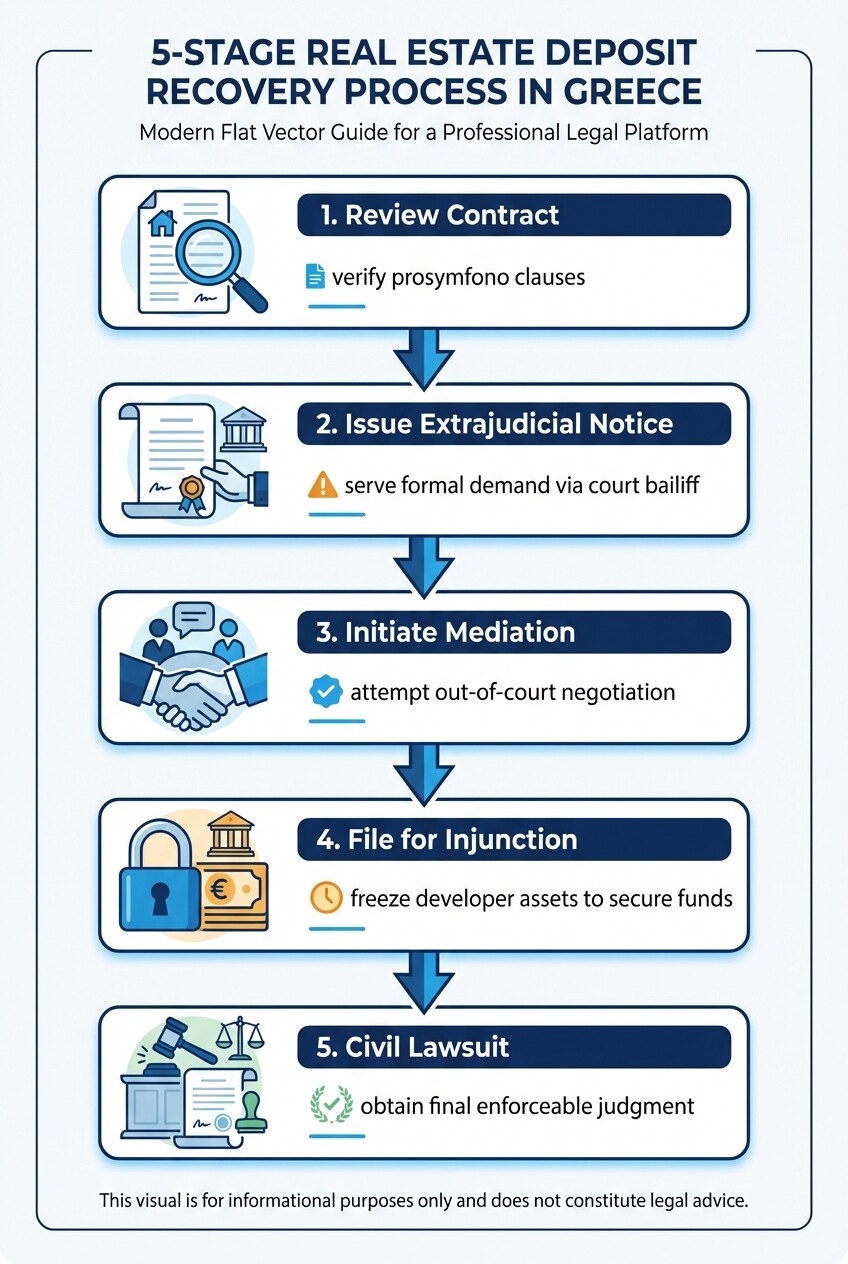
To recover an off-plan property deposit in Greece, you must prove the developer breached the preliminary agreement. If the seller is at fault for the breach, you are entitled to receive double the deposit amount back.
Follow these steps to legally demand and recover your funds:
- Review the contract: A lawyer will verify the specific performance clauses, delivery dates, and penalty terms in the notarized preliminary agreement (prosymfono).
- Issue an extrajudicial notice: Your lawyer drafts and serves a formal legal notice via a court bailiff (exodiko). This document notifies the developer of the breach, demands a refund within a specific timeframe, and is primary evidence in court.
- Initiate mediation: Try to negotiate the return of the deposit before engaging in a lengthy court battle.
- File for an injunction: If the developer ignores the notice, your lawyer can file a petition for interim measures (asfalistika metra). This freezes the developer's assets or places a legal burden on the property to secure your funds while the main lawsuit proceeds.
- File a civil lawsuit: Proceed with a lawsuit at the appropriate Court of First Instance to obtain a final, enforceable judgment.
Navigating Courts Without Being a Resident
You do not need to live in Greece or attend every court hearing in person. A registered Greek lawyer can manage the litigation process on your behalf using a Special Power of Attorney (Plirexousio). This document allows your lawyer to sign settlement agreements, file lawsuits, and represent you before Greek judges.
You can execute this document in three ways:
- Greek Consulate: Schedule an appointment at the Greek embassy or consulate in your home country. They draft the document in Greek.
- Foreign notary public: Sign the document before a local notary. It must have an Apostille stamp (under the Hague Convention) and an official Greek translation.
- Digitally via gov.gr: Buyers with Greek tax credentials (TAXISnet codes) can issue certain legal authorizations digitally through the official Greek e-government portal.
Estimated Legal Fees for Dispute Resolution
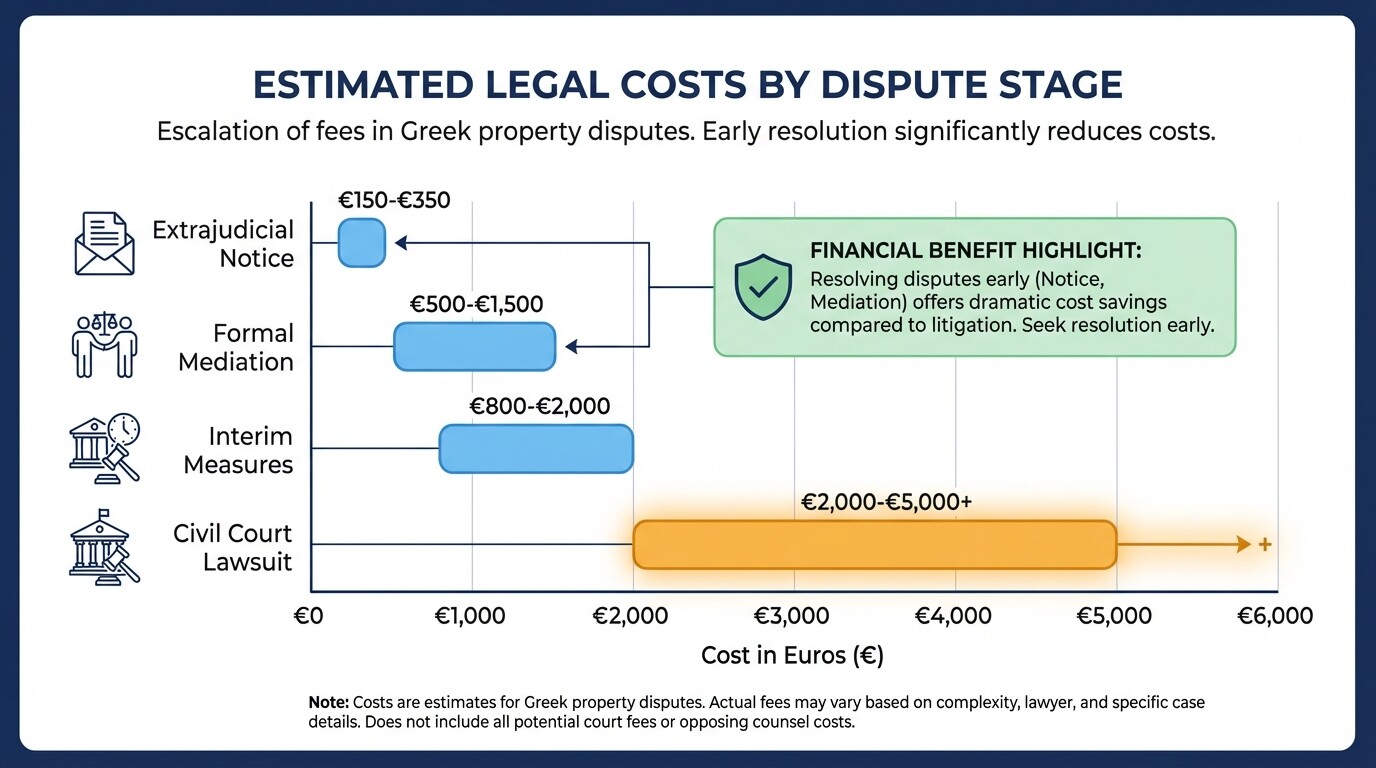
Resolving a property dispute in Greece generally costs between €1,500 and €10,000. Costs depend heavily on whether the case settles in mediation or goes to a full civil trial. Lawyers charge an hourly rate, a flat fee for specific actions, or a statutory percentage based on the property value.
| Legal Action | Estimated Cost (EUR) | Description |
|---|---|---|
| Extrajudicial Notice | €150 - €350 | Drafting the notice and court bailiff service fee. |
| Formal Mediation | €500 - €1,500+ | Mediator hourly rate and lawyer representation fee. |
| Interim Measures | €800 - €2,000 | Court filing fees and legal representation for an injunction. |
| Civil Court Lawsuit | €2,000 - €5,000+ | Litigation in the Court of First Instance. |
Realities of Greek Property Disputes
Many foreign investors lose money by believing incorrect assumptions about Greek property law, particularly regarding deposit refunds and contract enforceability. Understanding these legal processes prevents costly mistakes.
- Notarized agreements: Only a notarized preliminary agreement (prosymfono) offers full legal protection and the right to force a sale. Simple private agreements are much harder to enforce in court.
- Deposit forfeiture: You can safely back out and keep your deposit if the seller fails to clear tax debts, resolve forestry issues, or provide clean title deeds. If you change your mind without legal justification, you forfeit the deposit.
- Agent responsibilities: Real estate agents in Greece are facilitators. They cannot enforce contracts or provide binding legal remedies if a developer breaches an agreement.
- Litigation timelines: A standard civil lawsuit takes two to four years to reach a decision in the Court of First Instance. This makes interim injunctions and mediation highly recommended.
- Developer bankruptcy: If a developer goes bankrupt before finishing an off-plan property, you become an unsecured creditor. To protect against this, insist on bank guarantees or incremental payment schedules tied to certified construction milestones.
- Tax exemptions: Returning a deposit or receiving a legally mandated penalty for a breached contract is not taxable income in Greece. The transaction must still be documented through legal channels to satisfy anti-money laundering regulations.
When to Hire a Lawyer and Next Steps
Hire a Greek real estate attorney if a developer misses construction deadlines, a seller refuses to refund a deposit, or serious title issues emerge during due diligence. Rapid legal action protects your investment and prevents statutory time limits from expiring.
If you face a contract breach, organize your written communications, payment receipts, the preliminary contract, and any related architectural plans. Next, consult with qualified contract lawyers in Greece who specialize in property disputes. They will review your documentation, determine your grounds for a deposit refund, and draft the extrajudicial notice to formally initiate the resolution process.