


- Mandatory Initial Session (MAS): Under Greek Law 4640/2019, most commercial disputes with a value exceeding €30,000 must undergo a mandatory initial mediation session before proceeding to court.
- Enforceability: A mediation agreement, once filed with the Secretariat of the competent Court of First Instance, constitutes an enforceable title, carrying the same legal weight as a court judgment.
- The "Mediation Certificate": Litigants must submit a signed certificate from a mediator confirming they were informed about the mediation process; failure to do so results in the lawsuit being ruled inadmissible.
- Cost Efficiency: While traditional Greek litigation can take three to five years to reach a final decision, mediation typically concludes within weeks or months at a fraction of the court costs.
- Confidentiality: All Alternative Dispute Resolution (ADR) proceedings in Greece are strictly confidential, protecting sensitive corporate data and trade secrets from public record.
Which Commercial Disputes Require a Mandatory Initial Session (MAS)?
In Greece, a Mandatory Initial Session (MAS) is required for most civil and commercial disputes heard under the ordinary procedure where the value of the claim exceeds €30,000. This requirement also applies to specific categories of disputes regardless of the amount, such as family law matters and neighborhood disputes, provided the parties have the power to dispose of the subject matter of the dispute.
Law 4640/2019 serves as the cornerstone of Greek ADR, aiming to alleviate the significant backlog in the Greek judicial system. For international businesses, this means you cannot simply "sue and see"; you must engage in a good-faith preliminary session with a certified mediator.
Common Commercial Disputes Subject to MAS
- Contractual Breaches: Disputes involving supply agreements, distribution contracts, and service level agreements (SLAs).
- Shareholder Disputes: Conflicts between partners or shareholders in Greek corporations (S.A. or I.K.E.).
- Professional Liability: Claims against directors, officers, or service providers.
- Real Estate: Commercial lease disputes and property valuation disagreements.
- Intellectual Property: While some IP matters have specific carve-outs, many commercial licensing disputes fall under the MAS umbrella.
What Are the Deadlines and Procedural Requirements for Mediation?
The primary procedural requirement is the submission of the "Mediation Certificate" signed by both the lawyer and the client, along with the "MAS Minutes" if the case proceeds to the mandatory session. For cases where the MAS is compulsory, the session must take place within 20 days of the mediator being contacted by the parties, though this can be extended by mutual agreement.
If the parties decide not to proceed with full mediation after the MAS, the mediator issues a certificate of attendance. This document is vital; the Greek courts will refuse to hear your case if this certificate is not filed alongside the initial lawsuit or within the prescribed deadlines of the "New Code of Civil Procedure" (usually within 90 to 120 days of filing for most commercial cases).
Step-by-Step Procedural Checklist
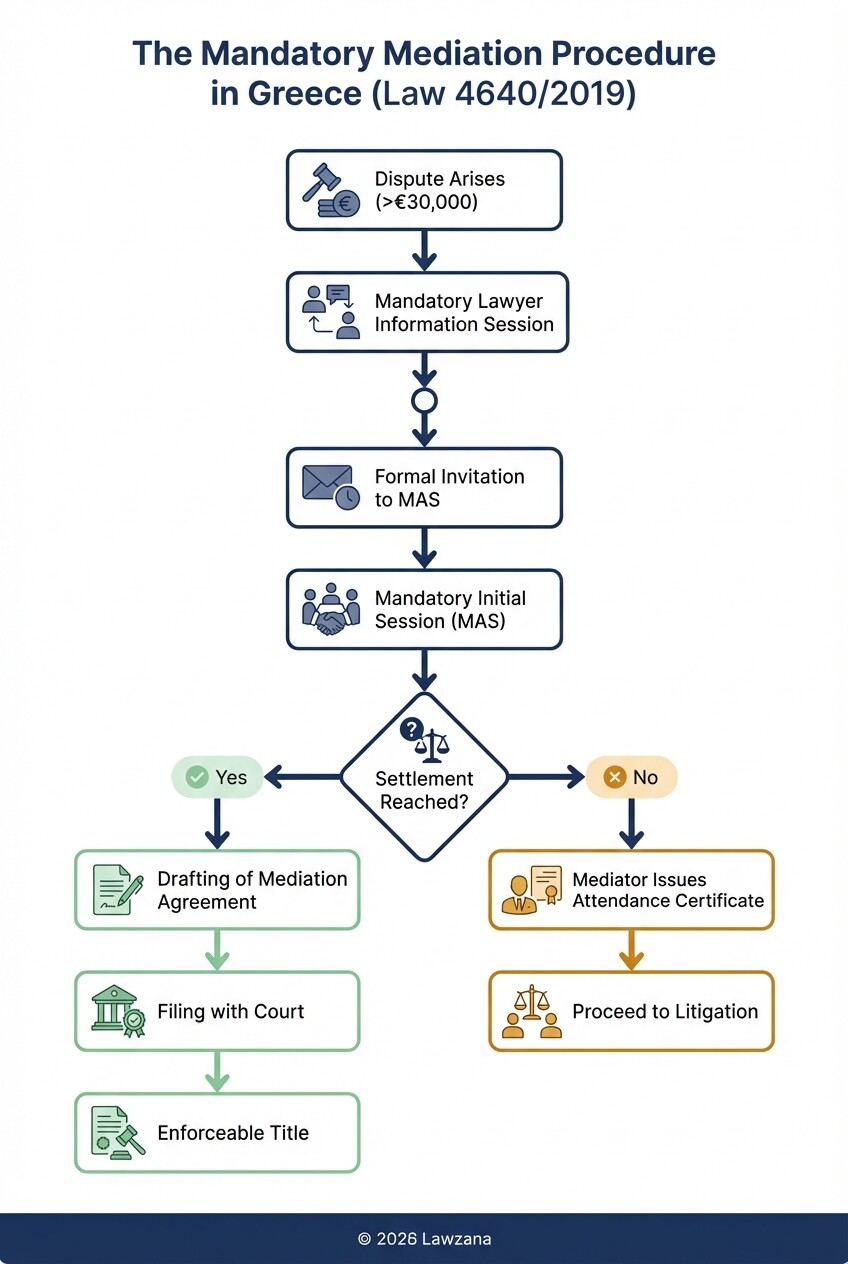
- The Information Requirement: Before filing a lawsuit, a Greek lawyer must inform their client in writing about the possibility of mediation.
- Selection of Mediator: Parties must agree on a mediator from the official Registry of the Ministry of Justice.
- The Invitation: One party sends a formal invitation to the other to attend the MAS.
- The Session: The parties and their legal counsel meet with the mediator to discuss the dispute's potential for settlement.
- The Outcome: If no settlement is reached, the mediator signs the minutes, allowing the court process to move forward.
Mediation vs. Traditional Greek Court Proceedings: A Cost-Benefit Analysis
Mediation in Greece offers a significantly faster and more predictable path to resolution than traditional litigation, which is often hampered by bureaucratic delays and a multi-tiered appeal process. While court fees in Greece (specifically the "megasimo" or court stamp duty) can be substantial-roughly 1% of the claim value plus VAT-mediation costs are largely limited to the mediator's fee and legal representation.
The Greek judicial system is currently ranked among the slowest in the Eurozone for enforcing contracts. By choosing ADR, international firms bypass the risk of "judicial fatigue" and currency fluctuations that may occur during a five-year litigation battle.
| Feature | Traditional Greek Litigation | ADR (Mediation/Arbitration) |
|---|---|---|
| Timeline | 3 to 6 years (including appeals) | 1 to 4 months |
| Publicity | Public record and open hearings | Strictly private and confidential |
| Control | Judge makes the final decision | Parties negotiate their own solution |
| Cost | High (Stamp duties, multiple hearings) | Moderate (Mediator fees, flat legal fees) |
| Enforceability | Requires final judgment | Immediate upon filing the agreement |
Is a Mediation Agreement Enforceable as a Court Judgment?
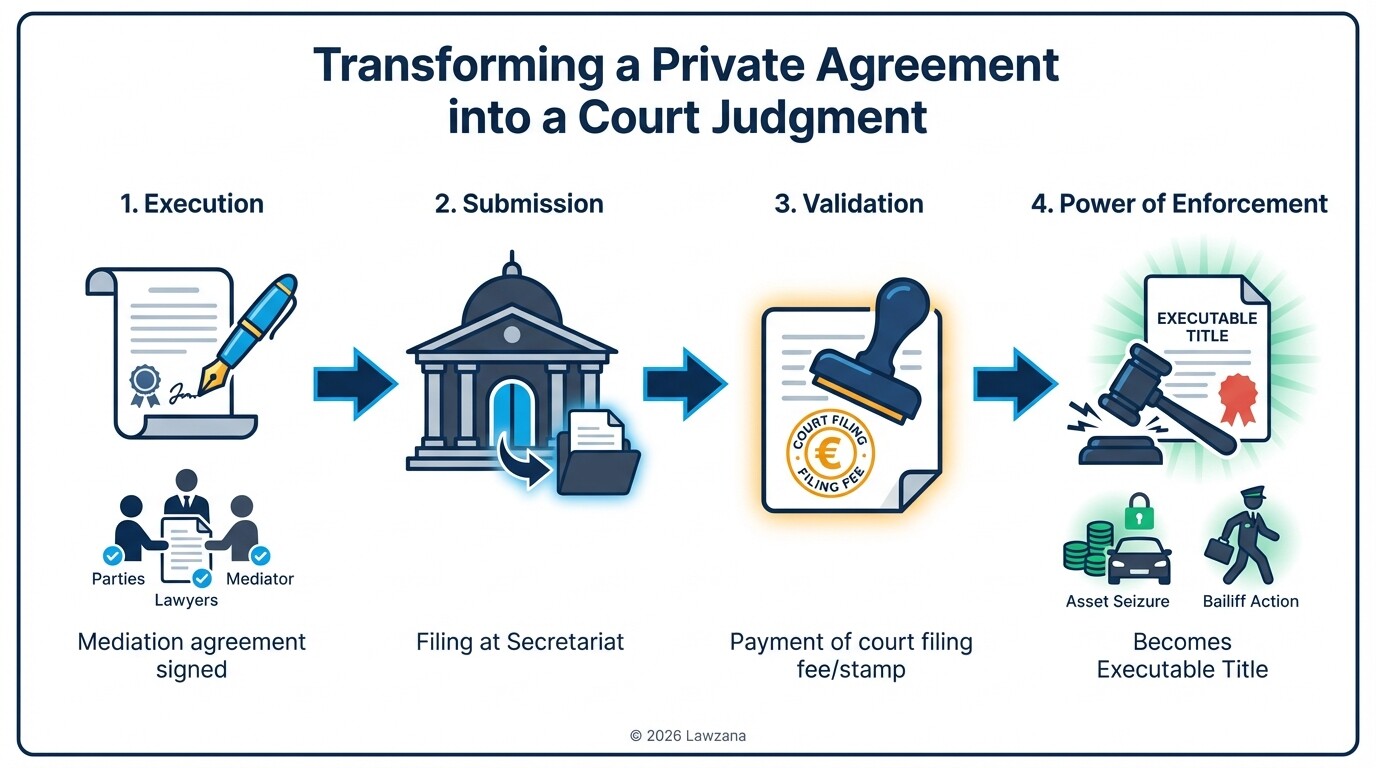
Yes, a mediation agreement in Greece is fully enforceable as an "executable title" once it is filed with the Secretariat of the Court of First Instance in the jurisdiction where the mediation took place. This is one of the most powerful features of the Greek ADR framework, as it grants the agreement the same legal "teeth" as a final court ruling without the need for a trial.
Once the agreement is filed, a small fee is paid, and the document is stamped for enforcement. If one party fails to uphold their end of the bargain-for example, by failing to pay the agreed-upon settlement amount-the other party can immediately initiate seizure of assets or other enforcement measures through a court bailiff.
Requirements for Enforceability
- The agreement must be in writing and signed by all parties, their lawyers, and the mediator.
- It must contain specific obligations (e.g., "Party A shall pay Party B €50,000 by December 1st").
- A request for filing must be submitted to the court by at least one of the parties.
How to Choose a Certified Mediator for Cross-Border Disputes
For international firms operating in Greece, selecting a mediator who understands both the local legal landscape and international commercial standards is critical. The Greek Ministry of Justice maintains a Central Registry of Mediators, which lists professionals who have undergone accredited training and certification.
When dealing with cross-border disputes, you should look for mediators who are not only certified in Greece but also have experience with UNCITRAL standards or are affiliated with international bodies like the International Chamber of Commerce (ICC).
Selection Criteria for International Firms
- Language Proficiency: Ensure the mediator is fluent in English and Greek to prevent nuances from being lost in translation.
- Specialization: Look for a mediator with a background in the specific industry (e.g., maritime, tech, or energy).
- Accreditation: Verify their status on the official Ministry of Justice portal.
- Neutrality: Ensure no prior conflicts of interest with local Greek subsidiaries or partners.
Common Misconceptions About Greek ADR
"Mediation is just an extra, expensive step before I can get to court."
Many litigants view the MAS as a "toll" they must pay. However, statistics from the Hellenic Ministry of Justice suggest that an increasing number of disputes are settled during or immediately after the MAS, saving parties thousands of Euros in subsequent court fees and years of litigation.
"If I agree to mediate, I am showing weakness in my legal position."
In the Greek legal market, participating in mediation is now a legal standard, not a tactical retreat. Because the MAS is mandatory for claims over €30,000, entering the room is seen as a procedural necessity rather than a sign of a weak case.
"The mediator acts like a judge and decides who is right."
A mediator in Greece has no power to impose a decision. Their role is purely facilitative-helping parties identify common ground. If you are looking for a third-party decision-maker outside of court, you should look toward Arbitration (governed by Law 5016/2023 for international cases), where an arbitrator issues a binding "award."
Does the mandatory mediation session apply to international companies?
Yes. If the dispute falls under the jurisdiction of Greek courts (e.g., the contract was performed in Greece or the defendant is based in Athens), the mandatory mediation rules apply regardless of the parties' nationality.
What happens if the other party refuses to attend the Mandatory Initial Session?
If a party is invited but fails to attend the MAS without a valid reason, the court can impose a financial penalty ranging from €100 to €500. More importantly, the court may take this lack of cooperation into account when awarding legal costs at the end of the trial.
How much does a mediator in Greece cost?
For the Mandatory Initial Session (MAS), fees are typically around €50 to €100. If the parties proceed to full mediation, the hourly rate is usually negotiated, often starting at approximately €80 to €150 per hour, split between the parties.
When to Hire a Lawyer
Navigating the Greek ADR landscape requires specialized legal counsel from the very beginning. You must hire a lawyer if:
- You are served with an invitation to a Mandatory Initial Session (MAS).
- You are preparing to file a commercial claim exceeding €30,000 in a Greek court.
- You need to draft a settlement agreement that must be enforceable under Law 4640/2019.
- You are involved in a cross-border dispute where Greek law is the governing law of the contract.
Next Steps
- Review Your Contracts: Check for existing ADR or arbitration clauses that may dictate how and where mediation should occur.
- Consult a Certified Professional: Contact a Greek lawyer to prepare the "Mediation Certificate" required for all new court filings.
- Verify Deadlines: If you are currently in litigation, ensure your "MAS Minutes" are filed within the strict timelines of the Greek Code of Civil Procedure to avoid your case being dismissed.
