- Establish clear milestones and objective Service Level Agreements (SLAs) in your Master Services Agreement to remove ambiguity over vendor performance.
- Protect your proprietary source code with explicit copyright assignments, as India does not recognize an automatic "work for hire" doctrine for independent contractors.
- Mandate pre-litigation mediation in your contracts to resolve disputes quickly while keeping critical development projects on track.
- Ensure your contracts comply with India's new Digital Personal Data Protection (DPDP) Act, 2023 to avoid regulatory penalties when outsourcing data processing.
- Choose institutional arbitration over traditional litigation to resolve unfixable SLA breaches within 12 to 18 months rather than several years.
IT Outsourcing Contract Drafting Checklist for India
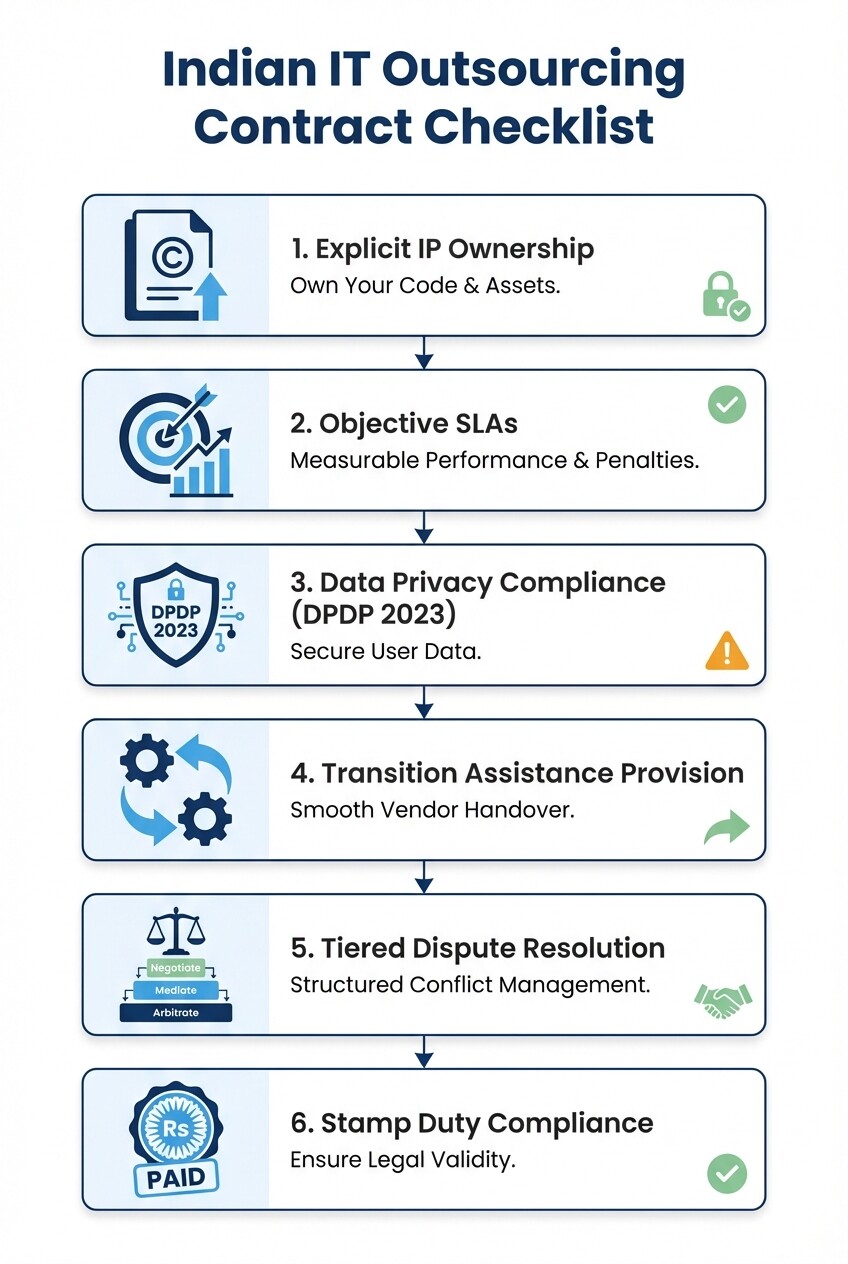
A well-drafted Master Services Agreement (MSA) is your first line of defense against outsourcing disputes in India. Use this checklist to ensure your contract covers critical project milestones, intellectual property (IP) assignments, and local compliance requirements.
- Explicit IP Ownership: Include a distinct clause assigning all copyrights, patents, and moral rights of the developed software to your company. Under Indian law, independent contractors retain IP rights unless transferred via a written agreement.
- Objective SLAs: Define performance standards using measurable metrics like server uptime percentages, bug resolution timeframes, and specific code delivery dates.
- Data Privacy Compliance: Incorporate clauses that strictly adhere to the Digital Personal Data Protection Act, 2023, clearly outlining the vendor's role as a data processor.
- Transition Assistance Provision: Mandate that the vendor must cooperate, transfer data, and hand over source code smoothly if the contract is terminated.
- Dispute Resolution Mechanism: Draft a tiered dispute resolution clause requiring good-faith negotiation, followed by mediation, and ultimately binding arbitration seated in a neutral location or under recognized Indian arbitral institutions.
- Stamp Duty Compliance: Ensure the contract is physically or digitally executed and adequately stamped under the Indian Stamp Act, making it legally admissible as evidence in India.
Common Mistakes When Structuring Vendor Contracts
Foreign companies frequently stumble by using vague performance metrics and standard boilerplate termination clauses that fail to account for Indian commercial realities. Avoiding these errors prevents minor project delays from escalating into full-scale contract disputes.
The most common mistake is relying on subjective language like "commercially reasonable efforts" rather than hard data points. When a vendor's performance slips, subjective language makes it incredibly difficult to prove a breach of contract. Instead, tie payments directly to the completion of specific, verifiable technical milestones.
Another widespread error is drafting inadequate termination clauses. Many foreign companies focus heavily on termination for cause but forget to secure post-termination obligations. If your contract lacks a robust transition assistance clause, a terminated vendor may legally withhold critical infrastructure access, source code, or documentation until the dispute is resolved.
How to Protect Source Code and Trade Secrets in India
Protecting proprietary source code when offshoring requires explicit contractual frameworks, as India does not have a dedicated trade secrets statute. You must rely on a tightly woven combination of confidentiality agreements and copyright assignments governed by the Indian Contract Act.
First, your MSA must contain an explicit IP assignment clause. Section 17 of the Indian Copyright Act dictates that an independent contractor owns the work they create unless a written contract expressly states otherwise. The contract must specifically mention the assignment of source code, object code, and all accompanying documentation.
Second, recognize the limitations of non-compete clauses in India. Under Section 27 of the Indian Contract Act, post-termination non-compete agreements are generally considered void and unenforceable. To protect your trade secrets, you must rely on incredibly specific Non-Disclosure Agreements (NDAs) that survive the termination of the contract indefinitely for trade secrets and secure your data through strict technical access controls.
Using Pre-Litigation Mediation to Preserve Vendor Relationships
Pre-litigation mediation allows foreign clients and Indian vendors to resolve disagreements confidentially without disrupting ongoing project deliverables. It serves as a practical alternative to traditional litigation, which can be notoriously slow in the Indian court system.
In a mediation setting, a neutral third party helps both sides identify the root cause of the SLA failure. Often, tech disputes stem from scope creep or misaligned technical expectations rather than intentional breaches. Mediation fosters a collaborative environment to renegotiate timelines, adjust deliverables, or revise payment structures.
Furthermore, the Commercial Courts Act of 2015 actually mandates pre-institution mediation for commercial disputes in India where no urgent interim relief is sought. Building this step into your contract not only complies with Indian legal procedures but actively saves business relationships that might otherwise be destroyed by aggressive litigation.
Timeline and Financial Impact of Enforcing SLA Breaches via ADR
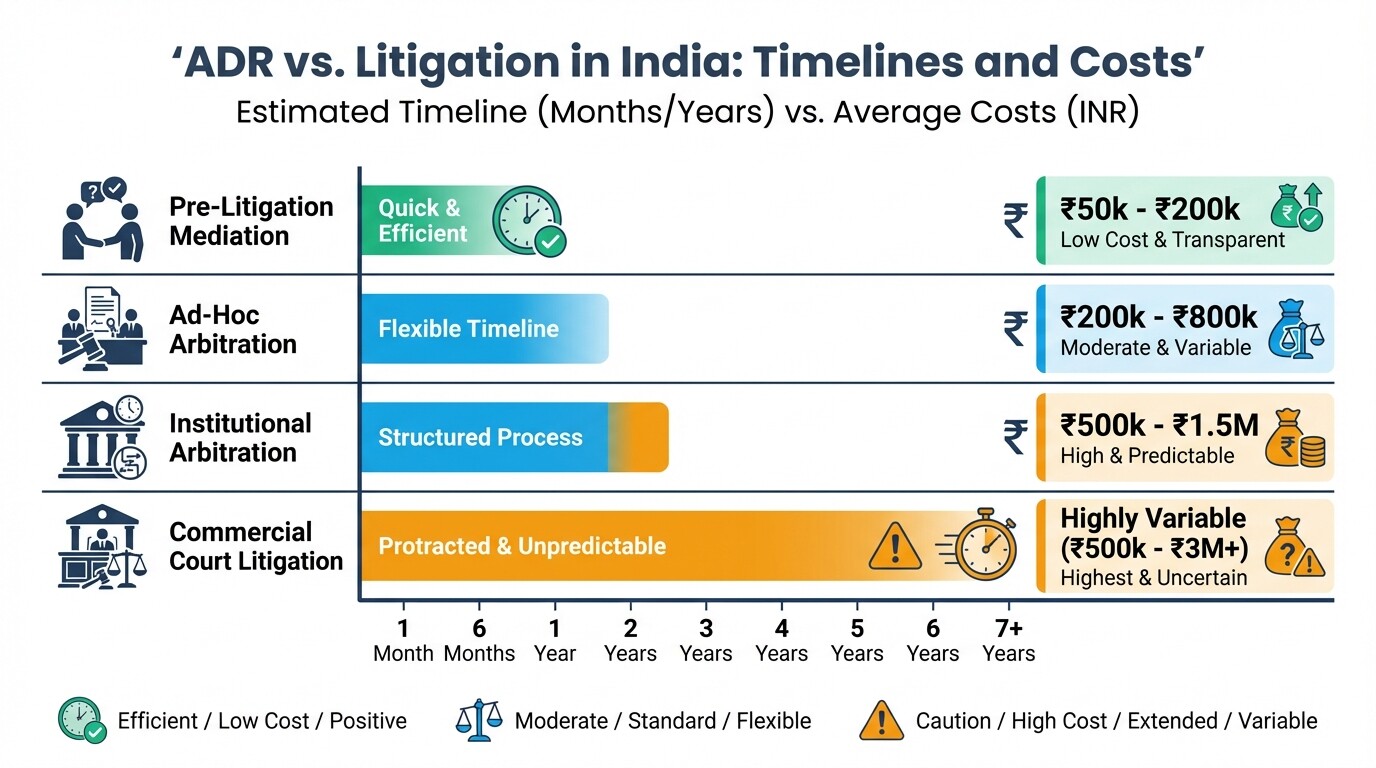
Resolving an SLA breach through Alternative Dispute Resolution (ADR) in India generally takes between 12 and 18 months, offering a much faster route than the civil court system. Costs vary based on the complexity of the tech dispute and the chosen arbitration institution.
Traditional civil litigation in India can take anywhere from three to seven years to reach a conclusion. ADR methods, specifically institutional arbitration, provide a predictable framework. The Arbitration and Conciliation Act mandates that arbitral tribunals in India must pass an award within 12 months, though a six-month extension is permissible under certain conditions.
| Dispute Resolution Method | Estimated Timeline | Average Administrative & Arbitrator Costs (INR) |
|---|---|---|
| Pre-Litigation Mediation | 1 to 3 months | ₹100,000 to ₹300,000 |
| Ad-Hoc Arbitration | 12 to 24 months | ₹500,000 to ₹1,500,000 |
| Institutional Arbitration | 12 to 18 months | ₹800,000 to ₹2,500,000+ |
| Commercial Court Litigation | 3 to 7+ years | Highly Variable |
Note: The costs above reflect typical arbitrator and administrative fees. They do not include legal counsel fees, expert witness costs, or damages sought.
Frequently Asked Questions
Can I enforce a foreign judgment against an Indian tech vendor?
Yes, you can enforce a foreign judgment in India if it comes from a court in a "reciprocating territory" recognized by the Indian government. If the judgment is from a non-reciprocating territory, you must file a fresh civil suit in an Indian court using the foreign judgment as your primary evidence.
Does India have specific data privacy laws impacting outsourced IT work?
Yes. The Digital Personal Data Protection (DPDP) Act, 2023 regulates how personal data is processed in India. Foreign companies outsourcing work must ensure their Indian vendors comply with these obligations, especially regarding data security practices and the processing of personal information.
Are non-compete clauses enforceable against Indian software developers?
During the term of the contract, non-compete clauses are generally valid. However, once the contract or employment terminates, non-compete clauses are typically void and unenforceable under Indian law. You must protect your assets through strong confidentiality and non-solicitation clauses instead.
When to Hire an IT Contracting Lawyer in India
Engaging local legal counsel before signing a Master Services Agreement ensures your IP and data are fully protected under Indian jurisdiction. A lawyer is essential when structuring the initial contract or the moment a vendor repeatedly misses critical deliverables.
Do not wait until a complete project failure to seek legal advice. An attorney can help you issue formal cure notices, negotiate SLA adjustments, and initiate mediation before the relationship breaks down entirely. By consulting dispute prevention and pre-litigation lawyers in India, you can proactively structure your vendor agreements to minimize risk and avoid the courtroom altogether.
Next Steps
To safeguard your current and future tech outsourcing investments, start by auditing your existing Master Services Agreements. Verify that all IP assignment clauses comply specifically with the Indian Copyright Act and that your performance metrics are entirely objective. Finally, update your dispute resolution clauses to require pre-litigation mediation and institutional arbitration, securing a clear roadmap for resolving future conflicts efficiently.