- The Companies Act 2016 provides three primary corporate rescue mechanisms: Corporate Voluntary Arrangement (CVA), Judicial Management (JM), and Schemes of Arrangement.
- A moratorium is a legal "shield" that prevents creditors from initiating or continuing legal proceedings against a company while it attempts to restructure.
- Corporate Voluntary Arrangements are generally restricted to private companies that do not have charged assets, making them a fast-track option for smaller firms.
- Judicial Management is a court-supervised process where an independent Judicial Manager takes over control from the board of directors to save the business.
- For large-scale debts involving multiple financial institutions, the Corporate Debt Restructuring Committee (CDRC) offers a mediated platform to avoid formal insolvency.
Corporate Debt Restructuring Comparison Table
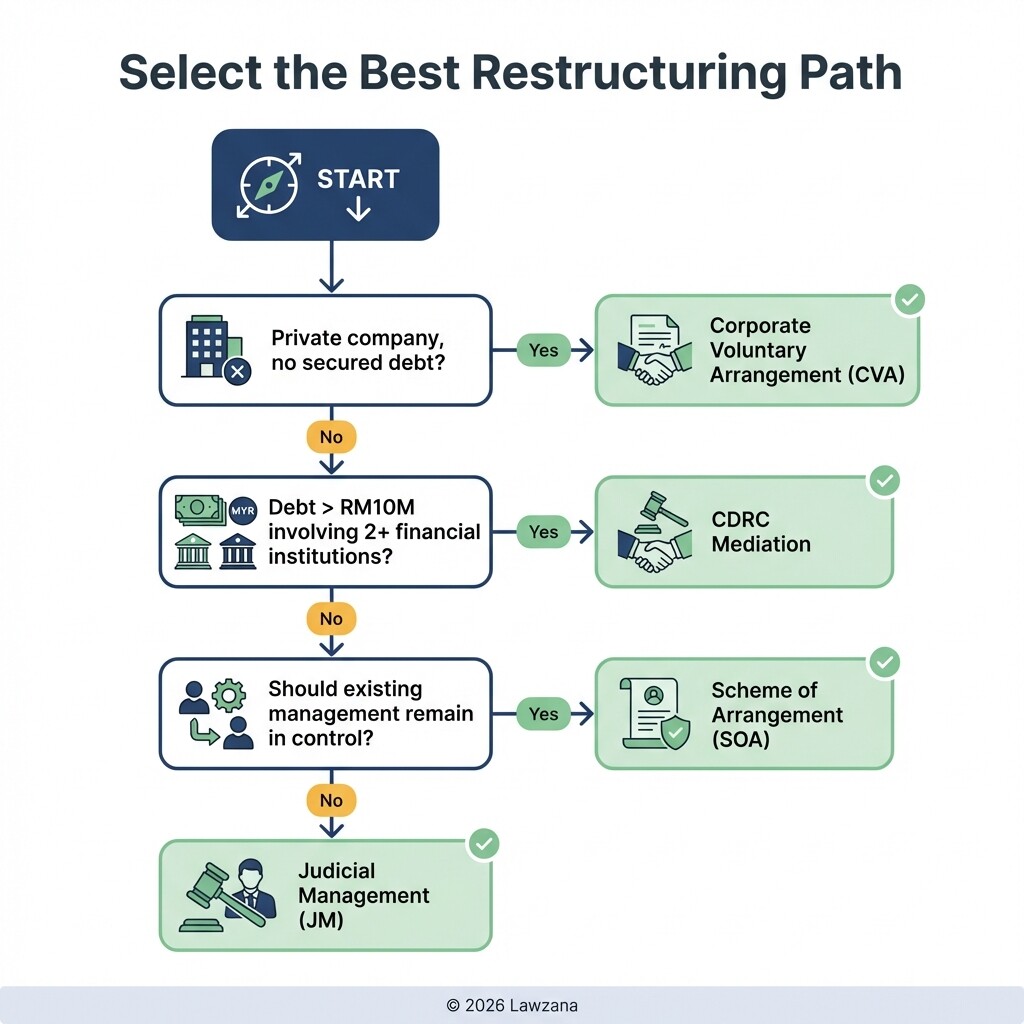
Choosing the right restructuring path depends on the company's size, the nature of its debt, and the level of creditor cooperation. The following table compares the three primary statutory frameworks under the Malaysian Companies Act 2016.
| Feature | Corporate Voluntary Arrangement (CVA) | Judicial Management (JM) | Scheme of Arrangement (SOA) |
|---|---|---|---|
| Court Involvement | Minimal (Out-of-court filing) | High (Court Order required) | Moderate to High |
| Moratorium | Automatic and immediate | Automatic upon application | Not automatic (requires court order) |
| Management Control | Existing Directors remain | Judicial Manager takes control | Existing Directors remain |
| Approval Threshold | 75% in value of creditors | 75% in value of creditors | 75% in value and majority in number |
| Duration | 28 days (extendable to 60) | 6 months (extendable by 6) | No fixed statutory limit |
| Best For | Private firms with no secured debt | Companies with complex debt/secured assets | Large groups or complex reorganizations |
Criteria for Applying for a Judicial Management Order
A Judicial Management Order (JMO) is a court-sanctioned rescue mechanism where an insolvency practitioner is appointed to manage a company's affairs. It is designed to provide a "breathing space" for companies that are insolvent but have a viable chance of survival or can provide a better return to creditors than a liquidation.
To qualify for a JMO under the Companies Act 2016, a company or its creditors must demonstrate two primary conditions to the High Court. First, the company must be, or is likely to become, unable to pay its debts. Second, the court must be satisfied that the order is likely to achieve one of three objectives: the survival of the company as a going concern, a more advantageous realization of assets than a winding-up, or the approval of a formal compromise with creditors.
Eligibility and Restrictions
Not all companies can apply for Judicial Management. The following restrictions apply:
- Exclusions: Licensed financial institutions, insurance companies, and companies subject to the Capital Markets and Services Act 2007 are generally excluded.
- Secured Creditors: If a receiver and manager has already been appointed by a debenture holder, the court will typically dismiss a JMO application unless public interest dictates otherwise.
- Solvency Status: The company must be genuinely distressed; the court will scrutinize the "likelihood" of insolvency based on cash flow and balance sheet tests.
The Role of Corporate Voluntary Arrangements (CVA) for Private Firms
A Corporate Voluntary Arrangement is a debt restructuring tool that allows a company to reach a compromise with its creditors with minimal court intervention. It is intended to be a swift, cost-effective alternative to more complex judicial proceedings, focusing on speed and business continuity.
The CVA process is led by a Nominee, who must be a licensed insolvency practitioner. The Nominee evaluates the restructuring proposal and reports to the court whether it has a reasonable prospect of being approved and implemented. Because the directors remain in control during a CVA, it is often preferred by small to medium enterprises (SMEs) that want to maintain operational stability while negotiating debt repayments.
Procedural Requirements for CVA
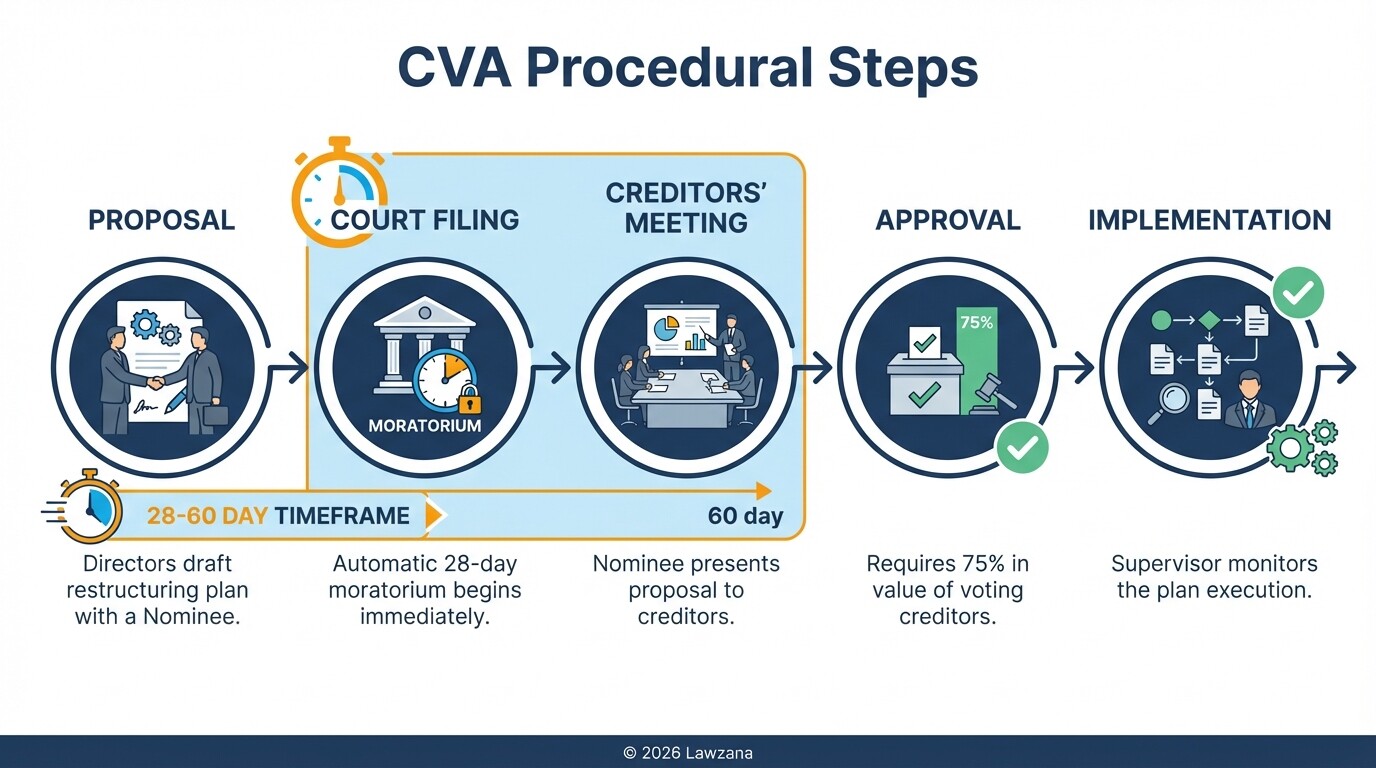
The effectiveness of a CVA depends on a strict procedural timeline:
- The Proposal: Directors submit a restructuring proposal to the Nominee.
- The Filing: The Nominee files the proposal and necessary documents with the court to trigger an automatic 28-day moratorium.
- Creditors' Meeting: A meeting is held where creditors vote on the proposal.
- Approval: The plan requires approval from 75% of the total value of creditors present and voting.
- Implementation: Once approved, the Nominee becomes the Supervisor and oversees the execution of the plan.
Moratorium Protections Against Legal Proceedings
A moratorium is a legal stay that prevents creditors from taking enforcement actions, such as seizing assets or filing winding-up petitions. This protection is vital because it stops the "race to the courthouse," ensuring that assets are preserved while a restructuring plan is finalized.
Under Judicial Management, an automatic moratorium begins as soon as the application is filed in court and continues if the order is granted. In a CVA, the moratorium is also automatic upon the filing of documents with the court. During this period, no resolution for winding up can be passed, and no legal proceedings or execution of judgments can be commenced or continued against the company without the court's permission.
Scope of the Moratorium
- Foreclosure: Secured creditors cannot exercise their rights to take possession of charged property without court leave.
- Leasing and Hire Purchase: Owners of property used by the company (under hire-purchase or leasing agreements) cannot recover their property during the moratorium.
- Ongoing Litigation: All civil suits against the company are stayed, allowing the management to focus entirely on the turnaround.
Involvement of the Corporate Debt Restructuring Committee (CDRC)
The Corporate Debt Restructuring Committee (CDRC) is a specialized platform established by Bank Negara Malaysia to facilitate out-of-court debt settlements. It serves as a mediator between distressed corporate debtors and their financial creditors, primarily banks.
The CDRC is not a court; rather, it is a voluntary forum. It is particularly effective for large Malaysian corporations with debts exceeding RM10 million and involving at least two financial institutions. When a company is accepted into the CDRC program, a standstill agreement is typically signed by all participating creditors, preventing them from taking legal action while negotiations are underway.
Why Choose CDRC?
- Cost Savings: It avoids the high legal costs and public nature of court-based insolvency.
- Expert Mediation: The committee consists of professionals with banking and legal expertise who help draft a Debt Restructuring Scheme (DRS).
- Consensus Building: The process encourages a collaborative environment where banks work together to maximize the recovery of their loans rather than competing for assets.
- Access: More information on eligibility can be found at the Bank Negara Malaysia website.
Timelines for Proposing and Approving a Restructuring Plan
Timelines in Malaysian restructuring law are designed to prevent companies from languishing in a state of "zombie" insolvency. Each mechanism has specific statutory deadlines that must be met to maintain the legal protections of the moratorium.
For Judicial Management, the initial order lasts for six months. A Judicial Manager can apply for an extension of another six months, but the total duration is generally capped at one year. Within 60 days of their appointment, the Judicial Manager must send a statement of proposals to the creditors and summon a meeting to vote on those proposals.
CVA and SOA Timelines
- CVA Moratorium: Lasts for an initial 28 days. It can be extended to 60 days if more than 50% of creditors agree.
- CVA Meeting: Must occur within the 28-day moratorium window.
- Scheme of Arrangement (SOA): While there is no rigid statutory timeline for the entire process, the court-ordered moratorium (Restraining Order) is typically granted for 90 days and can be extended if certain conditions-such as the appointment of a director nominated by creditors-are met.
Common Misconceptions
"Insolvency means the company is going out of business."
Restructuring is specifically designed to prevent a company from closing. Mechanisms like Judicial Management and CVA are "rescue" tools. If successful, the company emerges leaner and more financially stable, continuing its operations and preserving jobs.
"Directors lose all power the moment a restructuring starts."
This is only true for Judicial Management. In a Corporate Voluntary Arrangement (CVA) or a Scheme of Arrangement (SOA), the existing board of directors usually remains in control of daily operations. They work alongside a Nominee or Supervisor to implement the debt plan.
"Restructuring is only for large corporations."
While the CDRC is aimed at large-scale debt, the CVA was introduced in the 2016 Act specifically to help smaller private companies. It provides an affordable and relatively simple way for SMEs to settle debts without the complexity of a High Court trial.
FAQ
Can a secured creditor block a Judicial Management application?
Yes. A secured creditor who has the right to appoint a Receiver and Manager can generally veto a Judicial Management application unless the court finds that the public interest requires the order to be made.
What is the voting threshold for a restructuring plan to pass?
For CVA, JM, and SOA, the threshold is 75% in value of the creditors who are present and voting. In an SOA, there is an additional requirement for a "majority in number" of the creditors.
How much does it cost to initiate a CVA in Malaysia?
Costs vary based on the complexity of the debt and the fees of the licensed insolvency practitioner (Nominee). However, filing fees with the Companies Commission of Malaysia (SSM) are relatively low compared to the legal fees of a full court-supervised Judicial Management.
Does a moratorium protect the company from criminal proceedings?
No. A moratorium under the Companies Act 2016 generally only stays "proceedings" and "execution," which the courts have interpreted to mean civil and commercial legal actions. It does not provide immunity from criminal investigations or prosecutions.
When to Hire a Lawyer
Restructuring and insolvency laws in Malaysia are procedurally intense. You should consult a legal professional if:
- Your company is unable to meet its monthly debt obligations and faces the threat of a winding-up petition.
- You need to apply for a Restraining Order to stop creditors from seizing essential business assets.
- You are a creditor who believes a proposed restructuring plan unfairly prejudices your interests.
- You need to navigate the transition of power between a Board of Directors and a Judicial Manager.
Next Steps
- Conduct a Solvency Test: Review your company's cash flow and balance sheet to determine if you meet the "unable to pay debts" criteria under the Companies Act 2016.
- Consult an Insolvency Practitioner: Identify a licensed practitioner who can act as a Nominee (for CVA) or a Judicial Manager.
- Engage with Creditors: Start informal discussions with your primary lenders to gauge their willingness to support an out-of-court restructuring or a CDRC mediation.
- Prepare a Proposal: Draft a clear plan outlining how the business will return to profitability and how creditors will be repaid over time.