Labuan Offshore Company Setup: 2026 Compliance in Malaysia
Key Takeaways
The Labuan International Business and Financial Centre (IBFC) offers foreign investors a tax-efficient, well-regulated mid-shore jurisdiction in Malaysia. Structuring a business in Labuan requires strict adherence to international compliance frameworks, particularly regarding local economic substance.
- Labuan trading companies pay a 3% corporate tax on audited net profits, while pure holding (non-trading) companies enjoy a 0% tax rate.
- Preferential tax rates are strictly contingent on meeting economic substance requirements, including minimum local headcounts and operational expenditures in Labuan.
- Intellectual Property (IP) income is excluded from the 3% rate and is subject to Malaysia's standard 24% corporate tax rate to comply with OECD anti-avoidance rules.
- Complete incorporation and corporate bank account setup typically requires four to eight weeks due to rigorous compliance checks.
- Engaging a licensed Labuan Trust Company is a mandatory statutory requirement for incorporation and ongoing compliance.
Labuan Company Setup Checklist
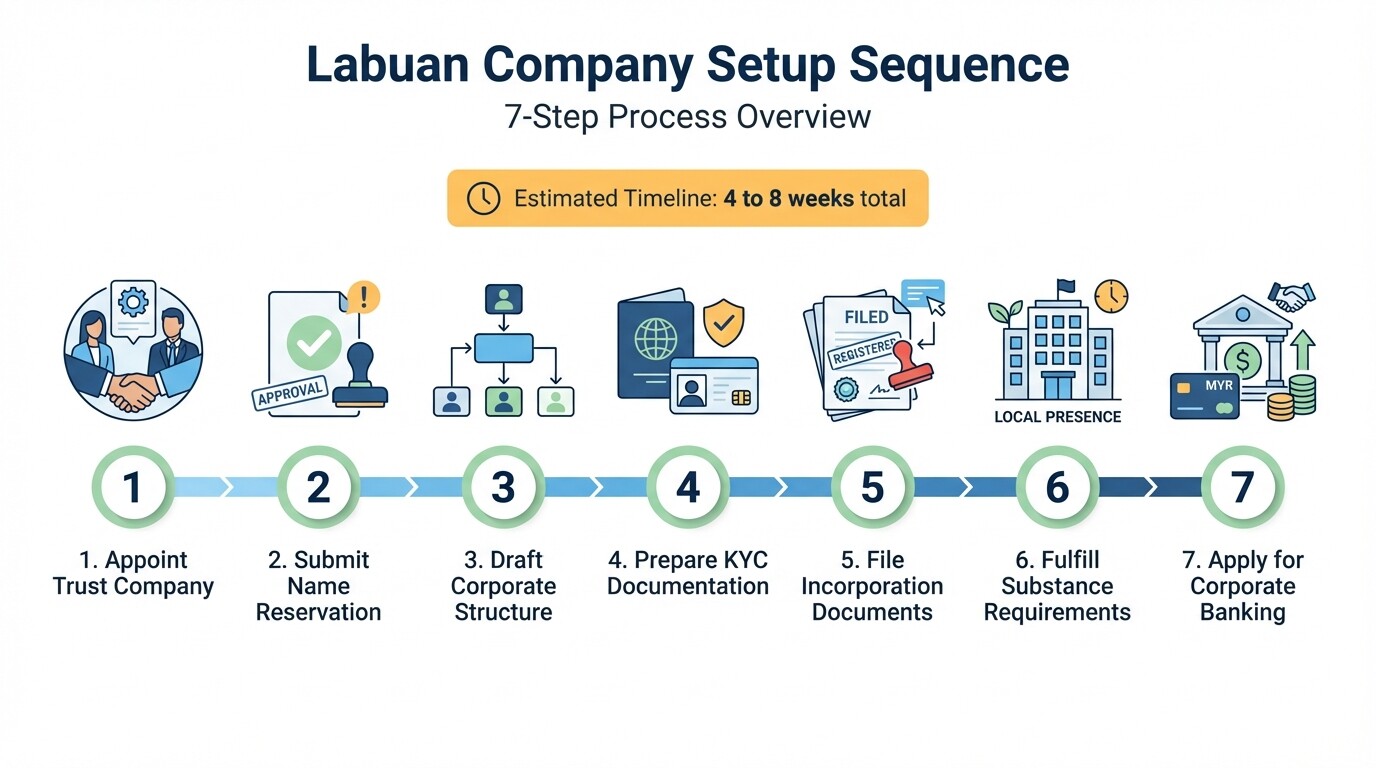
Establishing a Labuan entity requires coordinating with regulatory bodies, trust companies, and financial institutions. Completing these steps in the correct order prevents application rejections and compliance delays.
- Appoint a Labuan Trust Company: You must legally engage a licensed trust company in Labuan to act as your incorporation agent and provide your registered office address.
- Submit Name Reservation: Provide three proposed company names to the Labuan Financial Services Authority (Labuan FSA) for clearance and reservation.
- Draft the Corporate Structure: Define your company type (trading vs. non-trading) and structure your directors and shareholders. Labuan permits 100% foreign ownership with a minimum of one director and one shareholder, who can be the same person.
- Prepare KYC Documentation: Gather certified true copies of passports, proof of residential address, bank reference letters, and professional reference letters for all directors and ultimate beneficial owners (UBOs).
- File Incorporation Documents: Your trust company will submit the Memorandum and Articles of Association, consent letters from directors, and statutory declarations to the Labuan FSA.
- Fulfill Substance Requirements: Lease physical office space in Labuan, establish commercial operations, and hire the required number of local full-time employees based on your specific business activity.
- Apply for Corporate Banking: Submit your incorporation certificates, business plan, and KYC documents to a Labuan or Malaysian bank to open multi-currency accounts.
Understanding the 3% Tax Rate for Trading Activities
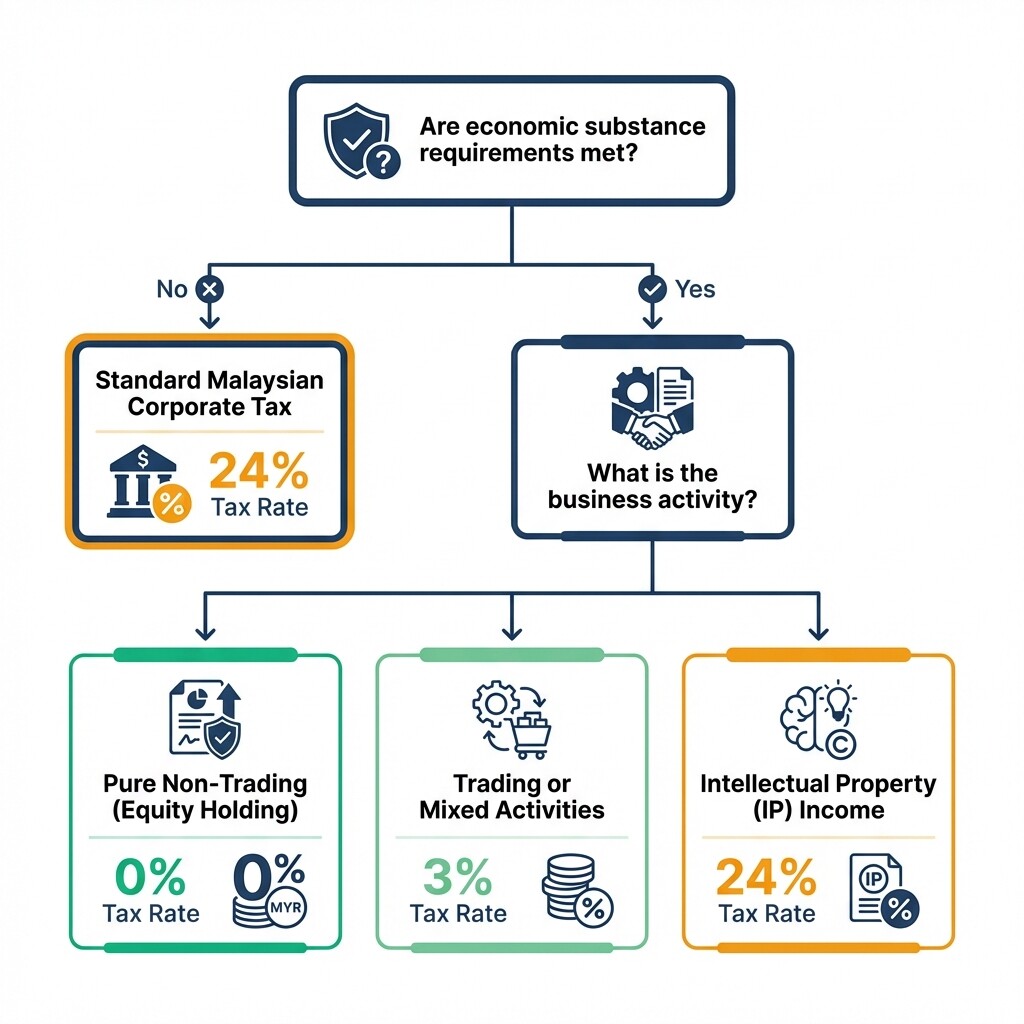
Labuan trading companies benefit from a 3% corporate tax rate on audited net profits under the Labuan Business Activity Tax Act 1990. Non-trading companies, such as pure equity holding entities, are subject to a 0% tax rate.
To determine your tax liability, the Labuan FSA categorizes business activities into trading and non-trading sectors. Trading activities encompass active commercial operations like management services, trading, shipping, and banking. Non-trading activities are strictly passive, primarily involving the holding of investments in securities, stocks, shares, loans, or real estate.
If a Labuan company engages in both trading and non-trading activities, its entire income is deemed to be from trading activities and is taxed at the 3% rate. To secure these rates, companies must file an annual statutory audit and prove they meet all economic substance requirements. Failing to meet these requirements results in the company being taxed at the standard Malaysian corporate tax rate of 24% under the Income Tax Act 1967.
2026 Substance Requirements: Office and Headcount Rules
To qualify for Labuan's preferential tax rates, companies must maintain physical economic substance within the jurisdiction. This means operating a local office, hiring full-time employees, and meeting minimum annual operating expenditures in Labuan.
The exact substance requirements vary depending on the specific type of Labuan entity. For a standard Labuan trading or holding company, the regulations strictly enforce the following baseline rules to prevent "shell company" tax avoidance:
- Minimum Headcount: Standard trading companies must employ at least two full-time employees in Labuan. Pure holding companies may require fewer, but must actively manage their investments from the jurisdiction.
- Operating Expenditure (OPEX): A standard Labuan trading company must incur a minimum annual operating expenditure of RM 50,000 (approximately $10,600 USD) within Labuan. Pure holding companies generally face a lower threshold of RM 20,000 (approximately $4,250 USD).
- Control and Management: The company's strategic decisions must be made in Labuan, typically evidenced by holding regular board of directors meetings within the territory.
Timeline for Incorporation and Bank Account Opening
Setting up a Labuan offshore company and opening a corporate bank account typically takes between four to eight weeks. While the initial incorporation is fast, modern banking compliance requires extensive due diligence.
The incorporation phase with the Labuan Financial Services Authority generally takes one to two weeks once all Know Your Customer (KYC) documents are compiled and certified. The primary delay in the setup timeline occurs during the corporate bank account opening. Labuan and Malaysian banks operate under strict anti-money laundering (AML) protocols and will scrutinize the business model, the source of funds, and the background of the beneficial owners. This banking approval process takes an additional three to six weeks.
Annual Licensing Fees and Maintenance Costs
Maintaining a Labuan entity requires annual payments for government licensing, secretarial services, and regulatory audits. Total annual maintenance costs typically range from $3,000 to $6,000 USD (approximately RM 14,000 to RM 28,000).
Predicting your annual compliance budget ensures your offshore structure remains cost-effective. Below is an estimated breakdown of the core recurring costs for a standard Labuan trading company.
| Maintenance Requirement | Estimated Annual Cost (USD) | Estimated Annual Cost (RM) |
|---|---|---|
| Labuan FSA Annual License Fee | $800 - $1,500 | RM 3,700 - RM 7,000 |
| Trust Company / Secretarial Fees | $1,000 - $2,000 | RM 4,700 - RM 9,400 |
| Registered Office Address | $300 - $600 | RM 1,400 - RM 2,800 |
| Statutory Financial Audit | $1,000 - $2,500 | RM 4,700 - RM 11,700 |
| Tax Agent Filing Fees | $300 - $800 | RM 1,400 - RM 3,700 |
Note: These estimates exclude the mandatory local operating expenditures (OPEX) and employee salaries required to meet economic substance rules.
Using Labuan Entities for Cross-Border IP and Licensing
Labuan entities are highly effective for managing international investments, but companies must navigate international anti-avoidance rules when dealing with intellectual property. Income derived directly from IP rights is subject to Malaysia's standard corporate tax rate rather than the preferential Labuan rate.
To align with the OECD's Base Erosion and Profit Shifting (BEPS) Action 5 framework, Labuan changed how it taxes royalties and licensing income. Any revenue generated from intellectual property-such as patents, trademarks, or copyrights held by the Labuan company-falls under the Malaysian Income Tax Act 1967 and is taxed at 24%. While Labuan remains an excellent jurisdiction for regional headquarters, treasury centers, and cross-border trade, businesses seeking pure IP holding structures must factor this standard tax rate into their global tax strategy.
Common Misconceptions About Labuan IBFC
Many foreign investors mistakenly view Labuan as a traditional, unregulated tax haven. In reality, it is a highly regulated mid-shore jurisdiction fully compliant with international tax transparency standards.
- Misconception: You do not need a physical presence. Many believe they can set up a paper company and instantly receive a 3% tax rate. In truth, failure to secure physical office space and hire local employees automatically subjects the company to the standard 24% Malaysian tax rate.
- Misconception: Labuan companies operate completely outside Malaysia. While Labuan is an offshore financial center, Labuan companies can conduct business with Malaysian residents and utilize the Malaysian Ringgit (RM). However, doing so requires specific regulatory notifications and may trigger different tax treatments.
- Misconception: Banking is guaranteed after incorporation. Securing a company registration number does not obligate any bank to accept the business. Banks independently verify commercial viability and substance before opening multi-currency accounts.
Frequently Asked Questions
Can a foreigner own 100% of a Labuan company?
Yes, Labuan allows 100% foreign ownership. There is no requirement to have a local Malaysian partner or a resident director to incorporate the company, though local employees must be hired to meet substance requirements.
Do Labuan companies require paid-up capital?
The minimum paid-up capital for a standard Labuan company is generally just $1 USD. However, companies applying for specific financial licenses (like fund management or insurance) face significantly higher statutory capital requirements.
What currencies can a Labuan company trade in?
Labuan companies are designed for international trade and generally transact in foreign currencies like USD, EUR, or SGD. Transactions in Malaysian Ringgit (RM) are permitted but must comply with specific central bank guidelines.
Is an annual audit mandatory for Labuan entities?
Yes, trading companies must submit audited financial statements to the Labuan FSA annually to claim the 3% tax rate. Pure holding companies claiming the 0% tax rate do not require an audit but must file a statutory declaration.
When to Hire a Lawyer and Next Steps
You should engage corporate legal counsel when designing your cross-border tax structure, specifically before finalizing your business activities or transferring assets to the new entity. A lawyer ensures your corporate structure correctly maps to Labuan's substance requirements and complies with international BEPS regulations.
To move forward, outline your commercial objectives and determine whether your primary operations will classify as trading or non-trading activities. Next, identify a licensed Labuan Trust Company to initiate the name reservation and regulatory clearance process. If you require legal guidance on structuring your offshore holding or commercial operations, consult experienced business registration lawyers in Malaysia to ensure complete regulatory compliance.