

Wasiat vs. Standard Wills in Malaysia: Probate Costs and Estate Planning Mistakes for Expats
- Malaysia uses a dual legal system for inheritance, applying Syariah law (Wasiat) for Muslims and civil law (Standard Wills) for non-Muslims.
- Dying without a valid Will in Malaysia freezes your assets and requires a lengthy Letters of Administration process that can take over a year.
- Executor fees in Malaysia are legally capped at a maximum of 5% of the total estate value.
- Expats must draft concurrent Wills to cover Malaysian assets without accidentally revoking their existing estate documents in their home country.
- Joint bank accounts in Malaysia are typically frozen upon the death of one account holder, severely impacting a surviving spouse's immediate cash flow.
The Legal Distinction Between Wasiat and Standard Wills
Malaysia operates a dual legal system where your religious status legally dictates how your estate is distributed. Non-Muslims are governed by the civil legal system under the Wills Act 1959, while Muslims are governed by Islamic Syariah law, which mandates specific inheritance fractions known as Faraid.
For non-Muslim expats, a Standard Will provides complete testamentary freedom. You can distribute your Malaysian assets to anyone you choose, in whatever proportions you prefer, provided the Will is properly executed and witnessed by two independent parties. The civil courts handle the probate process for these estates.
For Muslim expats, estate planning requires a Wasiat (Islamic Will). Under Syariah law, a Muslim can only bequeath a maximum of one-third of their estate to individuals who are not legal heirs under Faraid. The remaining two-thirds must be distributed according to strict Faraid formulas to legitimate Islamic heirs. If a Muslim wishes to leave more than one-third to a non-Faraid beneficiary, all legal Faraid heirs must explicitly consent to this distribution after the testator's death.
Probate and Estate Planning Cost Breakdown in Malaysia
Estate administration in Malaysia involves drafting fees, court filing fees, and executor commissions that vary based on the complexity and value of your assets. Planning ahead allows expats to understand these costs and prevent family members from facing unexpected financial burdens during the probate process.
The total cost of settling an estate depends heavily on whether you die with a Will (testate) or without one (intestate).
Common Estate Planning Mistakes Expats Make in Malaysia
Foreign residents frequently mishandle Malaysian inheritance planning by assuming local laws mirror those of their home country. This oversight leads to frozen assets, blocked property transfers, and severe financial distress for surviving family members.
Avoid these critical expatriate estate planning mistakes:
- Relying on Joint Bank Accounts: Many expats assume a joint bank account automatically transfers to the surviving spouse. In Malaysia, banks typically freeze joint accounts the moment they are notified of a death until a Grant of Probate is issued.
- Ignoring Property Consent Rules: Transferring Malaysian real estate to a foreign beneficiary requires state authority consent. Failing to account for these foreign ownership thresholds and consent fees in your estate plan can force a distressed property sale.
- Appointing Only Foreign Executors: Naming an executor who lives outside of Malaysia drastically slows down the probate process. Foreign executors face logistical hurdles with local banks, court appearances, and signing physical documents at the Malaysian Judiciary offices.
- Overlooking Minor Beneficiaries: If you leave assets to children under 18 without establishing a testamentary trust, Malaysian courts will hold the assets. You must explicitly appoint guardians and trustees within your local Will.
Timelines: Grant of Probate vs. Letters of Administration
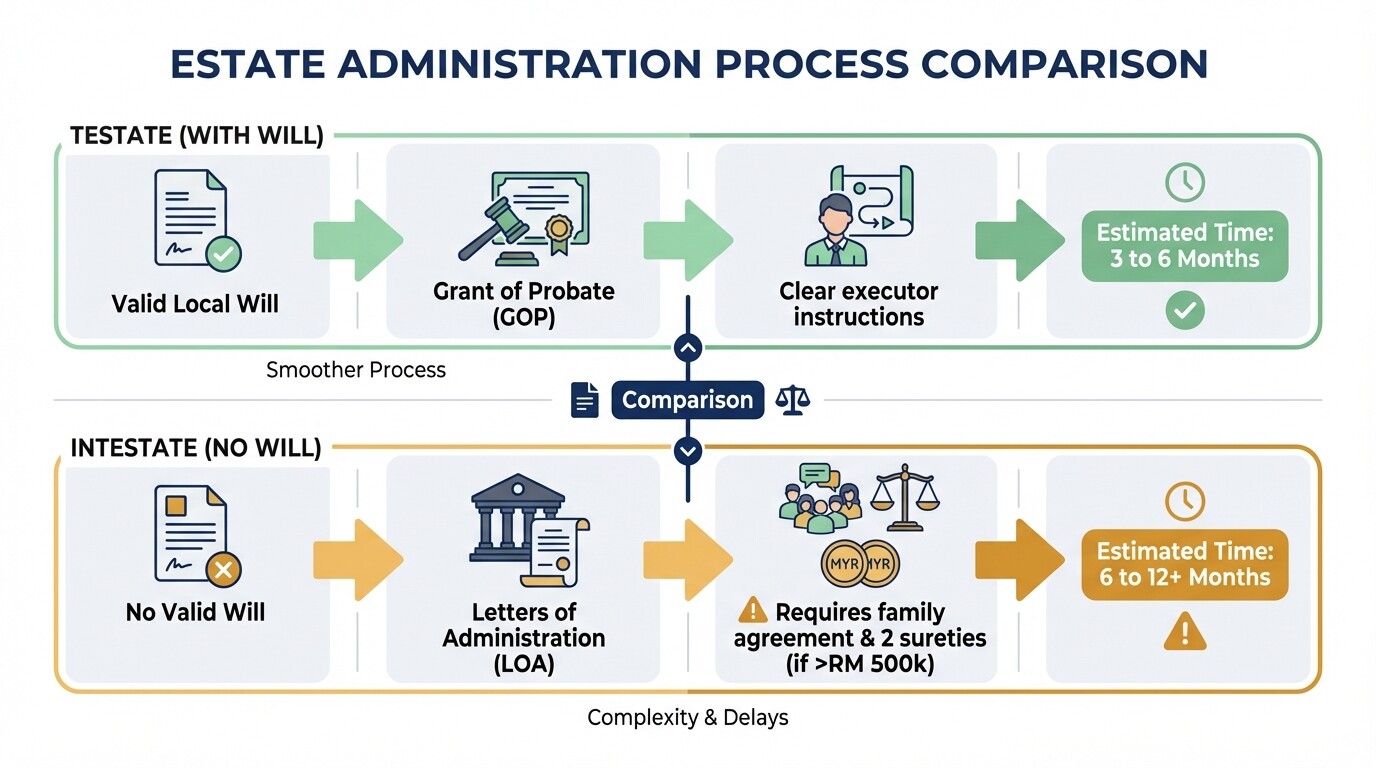
Securing a Grant of Probate for an estate with a valid Will takes significantly less time than obtaining Letters of Administration for an intestate estate. Proper planning ensures your family accesses their inheritance in months rather than years.
A Grant of Probate (GOP) applies when you leave a valid Will. Because the executor is already named and your wishes are clear, the High Court process is streamlined. For a standard expat estate with a well-drafted Will, extracting the GOP typically takes 3 to 6 months.
Letters of Administration (LOA) apply when you die without a Will. This process is complex because the family must agree on an administrator, and the estate is distributed strictly according to the Distribution Act 1958. Furthermore, if the estate value exceeds RM 500,000, the court requires two sureties (guarantors) to back the estate's value, which is nearly impossible for most expat families to secure. Obtaining an LOA generally takes 6 to 12 months, and often much longer for foreigners.
Synchronizing a Malaysian Will with Home Country Documents
Creating a Malaysian Will requires precise drafting to isolate your local assets and prevent the accidental revocation of your home country's estate documents. A poorly worded revocation clause in a new Will can inadvertently cancel all your previous global estate planning.
The most effective strategy for expats is utilizing "Concurrent Wills." This involves having one Will governing your assets in your home country and a separate, distinct Will governing only your assets in Malaysia.
To execute this properly:
- Ensure your Malaysian Will explicitly states that it applies exclusively to assets located within Malaysia.
- Modify the standard revocation clause in the Malaysian Will so it only revokes previous Wills concerning Malaysian assets.
- Notify your estate planning attorney in your home country about the Malaysian Will to ensure future updates do not accidentally override it.
Common Misconceptions About Malaysian Estate Planning
People often believe that an international Will drafted in their home country will seamlessly cover their assets in Malaysia. While a foreign Will can technically be resealed in a Malaysian court, the translation, verification, and cross-border legal processes are highly expensive and take months longer than executing a local Will.
Another widespread myth is that your debts die with you. In Malaysia, all outstanding liabilities, including local mortgages, credit cards, and personal loans, must be settled from your estate before any remaining assets are distributed to your beneficiaries.
Frequently Asked Questions
Can an expat draft a Wasiat if they are Muslim?
Yes. Any practicing Muslim residing or holding assets in Malaysia, regardless of nationality, must follow Syariah principles for their estate. A Wasiat allows you to dictate the distribution of up to one-third of your assets, while the remainder follows Faraid law.
Who should I appoint as an executor for my Malaysian Will?
You should appoint a trusted individual residing in Malaysia or a professional Malaysian trust corporation. Local executors can easily visit banks, government offices, and courts, which prevents severe delays in estate administration.
Does Malaysia have an inheritance tax?
No. Malaysia abolished its estate duty in 1991. Beneficiaries do not pay inheritance tax on the assets they receive, though standard stamp duties and legal fees still apply when transferring real estate.
What happens to my Malaysian property if I die without a Will?
If you die without a Will, your Malaysian property is frozen and eventually distributed according to the formulas in the Distribution Act 1958. This usually means a specific split between your surviving spouse, children, and surviving parents, which may not align with your wishes.
When to Hire an Estate Planning Lawyer
You need a legal professional when you own real estate in Malaysia, hold substantial local bank balances, or have a complex international family structure. Consulting experienced dispute prevention lawyers in Malaysia ensures your concurrent Wills do not conflict and that your asset distribution complies with either the Wills Act 1959 or Syariah requirements. A lawyer will also act as a crucial buffer, ensuring the Will is drafted unambiguously to prevent future litigation among your heirs.
Next Steps
Begin by listing all your current assets and liabilities located within Malaysia, including property deeds, bank account numbers, and vehicle registrations. Locate your existing home-country Will and provide a copy to a qualified Malaysian legal professional so they can draft a localized, concurrent Will. Finally, inform your designated local executor where your original Malaysian Will is securely stored so they can act immediately when necessary.