Nigeria Data Protection Act FAQ: Compliance for Multinational Tech Firms
- The Nigeria Data Protection Act (NDPA) 2023 applies to any multinational tech firm processing the personal data of individuals residing in Nigeria, regardless of the company's physical location.
- Cross-border data transfers are strictly regulated and require established legal bases, such as Standard Contractual Clauses (SCCs) or an adequacy decision.
- Multinational companies processing significant volumes of Nigerian user data must formally appoint a Data Protection Officer (DPO).
- Non-compliance can result in severe regulatory fines of up to ₦10,000,000 or 2% of the company's annual gross revenue, whichever is greater.
- Annual compliance audits must be conducted and filed through a locally licensed Data Protection Compliance Organization (DPCO).
Core Regulatory Obligations Under the NDPA for Foreign Entities
Multinational tech firms must comply with the Nigeria Data Protection Act (NDPA) 2023 if they process the personal data of individuals residing in Nigeria. Operating without a physical Nigerian branch does not exempt foreign technology companies from local data governance oversight.
To operate legally within the Nigerian market, multinational technology platforms must implement specific corporate governance frameworks regarding data privacy. The Nigeria Data Protection Commission (NDPC) is the primary regulatory authority enforcing these obligations. Key regulatory requirements include:
- Lawful Basis for Processing: Foreign entities must establish a clear legal ground for data collection, such as explicit user consent, performance of a contract, or a legitimate business interest that does not override user rights.
- Data Subject Rights: Tech platforms must build infrastructure that allows Nigerian users to exercise their rights to data access, rectification, erasure (the "right to be forgotten"), and data portability.
- Transparent Privacy Policies: Privacy notices must be easily accessible, written in plain language, and explicitly detail what data is collected, why it is collected, and who it is shared with.
- Registration as a Data Controller: Entities categorized as "Data Controllers or Processors of Major Importance" must register with the NDPC and maintain active compliance status.
Rules and Legal Requirements for Cross-Border Data Transfers
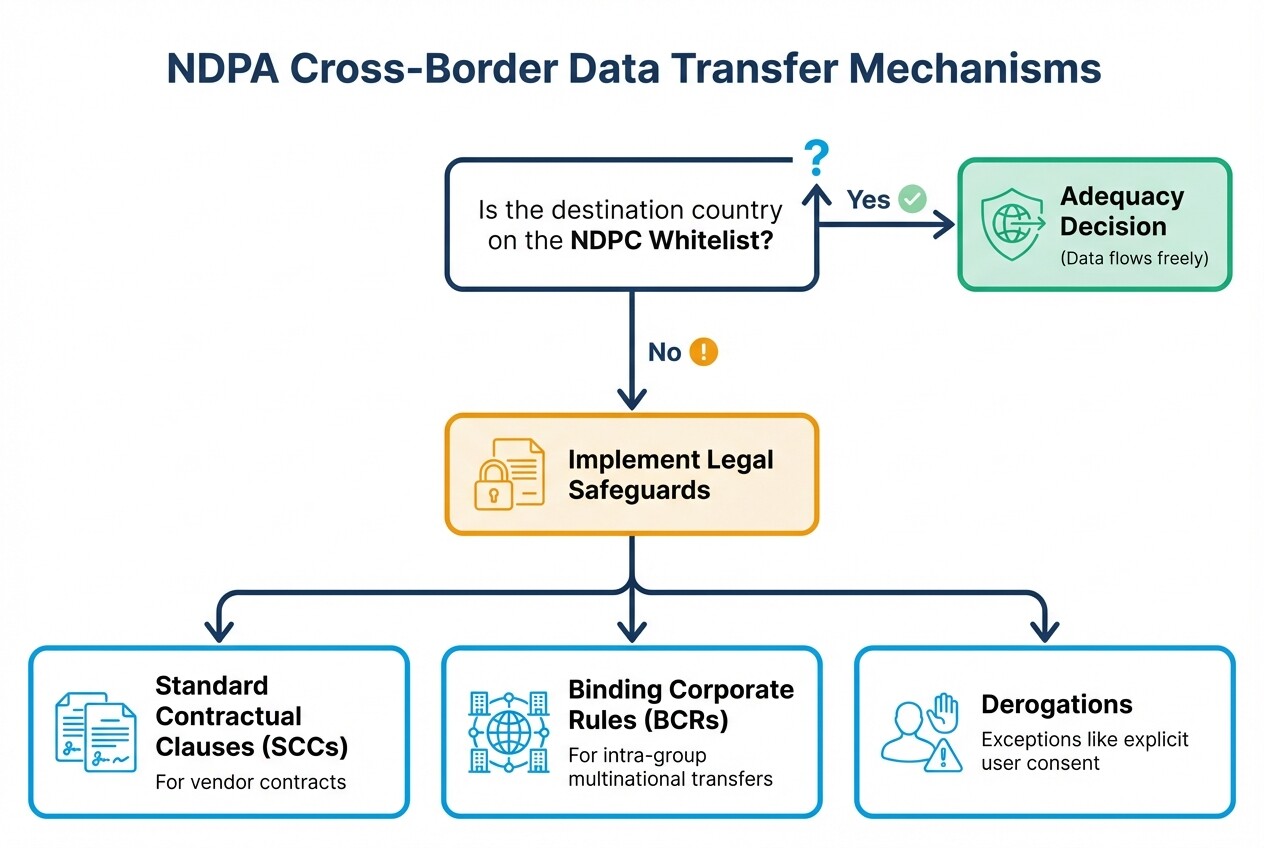
Transferring personal data from Nigeria to servers located in other countries is prohibited unless the destination jurisdiction provides adequate data protection laws or specific legal safeguards are implemented. Multinational tech firms must validate their international data flows against NDPA standards.
For cloud service providers, SaaS companies, and international tech platforms, routing Nigerian user data out of the country requires reliance on specific legal mechanisms. Companies must document these mechanisms thoroughly in their corporate governance records. Acceptable transfer mechanisms include:
- Adequacy Decisions: The NDPC maintains a "whitelist" of countries deemed to have data protection laws equivalent to Nigeria's. Data can flow freely to these jurisdictions.
- Standard Contractual Clauses (SCCs): If transferring data to a non-whitelisted country, the multinational firm must execute binding SCCs that contractually obligate the receiving entity to protect the data to NDPA standards.
- Binding Corporate Rules (BCRs): For intra-group transfers within a multinational corporation, legally enforceable BCRs approved by the NDPC can serve as the legal foundation for moving data across borders.
- Derogations (Exceptions): In limited cases, data can be transferred based on the explicit, informed consent of the data subject or if the transfer is necessary for the conclusion of a contract.
Compliance Audit Costs and Legal Review Estimates
Mandatory data compliance audits and legal reviews in Nigeria typically cost between ₦1,500,000 and ₦5,000,000 annually for multinational tech firms. The exact fee depends on the volume of data processed, the complexity of your global data architecture, and the rates of the licensed local compliance organization.
Under Nigerian regulations, companies of major importance must file an annual audit report. This report cannot be generated internally; it must be conducted and filed by an independent, licensed Data Protection Compliance Organization (DPCO). Multinationals should budget for the following estimated corporate governance expenses:
| Compliance Requirement | Estimated Cost (NGN) | Frequency |
|---|---|---|
| Initial Gap Analysis & Legal Review | ₦1,500,000 - ₦3,500,000 | One-time |
| Annual DPCO Audit & Filing | ₦500,000 - ₦1,500,000 | Annually |
| DPO Outsourcing (External Consultant) | ₦2,000,000 - ₦6,000,000 | Annually |
| NDPC Registration Fees | ₦10,000 - ₦250,000 | Upon Registration |
Alternative Data Localization Strategies for Multinational Cloud Providers
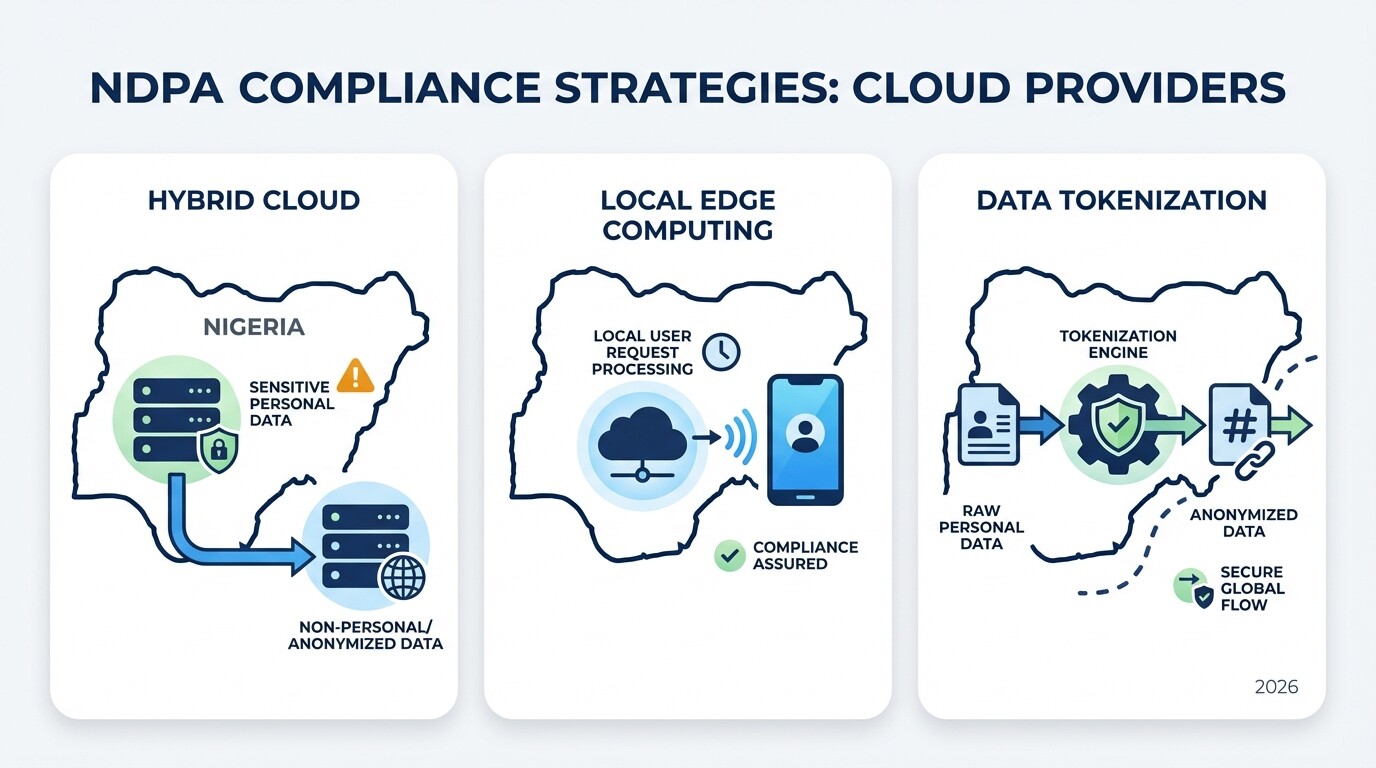
While the NDPA does not mandate strict, universal data localization for all foreign companies, multinational cloud service providers often adopt hybrid data architectures or local edge nodes to mitigate cross-border transfer risks. These technical strategies reduce the regulatory burden associated with international data flows.
For infrastructure-as-a-service (IaaS) and global platform providers, storing data locally in Nigeria can bypass the complex legal hurdles of cross-border data transfer mechanisms. Common architectural strategies include:
- Hybrid Cloud Deployment: Storing highly sensitive personal data (such as financial or biometric information) on local Nigerian servers while keeping anonymized or non-personal application data on international servers.
- Local Edge Computing: Utilizing local data centers or edge nodes within Nigeria to process user requests locally, improving application latency while simultaneously keeping raw personal data within the jurisdiction.
- Data Tokenization: Tokenizing or heavily anonymizing data before it leaves Nigerian borders. Because properly anonymized data falls outside the scope of the NDPA, this strategy allows multinationals to perform global analytics without violating privacy laws.
Legal Steps for Appointing a Data Protection Officer (DPO)
Multinational tech firms processing sensitive personal data or large volumes of information must formally appoint a Data Protection Officer (DPO) to oversee NDPA compliance. The DPO serves as the primary point of contact between the foreign tech firm and the Nigerian regulatory authorities.
The DPO can be a direct employee of the multinational company or an outsourced legal consultant, provided they possess expert knowledge of Nigerian data protection law and technology infrastructure. To legally appoint a DPO, follow these steps:
- Assess the Mandate: Determine if your data processing activities trigger the mandatory DPO requirement (typically triggered by large-scale processing or handling sensitive personal data).
- Ensure Independence: Structure the corporate governance framework so the DPO reports directly to the highest management level (e.g., the Board of Directors) without conflict of interest.
- Appoint the Officer: Formally designate a qualified professional. If your primary operations are abroad, outsourcing to a localized Nigerian privacy expert often ensures better regulatory alignment.
- Register with the NDPC: Submit the appointed DPO's contact details to the Nigeria Data Protection Commission so they can serve as your official regulatory liaison.
Common Misconceptions About Data Protection in Nigeria
Many foreign tech executives misunderstand the jurisdictional scope of Nigerian data laws, leading to costly compliance failures and regulatory penalties. Operating your corporate headquarters outside of Africa does not shield you from local enforcement.
- Misconception: The NDPA only regulates businesses registered with the Nigerian Corporate Affairs Commission. Reality: The NDPA applies territorially to the data of individuals residing in Nigeria. If your application targets Nigerian users, tracks their behavior, or processes their data, you must comply regardless of your corporate domicile.
- Misconception: Internal legal teams can file the annual data compliance audit. Reality: Nigeria has a unique compliance ecosystem. Only a specialized, locally licensed Data Protection Compliance Organization (DPCO) can legally conduct and submit the mandatory annual audit to the NDPC.
Frequently Asked Questions
What is the penalty for violating the Nigeria Data Protection Act?
For Data Controllers of Major Importance, non-compliance can result in fines of up to ₦10,000,000 or 2% of the company's annual gross revenue, whichever amount is greater. The NDPC may also issue enforcement orders halting your data processing operations in the country.
Do we need a physical office in Nigeria to be liable under the NDPA?
No. Liability under the NDPA is triggered by the act of processing the personal data of individuals residing in Nigeria. A physical corporate footprint in the country is not required for the NDPC to enforce compliance or issue penalties.
How often must multinational companies file data compliance audit reports?
Data Controllers of Major Importance must file a compliance audit report annually. This report is typically due by March 15th of the following year and must be submitted through a licensed DPCO.
Does the NDPA apply to B2B technology vendors?
Yes. If a B2B multinational firm acts as a data processor for a Nigerian corporate client, they are subject to NDPA processor obligations, including implementing security safeguards and assisting the data controller with compliance requests.
When to Hire a Corporate Governance Lawyer
Navigating the jurisdictional nuances of the Nigerian Data Protection Act requires specialized legal counsel, particularly when structuring cross-border transfer agreements or responding to a regulatory data breach inquiry. Multinational firms should engage legal counsel prior to launching services targeted at Nigerian residents or before initiating a major data migration.
A qualified local attorney will draft your Standard Contractual Clauses, liaise with licensed DPCOs, and ensure your global privacy policies align with local statutes. You can connect with experienced corporate governance lawyers in Nigeria to audit your current compliance posture and protect your operational continuity.
Next Steps
Begin your compliance journey by conducting a comprehensive data mapping exercise to identify exactly what Nigerian user data your multinational firm collects, stores, and transfers. Once your data flows are mapped, engage a locally licensed DPCO to perform a formal gap analysis against NDPA requirements. Address any immediate vulnerabilities, particularly regarding cross-border transfer mechanisms, before filing your initial compliance audit with the regulatory commission.