Essential BPO Contract Clauses for Foreign Clients
A BPO service agreement in the Philippines acts as the primary safeguard for your company's assets, reputation, and operations. Because Philippine law derives from both civil and common law traditions, specific wording is required to ensure that the protections you expect in your home jurisdiction actually apply locally.
Sample Intellectual Property Assignment Clause
"The Provider hereby irrevocably assigns, transfers, and conveys to the Client all right, title, and interest in and to any work product, inventions, or materials created during the term of this Agreement. This assignment is effective immediately upon creation, and the Provider waives all 'moral rights' under the Intellectual Property Code of the Philippines (Republic Act No. 8293) to the extent permitted by law."
Sample Data Privacy & Security Clause
"The Provider agrees to implement appropriate physical, technical, and organizational security measures as required by the Data Privacy Act of 2012. The Provider shall act only as a 'Data Processor' and shall process personal information strictly in accordance with the Client's documented instructions. Any data breach must be reported to the Client within twenty-four (24) hours of discovery."
Sample Termination for Convenience Clause
"The Client may terminate this Agreement at any time, without cause, by providing the Provider with at least sixty (60) days' written notice. In such event, the Client shall only be liable for services rendered and approved up to the effective date of termination, without any further penalty or early termination fees."
Service Level Agreements (SLAs) and Penalty Frameworks
Service Level Agreements (SLAs) establish the technical and operational benchmarks that the Philippine BPO provider must meet. In the Philippines, these are typically enforced through "Service Credits," which are pre-calculated discounts applied to the client's next invoice when the provider fails to meet agreed-upon metrics.
To create an effective penalty framework, you must define Key Performance Indicators (KPIs) such as "Uptime," "Average Handle Time," or "Accuracy Rate." Under the Civil Code of the Philippines, these penalties are viewed as "liquidated damages." For these to be enforceable, they must be a reasonable pre-estimate of loss and not "iniquitous or unconscionable," or a court may reduce them.
| Metric | Target Level | Service Credit (Penalty) |
|---|---|---|
| System Uptime | 99.9% | 5% of monthly fee for every 0.1% drop |
| Response Time | < 4 hours | 2% of monthly fee per instance |
| Quality Score | > 95% | 10% of monthly fee if average falls below 90% |
Data Privacy Act (DPA) Compliance for Cross-Border Transfers
The Data Privacy Act of 2012 (RA 10173) regulates how BPO providers handle the personal information of a foreign client's customers. To remain compliant, the contract must include a "Data Processing Agreement" (DPA) that outlines the provider's obligations as a data processor.
The Philippines National Privacy Commission requires that personal data transfers provide a "substantial level of protection." Foreign clients should ensure the contract grants them the right to audit the provider's security infrastructure and requires the provider to maintain a dedicated Data Protection Officer (DPO). Failure to include these protections can expose the foreign client to significant regulatory fines in both the Philippines and their home country (such as GDPR or CCPA violations).
Intellectual Property Ownership in Work-for-Hire Arrangements
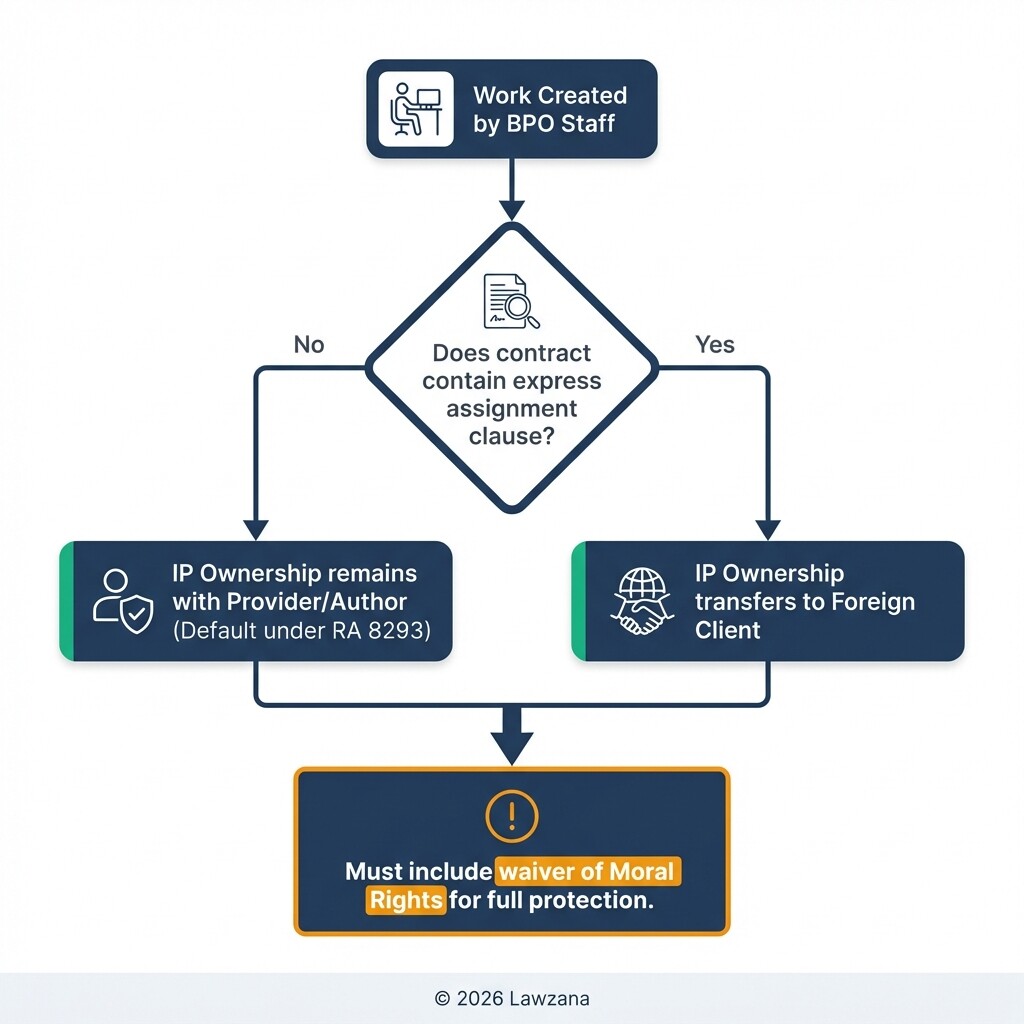
Intellectual Property (IP) ownership is one of the most litigated areas in Philippine outsourcing. Unlike some Western jurisdictions where "work-for-hire" automatically grants ownership to the employer, the Intellectual Property Code of the Philippines (RA 8293) can be ambiguous regarding independent contractors and BPO providers.
To secure your IP, the contract must explicitly state that the client owns all "deliverables" and "work product." This should include a "further assurances" clause, requiring the Philippine provider to sign any additional documents needed to register the IP in the client's home country. Without this, the BPO provider might legally claim ownership of the software code, processes, or creative assets developed by their employees for your project.
Termination for Convenience vs. Termination for Cause
Termination clauses define how you exit a relationship that is no longer beneficial. Termination "for cause" usually happens immediately after a material breach, such as a massive data leak or total service failure. Termination "for convenience" allows you to end the contract without needing a specific reason, providing flexibility if your business strategy changes.
In the Philippines, BPO providers often push for long notice periods (90+ days) and "exit fees" to recover their recruitment and infrastructure costs. Foreign clients should negotiate a "Step-in Right" clause, allowing them to take over operations temporarily if the provider fails to perform, and a "Disengagement Plan" that requires the provider to cooperate in transferring data back to the client or to a new vendor.
Choosing Governing Law and Dispute Resolution Venues
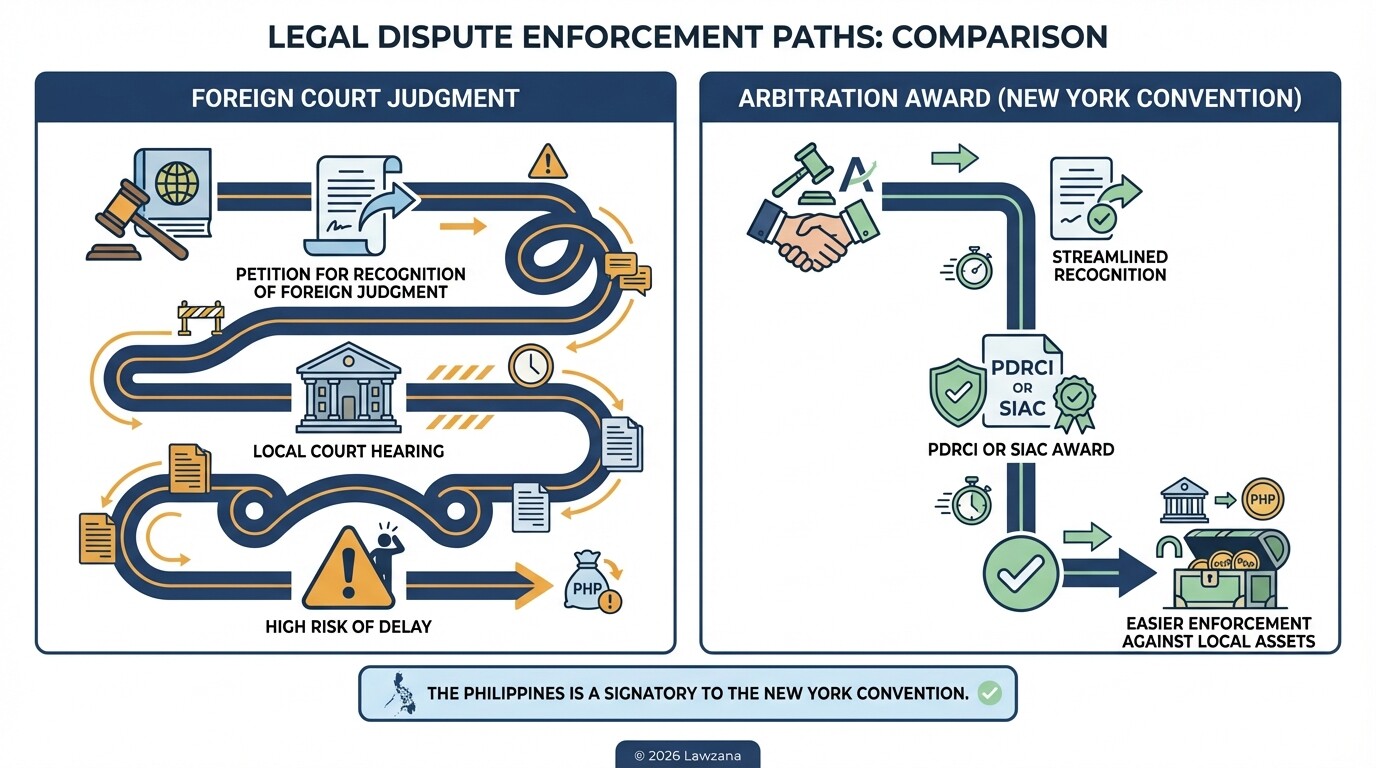
Foreign clients often prefer their home country's law (e.g., New York or English law) to govern the contract. While Philippine courts generally respect the "choice of law" principle, enforcing a foreign court judgment in the Philippines is a long and difficult process.
The most efficient solution is to include an Arbitration Clause. Choosing a venue like the Philippine Dispute Resolution Center (PDRCI) or the Singapore International Arbitration Centre (SIAC) allows for a faster, private resolution. Because the Philippines is a signatory to the New York Convention, an arbitration award is much easier to enforce against a Philippine provider's local bank accounts and assets than a foreign court ruling.
Checklist for Drafting a Philippine BPO Agreement
- Entity Verification: Have you verified the provider's SEC registration in the Philippines?
- IP Assignment: Is there a clear, irrevocable transfer of all work product to the client?
- Exclusivity: Does the contract prevent the provider from working with your direct competitors?
- DPA Requirements: Does the contract name a Data Protection Officer and allow for security audits?
- Business Continuity: Is there a plan for "Force Majeure" events like typhoons or internet outages?
- Service Credits: Are the penalties for missing KPIs high enough to encourage performance but reasonable enough to be legal?
- Notarization: Have you planned for the document to be notarized in the Philippines to ensure its status as a public document?
Common Misconceptions
"US law applies, so I am fully protected."
Even if the contract says US law applies, Philippine labor laws and data privacy regulations are mandatory for operations physically located in the Philippines. You cannot "contract out" of local criminal liability for data breaches or local labor standards for the provider's employees.
"I automatically own everything the BPO staff creates."
Under RA 8293, if the contract is silent, the "author" or the "creator" may retain certain rights. You must have an explicit assignment of rights that covers both current and future developments to ensure full ownership.
"Notarization is just a formality."
In the Philippines, an unnotarized contract is a "private document." A notarized contract is a "public document," which serves as self-authenticating evidence in court. This significantly speeds up legal proceedings if you ever need to sue for breach of contract.
FAQ
What is the typical cost of legal review for a BPO contract in the Philippines?
Legal fees for reviewing or drafting a standard BPO agreement typically range from ₱50,000 to ₱150,000 ($900 - $2,700 USD), depending on the complexity of the SLAs and the volume of data involved.
How long does it take to finalize a BPO contract?
Negotiations and legal drafting usually take 2 to 4 weeks. If the provider is a large firm with its own legal department, the "redlining" process can extend this to 2 months.
Can I include a non-compete clause for the BPO's employees?
You can include a non-solicitation clause preventing the provider from hiring your staff, but enforcing non-compete clauses against the provider's individual employees is difficult under Philippine labor law unless they are very specific and limited in duration and geography.
When to Hire a Lawyer
You should consult a Philippine technology or corporate lawyer if your BPO arrangement involves sensitive customer data (PHI or PII), proprietary software development, or a contract value exceeding $50,000 USD annually. A lawyer is essential when the provider requests significant changes to the standard IP or indemnity clauses, as these "small" changes can leave your company exposed to massive liability under local regulations.
Next Steps
- Audit Your Data: Identify what type of personal information will be shared with the Philippine provider to determine the necessary DPA protections.
- Define Metrics: Draft your Service Level Agreement (SLA) benchmarks before starting the legal drafting process.
- Request Corporate Documents: Ask the provider for their SEC Certificate of Incorporation and latest General Information Sheet (GIS) to confirm they are a legitimate entity.
- Draft and Localize: Engage a legal professional to adapt your standard master services agreement to comply with Philippine statutes (RA 10173 and RA 8293).