Singapore Commercial Dispute Prevention Checklist for Foreign HQs
Key Takeaways
Strategic dispute prevention minimizes cross-border risks and protects your bottom line when managing Asia-Pacific (APAC) operations from a Singapore headquarters.
- Implement clear vendor agreements with defined key performance indicators (KPIs) and exit mechanisms to prevent operational gridlock.
- Incorporate Singapore International Arbitration Centre (SIAC) clauses to guarantee enforceable, private cross-border dispute resolution.
- Utilize Alternative Dispute Resolution (ADR) to cut legal costs by up to 50% compared to traditional High Court litigation.
- Audit your regional data flows to ensure strict compliance with Singapore's Personal Data Protection Act (PDPA).
- Update standard force majeure clauses to address modern geopolitical, supply chain, and climate disruptions.
Complete Dispute Prevention Checklist for Foreign HQs
A systematic review of your corporate agreements and compliance frameworks prevents minor disagreements from escalating into costly regional litigation. Use this operational checklist to audit your headquarters' legal risk profile.
Contract Architecture & Performance
- Define objective, measurable KPIs in all regional vendor and supplier agreements.
- Include step-in rights and specific cure periods for underperformance.
- Draft clear "termination for convenience" and "termination for cause" exit clauses.
- Mandate post-termination transition assistance to prevent business interruption.
Dispute Resolution Mechanics
- Remove boilerplate local court jurisdiction clauses from cross-border contracts.
- Insert a tiered dispute resolution clause requiring mandatory mediation before arbitration.
- Specify the seat of arbitration as Singapore to leverage its pro-arbitration legal framework.
- Designate the governing law of the contract (preferably Singapore law or English law).
Regional Compliance & Risk
- Map all cross-border data transfers originating from or passing through the Singapore HQ.
- Execute localized data processing agreements that comply with PDPA transfer limits.
- Audit and update force majeure clauses to explicitly cover pandemics, cyberattacks, and trade sanctions.
- Schedule annual legal reviews of standard vendor templates.
Drafting Cross-Border Vendor Agreements
Effective cross-border vendor agreements require precise key performance indicators (KPIs) and unambiguous exit clauses to manage performance failures across different jurisdictions. Relying on vague deliverables invites jurisdictional battles and costly operational delays.
When managing vendors across APAC, foreign headquarters must replace subjective service descriptions with quantifiable metrics. This includes specific delivery windows, quality defect tolerances, and localized service level agreements (SLAs). Contractual audit rights should be explicitly stated, allowing the Singapore HQ to inspect vendor facilities or financial records to verify compliance without requiring a court order.
Exit clauses must be equally precise. Cross-border contracts should clearly outline a detailed disengagement process. This means specifying exactly how data, proprietary tools, and inventory will be returned to the HQ upon termination. By locking in predetermined transition assistance terms, companies prevent vendors from holding critical operational assets hostage during a commercial dispute.
Sample SIAC Arbitration and Mediation Clauses
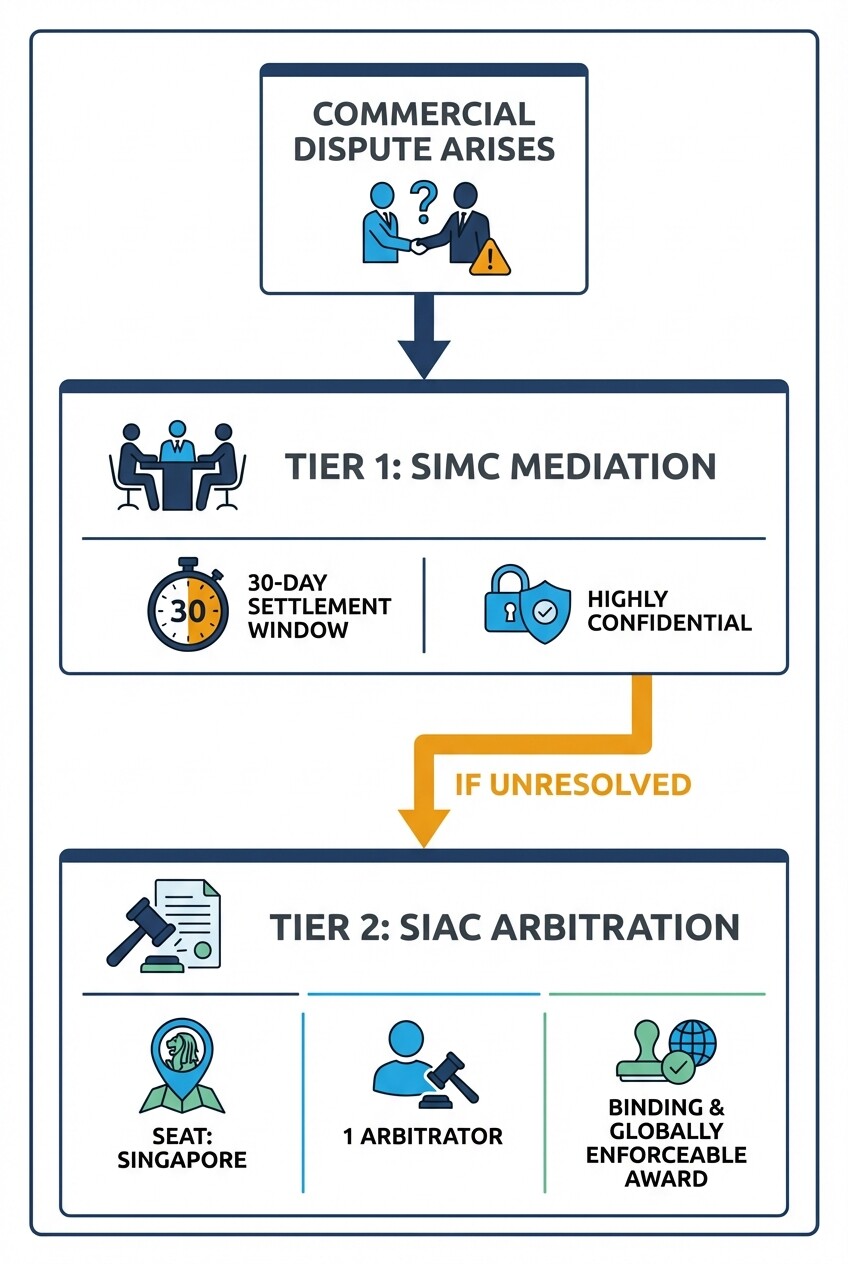
Inserting a standard arbitration clause into your commercial contracts provides a globally recognized, enforceable mechanism for resolving cross-border disputes without navigating foreign court systems. The Singapore International Arbitration Centre (SIAC) offers a predictable, highly respected framework for APAC commerce.
To prevent immediate escalation, multinational corporations often use a "tiered" or "multi-tiered" dispute resolution clause. This requires both parties to attempt mediation before legally commencing arbitration. Below is standard sample language adapted from the official Singapore International Arbitration Centre (SIAC) guidelines:
Tiered Mediation and Arbitration Clause Template: "In the event of any dispute arising out of or in connection with this contract, including any question regarding its existence, validity, or termination, the parties shall first seek settlement of that dispute by mediation in accordance with the Mediation Rules of the Singapore International Mediation Centre (SIMC) for the time being in force.
If the dispute is not settled by mediation within 30 days of the commencement of the mediation, or such further period as the parties shall agree in writing, the dispute shall be referred to and finally resolved by arbitration administered by the Singapore International Arbitration Centre (SIAC) in accordance with the Arbitration Rules of the Singapore International Arbitration Centre (SIAC Rules) for the time being in force, which rules are deemed to be incorporated by reference in this clause.
The seat of the arbitration shall be Singapore. The Tribunal shall consist of one arbitrator. The language of the arbitration shall be English."
Cost Comparison: ADR vs. Commercial Litigation in Singapore
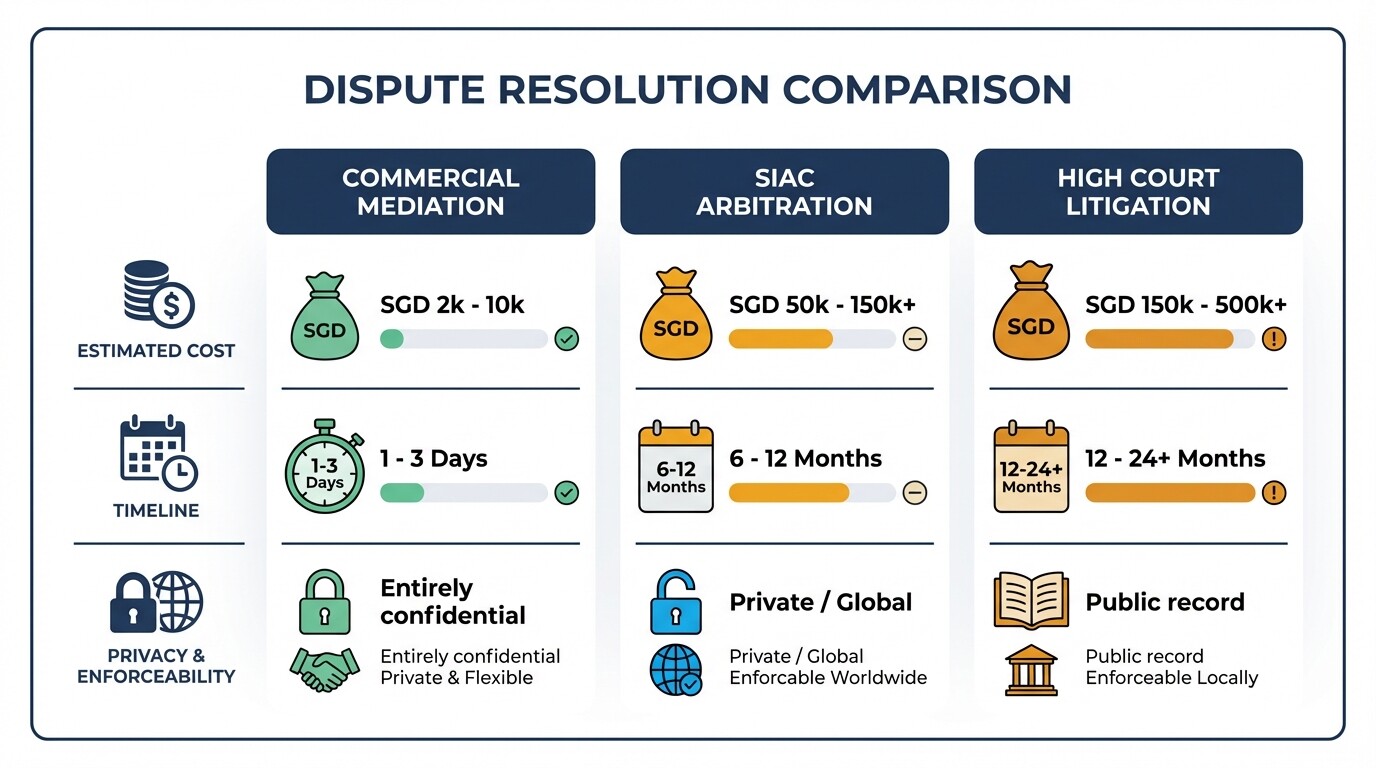
Alternative Dispute Resolution (ADR) typically costs 30% to 50% less than traditional High Court litigation in Singapore and concludes in a fraction of the time. Arbitration and mediation offer predictable fee structures and procedural flexibility compared to rigid court battles.
For a foreign headquarters, cost predictability is vital. Litigation in foreign jurisdictions or the Singapore High Court involves open-ended legal fees, public exposure of trade secrets, and lengthy appeals. Arbitration caps procedural timelines, while mediation empowers parties to settle disputes commercially before massive legal fees accumulate.
| Dispute Mechanism | Estimated Cost (SGD) | Average Timeline | Privacy & Enforceability |
|---|---|---|---|
| Commercial Mediation | $2,000 to $10,000 | 1 to 3 Days | Entirely confidential; preserves business relationships. |
| SIAC Arbitration | $50,000 to $150,000+ | 6 to 12 Months | Private; highly enforceable globally under the New York Convention. |
| High Court Litigation | $150,000 to $500,000+ | 12 to 24+ Months | Public record; subject to complex cross-border enforcement hurdles. |
Note: Costs vary heavily based on the complexity of the claim, the volume of evidence, and the legal counsel retained.
Data Compliance: Navigating the PDPA Across APAC
Localizing compliance with Singapore's Personal Data Protection Act (PDPA) is mandatory for multinational headquarters handling cross-border data transfers across the APAC region. Failing to secure proper data transfer agreements triggers severe regulatory fines and immediate business disruptions.
Singapore acts as a central data hub for many foreign MNCs. Under the PDPA, an organization must not transfer personal data to a country or territory outside Singapore unless it legally ensures the transferred data receives a standard of protection comparable to the PDPA. Headquarters must bind their regional subsidiaries and third-party vendors to strict data processing agreements. You can review the exact legal transfer obligations through the Personal Data Protection Commission (PDPC) resources.
Foreign HQs must audit their digital supply chains routinely. If a vendor in a neighboring country experiences a data breach, the Singapore HQ can be held legally accountable if they failed to implement necessary contractual safeguards. Standardizing your regional IT contracts to include mandatory breach notification windows (typically 24 to 72 hours) and localized compliance indemnities is a crucial pre-litigation defense.
Common Misconceptions About Regional Contracts
Many multinational executives mistakenly assume that standard boilerplate contracts offer universal protection across the APAC region. This oversight leaves companies vulnerable to unmitigated supply chain disruptions and unenforceable terms.
Misconception: Standard "Act of God" clauses protect against modern disruptions. Many headquarters neglect force majeure updates, relying on legacy language that only covers natural disasters. Modern cross-border contracts must explicitly list pandemics, localized regulatory lockdowns, cyberattacks, and international trade sanctions to effectively excuse performance delays without triggering a breach of contract dispute.
Misconception: Foreign courts will easily enforce a Singapore court judgment. Companies often write contracts subject to the exclusive jurisdiction of Singapore courts, assuming they can easily enforce a winning judgment against a vendor in another Asian country. In reality, enforcing court judgments across borders is notoriously difficult. Arbitration awards, by contrast, are recognized in over 170 countries, making arbitration the superior choice for regional enforceability.
Misconception: Long-term vendor relationships do not need strict contractual updates. Headquarters often let regional supplier agreements roll over automatically without updating KPIs or compliance terms. When a relationship sours, the HQ discovers they have no contractual leverage or documented metrics to prove the vendor failed to perform, severely weakening their pre-litigation negotiation position.
Frequently Asked Questions
Why is Singapore the preferred hub for APAC dispute resolution?
Singapore offers a neutral, politically stable environment with a world-class legal infrastructure. Its judiciary is strongly pro-arbitration, and the SIAC is globally recognized, making it a safe, predictable seat for resolving disputes between Western headquarters and Asian regional partners.
Can we enforce a Singapore arbitration award in other Asian countries?
Yes. Because most Asian countries are signatories to the New York Convention, an arbitration award issued in Singapore can be directly enforced in local courts across the region much more easily than a standard court judgment.
What happens if an APAC vendor breaches a contract without an arbitration clause?
Without an arbitration clause, you are generally forced to sue the vendor in their home country's local court system, or sue in Singapore and face significant hurdles enforcing the judgment abroad. This exposes the HQ to unfamiliar local laws, longer timelines, and potential home-court bias.
When to Hire a Lawyer and Next Steps
Engage a commercial dispute prevention lawyer during your market entry or annual contract audit phase, long before a breach occurs. Proactive legal counsel structures your agreements to heavily favor swift, private resolution and ensures your regional operations remain insulated from localized risks.
To protect your headquarters, start by compiling your top ten most critical vendor and supplier agreements for a legal audit. Focus on reviewing the governing law, dispute resolution mechanics, and liability caps. If your contracts lack tiered mediation and arbitration provisions, it is time to upgrade your legal architecture. You can connect with qualified legal partners to review your regional exposure through the Singapore Dispute Prevention & Pre-Litigation Lawyers directory on Lawzana.