- Foreign joint ventures must comply with South African antitrust laws if their business activities have an economic effect within the country, regardless of where the entities are incorporated.
- The Competition Commission heavily prioritizes public interest factors, such as employment and the promotion of historically disadvantaged persons, alongside traditional competition metrics.
- Penalties for anti-competitive behavior are severe, including administrative fines of up to 10% of a company's turnover and potential criminal liability for corporate directors.
- Implementing clean teams and strict information exchange protocols is critical to avoid accidental cartel conduct between parent companies.
- Proactive engagement through the Corporate Leniency Policy can help multinational corporations avoid costly antitrust litigation and reduce financial penalties.
Joint Venture Antitrust Compliance Checklist
Establishing a joint venture in South Africa requires rigorous upfront planning to avoid triggering antitrust litigation. Use this compliance checklist to structure your partnership legally and transparently before entering the market.
- Assess the "Effects Test": Determine if the joint venture's operations, sales, or supply chains will impact the South African economy, triggering local jurisdiction.
- Calculate Notification Thresholds: Calculate the combined annual turnover and asset value of the joint venture partners in South Africa to see if mandatory merger notification is required.
- Establish a Clean Team: Appoint independent personnel or outside counsel to handle competitively sensitive information during the negotiation phase.
- Draft Information Exchange Protocols: Create written guidelines detailing exactly what pricing, customer, and strategic data the parent companies can share with the joint venture.
- Evaluate Public Interest Impact: Document how the joint venture will affect local employment, small businesses, and Broad-Based Black Economic Empowerment initiatives.
- Conduct Ongoing Training: Mandate South African competition law training for all directors and executives involved in the joint venture's operations.
Navigating Competition Act Requirements for Foreign Joint Ventures
Foreign joint ventures operating in South Africa must comply with the Competition Act 89 of 1998 if their activities have an economic effect within the country. This requires mandatory merger notifications to the Competition Commission if specific financial thresholds regarding local assets and turnover are met.
South African competition authorities utilize a broad interpretation of the "effects doctrine." This means that even if a joint venture is formed in another country between two foreign parent companies, South African regulators claim jurisdiction if the entities export goods to South Africa or own subsidiaries within the country. Joint ventures are generally assessed under merger control regulations if they perform all the functions of an autonomous economic entity on a lasting basis.
When a joint venture meets the definition of a merger, the partners must halt implementation until the Competition Commission or Competition Tribunal grants approval. Implementing a notifiable joint venture before receiving clearance constitutes "prior implementation," which routinely triggers significant financial penalties and immediate litigation.
Identifying Cartel Conduct and Prohibited Horizontal Practices
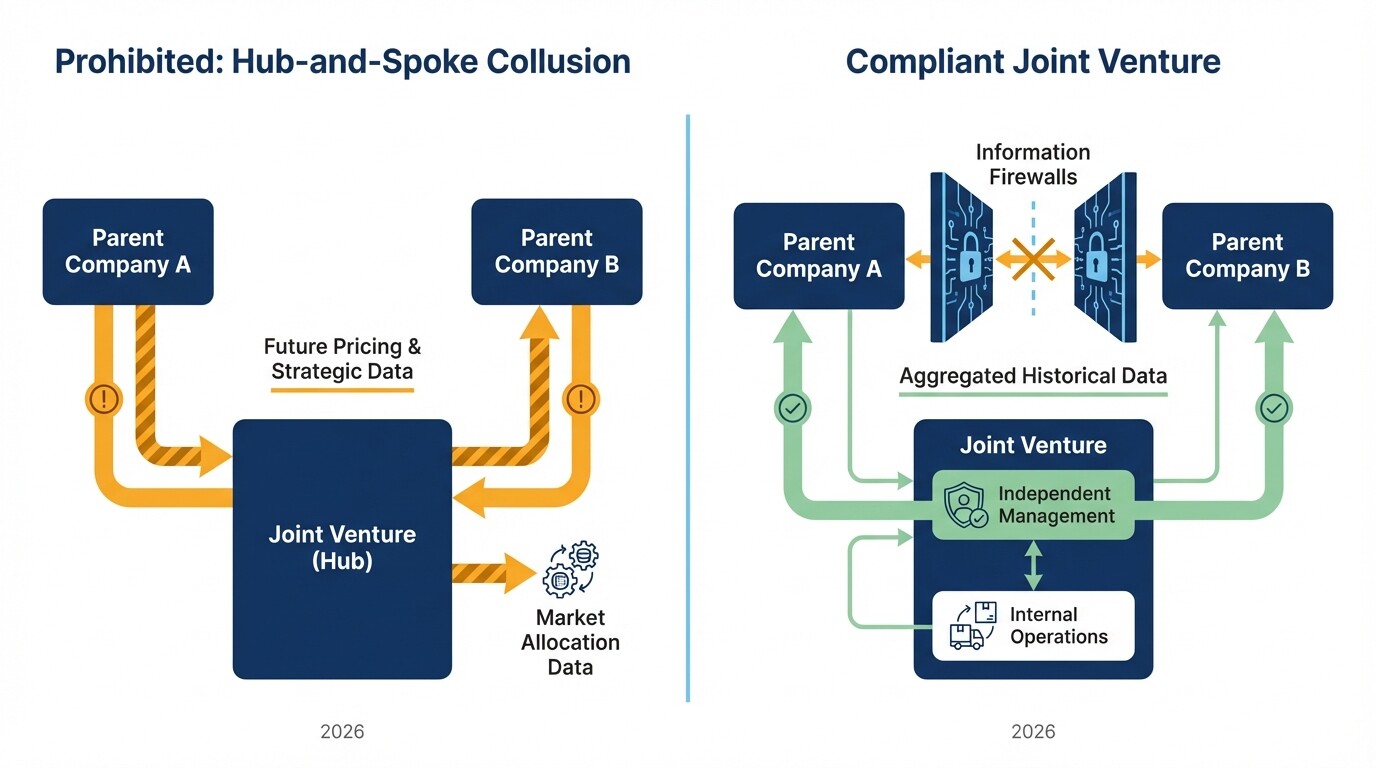
South African law strictly prohibits horizontal practices such as price-fixing, market division, and collusive tendering between competitors. Joint ventures must ensure that parent companies do not use the partnership as a conduit to share competitively sensitive information or coordinate market behavior outside the joint venture.
The creation of a joint venture inherently brings competing or potentially competing parent companies together, creating high risks for cartel conduct. The Competition Commission actively prosecutes "hub-and-spoke" arrangements where the joint venture acts as the hub to pass pricing strategies or output limitations between the parent companies.
To prevent prohibited horizontal practices, businesses must structure the joint venture carefully:
- Scope Limitation: Strictly confine the joint venture's operations to the agreed-upon market, preventing spillover collusion into the parent companies' core businesses.
- Information Firewalls: Implement robust IT and physical firewalls to ensure parent companies only receive aggregated, historical data regarding the joint venture's performance rather than future pricing intentions.
- Independent Management: Appoint independent executives to run the joint venture, rather than relying on current employees of the competing parent companies who retain dual roles.
The Impact of Public Interest Conditions on Antitrust Approvals
The South African Competition Commission heavily weighs public interest factors when approving joint ventures, often prioritizing these over pure economic efficiencies. Approvals are frequently subject to binding conditions designed to protect local employment and promote historically disadvantaged persons.
Foreign corporations must recognize that South African antitrust enforcement is unique in its statutory mandate to address historical economic imbalances. Even if a joint venture raises no competitive concerns, it can be blocked or heavily conditioned on public interest grounds.
Regulators primarily focus on three public interest pillars:
- Employment: The Commission requires detailed justifications for any job losses resulting from the joint venture and often imposes moratoriums on retrenchments for two to five years.
- SME and Black Business Support: Joint ventures are expected to support small and medium-sized enterprises and firms controlled by historically disadvantaged persons, often through supplier development funds.
- Broad-Based Black Economic Empowerment: Regulators expect joint ventures to promote a greater spread of ownership in the economy, frequently mandating the inclusion of local worker ownership schemes or empowerment partners.
Typical Fines and Legal Risks for Multinational Corporate Directors
Multinational corporations face administrative penalties of up to 10% of their annual turnover in South Africa for antitrust violations, escalating to 25% for repeat offenses. Directors can also face personal criminal liability, including severe fines or imprisonment, for causing or permitting cartel conduct.
The financial risks of antitrust litigation in South Africa extend beyond the local subsidiary. The Competition Commission increasingly seeks to impute liability to foreign parent companies if they exercised decisive influence over the joint venture's anti-competitive behavior.
For individual executives, the stakes are equally high. Under Section 73A of the Competition Act, directors or managers who have management authority and cause the company to engage in prohibited horizontal practices face criminal prosecution. Convictions can result in personal fines of up to ZAR 500,000 or imprisonment for up to 10 years. Because cartel conduct is criminalized, foreign directors also face the risk of extradition proceedings.
Pre-Litigation Strategies to Resolve Investigations
Resolving Competition Commission investigations before litigation requires proactive engagement through the Corporate Leniency Policy or settlement negotiations. Early cooperation can significantly reduce financial penalties and shield directors from criminal prosecution.
When a multinational corporation discovers potential antitrust violations within its South African joint venture, a rapid internal investigation is critical. If cartel conduct is identified, the company should immediately consider applying for the Corporate Leniency Policy. This policy grants immunity from administrative penalties and criminal prosecution to the first cartel member that comes forward with information and fully cooperates with the Commission.
If leniency is unavailable because another party applied first, companies can negotiate Consent Agreements. By admitting liability and agreeing to pay an administrative penalty, corporations avoid the costs, public exposure, and unpredictable outcomes of contested litigation before the Competition Tribunal. Consent agreements often include requirements to implement comprehensive compliance programs and submit to periodic audits.
Common Misconceptions About South African Antitrust Law
Many foreign executives misunderstand the reach and priorities of South African antitrust enforcement. Assuming local laws mirror American or European regulations often leads to severe compliance failures and unexpected litigation.
- Misconception: Offshore joint ventures do not need South African approval. Reality: Because of the effects doctrine, a joint venture formed entirely outside South Africa by foreign entities still requires local approval if it impacts the South African market through sales or subsidiaries.
- Misconception: Economic efficiencies always outweigh public interest concerns. Reality: The Competition Tribunal has the authority to block a pro-competitive joint venture solely on the grounds that it negatively impacts employment or local ownership initiatives.
- Misconception: Only the local joint venture entity is liable for fines. Reality: The Competition Commission can and does fine parent companies based on their global turnover if they are found to control the joint venture's anti-competitive conduct.
Frequently Asked Questions (FAQ)
What are the merger notification thresholds in South Africa?
Mandatory notification is required when the combined annual turnover or asset value of the merging parties in South Africa equals or exceeds ZAR 600 million, and the target firm's turnover or asset value equals or exceeds ZAR 100 million.
Can foreign directors be extradited for South African antitrust violations?
Yes. Because cartel conduct like price-fixing and market allocation is a criminal offense in South Africa, authorities can initiate extradition proceedings for foreign directors under applicable mutual legal assistance treaties.
How long does a Competition Commission investigation take?
Merger reviews typically take 20 to 60 business days depending on complexity. However, investigations into cartel conduct or abuse of dominance can take several years before reaching the Competition Tribunal for litigation.
Does South Africa recognize attorney-client privilege in antitrust investigations?
Yes, South African law recognizes legal professional privilege. However, this privilege generally only applies to communications with external legal counsel, not in-house counsel, making it vital to structure compliance reviews carefully.
When to Hire a Lawyer
Engage local antitrust counsel immediately when planning a joint venture that impacts the South African market or upon receiving an information request from the Competition Commission. Navigating the intersection of merger control, horizontal practice prohibitions, and public interest mandates requires specialized local knowledge.
Do not wait until a formal investigation is announced to seek legal advice. Involving antitrust litigation lawyers in South Africa during the initial negotiation phase ensures your joint venture is structured to avoid compliance pitfalls. Early counsel is also essential for establishing clean teams and determining whether mandatory merger filings are required before you finalize your commercial agreements.
Next Steps
- Conduct a Jurisdictional Assessment: Work with your legal team to map your proposed joint venture's supply chains and sales to determine if South African notification thresholds are met.
- Draft a Public Interest Strategy: Develop a concrete plan addressing how the joint venture will protect local employment and support broad-based black economic empowerment.
- Implement Information Protocols: Establish strict data firewalls between the joint venture partners to prevent the accidental sharing of pricing and strategic information.
- Connect with Local Experts: Consult a vetted legal professional through the Lawzana directory to guide your compliance strategy and handle all interactions with the South African Competition Commission.