- B-BBEE compliance is measured on a scale of Level 1 to Level 8, where Level 1 provides the highest competitive advantage for securing government tenders and private sector contracts.
- Small businesses with an annual turnover under R10 million are classified as Exempted Micro Enterprises (EMEs) and automatically qualify for Level 4 status (or higher if black-owned).
- Fronting-the practice of misrepresenting BEE credentials-is a criminal offense in South Africa that can lead to ten years of imprisonment and significant financial penalties.
- Verification requirements differ by business size: small businesses often only need a sworn affidavit, while larger entities require a formal certificate from a SANAS-accredited agency.
- Compliance is not just a legal hurdle; it is a strategic B2B requirement, as your BEE level directly impacts your clients' ability to claim procurement points.
How do EME, QSE, and Generic Enterprises differ in South Africa?
South African law categorizes businesses into three tiers based on their annual turnover to determine their B-BBEE compliance obligations. These categories-Exempted Micro Enterprises (EMEs), Qualifying Small Enterprises (QSEs), and Generic Enterprises-dictate whether a company must undergo a full audit or can simply self-certify its status.
The Department of Trade, Industry and Competition (DTIC) sets these thresholds to lower the administrative burden on smaller firms while ensuring larger corporations contribute more significantly to economic transformation.
| Category | Annual Turnover Threshold | Compliance Requirement |
|---|---|---|
| Exempted Micro Enterprise (EME) | Less than R10 million | Sworn Affidavit or CIPC Certificate |
| Qualifying Small Enterprise (QSE) | Between R10 million and R50 million | B-BBEE Scorecard or Affidavit (if >51% black-owned) |
| Generic Enterprise | Above R50 million | Full B-BBEE Verification Certificate |
For an EME, the process is streamlined. A business that is less than 51% black-owned is automatically granted Level 4 status. If the EME is 51% black-owned, it is promoted to Level 2, and 100% black-owned EMEs achieve Level 1 status instantly. QSEs follow a similar logic if they are majority black-owned; however, if they are less than 51% black-owned, they must be measured against all five elements of the B-BBEE scorecard.
What are the five elements of the B-BBEE scorecard?
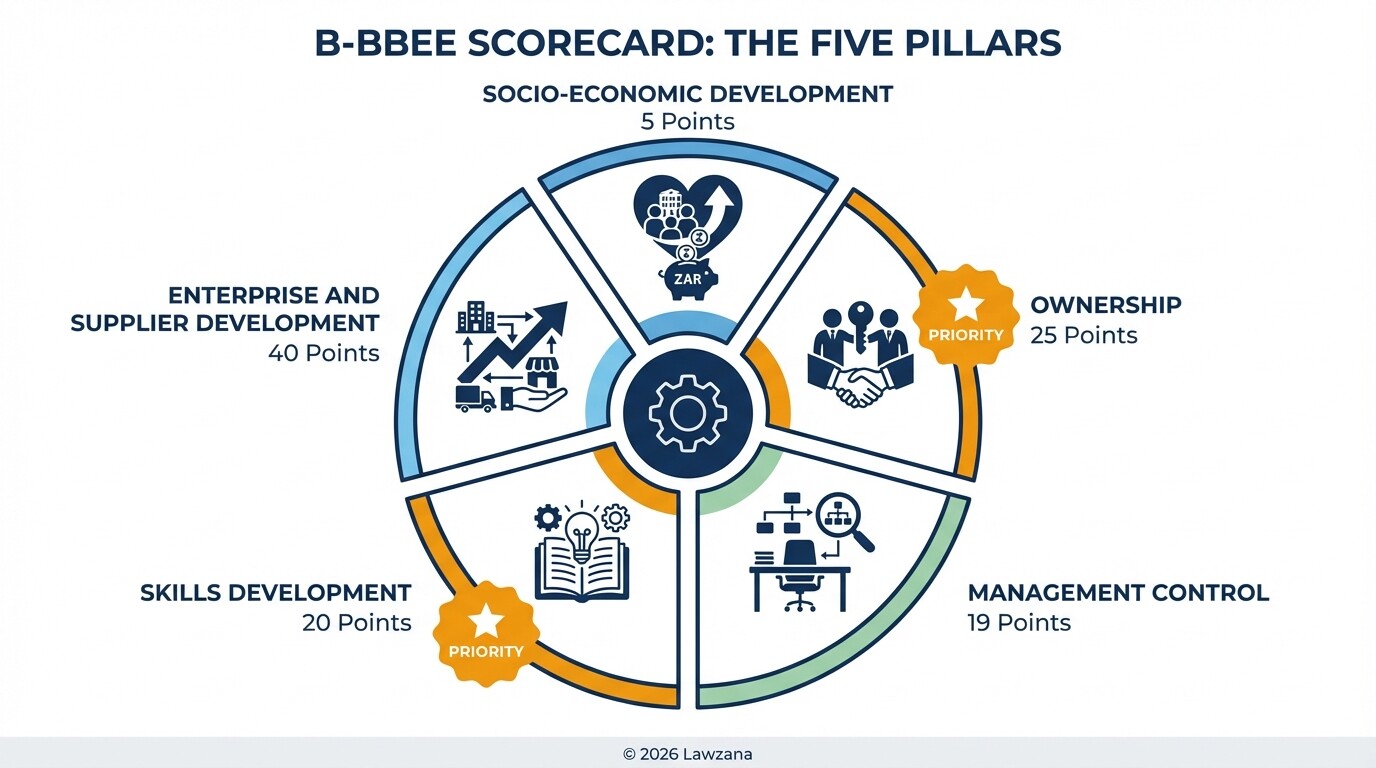
The B-BBEE scorecard is a measurement tool used to evaluate a company's contribution to economic integration across five distinct pillars. Each element carries a specific weight, and the total score determines the company's final BEE Level.
Under the Amended Codes of Good Practice, the five elements are:
- Ownership (25 Points): Measures the percentage of the company owned by black people. This is a "priority element," meaning failure to meet sub-minimum targets (usually 40% of the net value target) results in a penalty of one level drop on the overall scorecard.
- Management Control (19 Points): Evaluates the representation of black people at the board level and in executive management positions.
- Skills Development (20 Points): Measures investment in the training and development of black employees and unemployed people. This is also a priority element.
- Enterprise and Supplier Development (40 Points): This is the most heavily weighted pillar. It encourages businesses to buy from BEE-compliant suppliers and invest in the growth of small black-owned businesses.
- Socio-Economic Development (5 Points): Measures corporate social responsibility initiatives that promote access to the economy for black people.
For small businesses (QSEs), these elements are vital because they demonstrate to the government and large corporate clients that your business is actively participating in the country's transformation goals.
When should a business use an Affidavit versus a Verification Certificate?
Small businesses in South Africa can often avoid the high costs of formal audits by using a B-BBEE Sworn Affidavit, provided they meet specific turnover and ownership criteria. A formal Verification Certificate is only mandatory for Generic Enterprises and certain QSEs that do not meet black-ownership thresholds.
The distinction is critical because presenting the wrong document during a tender process can lead to immediate disqualification.
- Sworn Affidavits: EMEs (turnover < R10m) and majority black-owned QSEs (turnover < R50m) only need a sworn affidavit. This is a free document that must be signed by a Commissioner of Oaths. You can find official templates on the dtic.gov.za website.
- Verification Certificates: These are required for Generic Enterprises and QSEs with less than 51% black ownership. These certificates must be issued by an agency accredited by the South African National Accreditation System (SANAS).
A Sworn Affidavit is valid for 12 months from the date of signature and carries the same legal weight as a certificate for the entities mentioned above.
What are the legal consequences of Fronting practices?
Fronting is a deceptive practice where a business misrepresents its B-BBEE status or creates "window-dressing" roles for black individuals to secure contracts without actually empowering them. In South Africa, fronting is a serious criminal offense under the B-BBEE Act, as amended in 2013.
The B-BBEE Commission is the regulatory body tasked with investigating these practices. If a business is found guilty of fronting, the consequences are severe for both the entity and the individuals involved.
- Criminal Prosecution: Individuals involved can face up to 10 years in prison.
- Corporate Fines: Companies can be fined up to 10% of their annual turnover.
- Blacklisting: The business may be barred from doing business with the state or any public entity for up to 10 years.
- Contract Cancellation: Any government contracts obtained through fronting are usually cancelled immediately, often without compensation for work already performed.
Common examples of fronting include appointing black directors who have no actual decision-making power or routing payments through a BEE-compliant shell company while the work is performed by a non-compliant entity.
How does preferential procurement impact B2B sales?
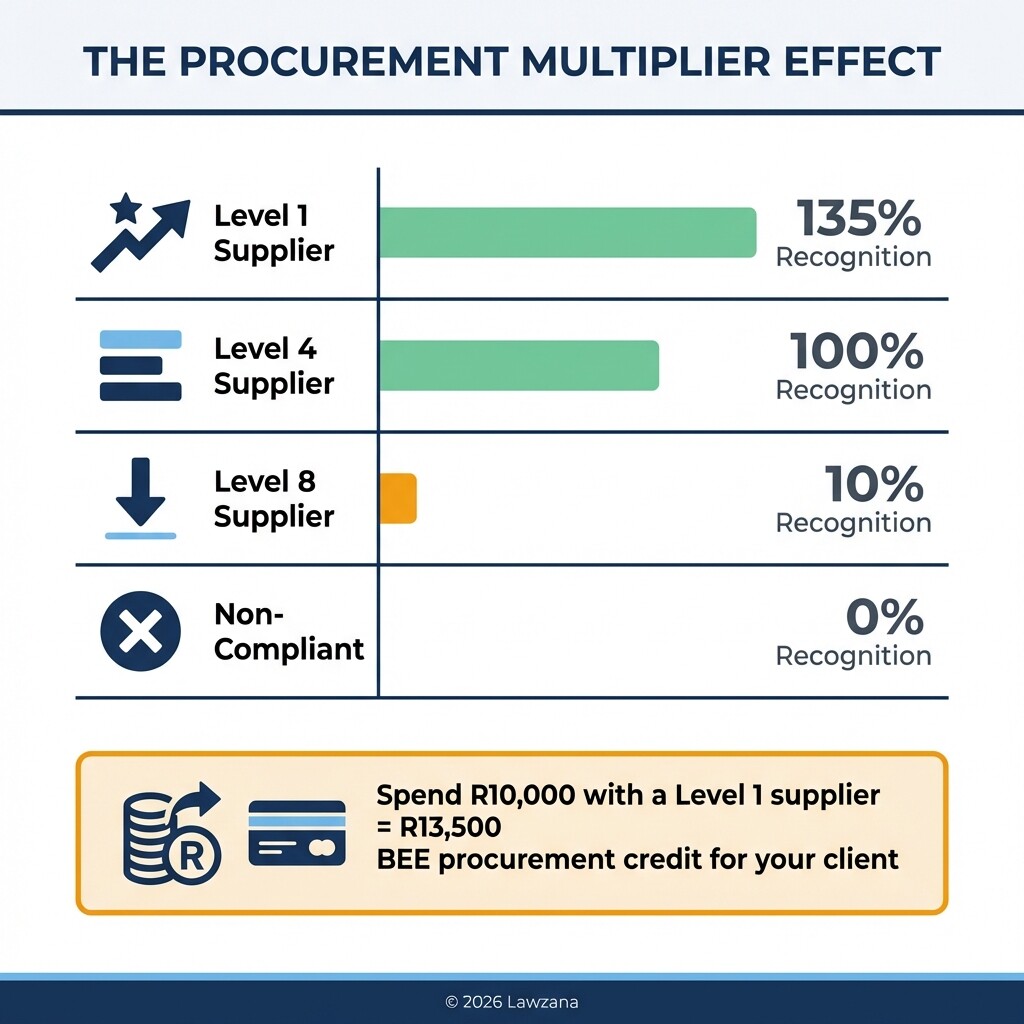
Preferential procurement is a policy that encourages companies to buy goods and services from BEE-compliant suppliers by rewarding them with points on their own scorecards. In the South African B2B landscape, your BEE level is often the deciding factor in whether a large corporation chooses you as a vendor.
When a large company (a "Generic") buys from you, they look at your BEE certificate or affidavit. They can claim a percentage of their spend with you as "BEE procurement spend" based on your level:
- Level 1 Supplier: The client can claim 135% of what they spend with you.
- Level 4 Supplier: The client can claim 100% of what they spend with you.
- Level 8 Supplier: The client can only claim 10% of what they spend with you.
- Non-Compliant: The client claims 0%.
Because the Enterprise and Supplier Development element is worth 40 points on the large company's scorecard, they are financially and legally incentivized to drop non-compliant suppliers in favor of those with Level 1 or Level 2 status. For a small business, being compliant is not just about government work; it is about remaining relevant in the private sector supply chain.
Common Misconceptions about B-BBEE
"B-BBEE is only for big companies."
Many small business owners believe that because they don't deal with the government, they don't need to worry about BEE. However, because of the "chain of compliance" in preferential procurement, private sector clients will demand your BEE status so they can maintain their own scorecard levels.
"I have to give away 51% of my company to be compliant."
Ownership is only one of five elements. While high black ownership provides an easier path to a Level 1 or 2 status (especially for EMEs), a company can still achieve a good BEE level through high scores in Skills Development, Management Control, and Socio-Economic Development.
"B-BBEE certificates are expensive to get."
For EMEs and black-owned QSEs, compliance is virtually free. The use of a Sworn Affidavit removes the need for expensive SANAS audits. You only incur significant costs if your turnover exceeds R50 million or if you are a white-owned QSE needing a full scorecard audit.
FAQ
How long is a B-BBEE certificate or affidavit valid?
Both a SANAS-accredited B-BBEE certificate and a Sworn Affidavit are valid for exactly 12 months from the date of issue or signature. You must renew your status annually based on your most recent financial year-end.
Can a start-up get a B-BBEE certificate?
Yes. New businesses are generally treated as Exempted Micro Enterprises (EMEs) because they have not yet reached the R10 million turnover threshold. You can obtain a "Start-Up" B-BBEE affidavit to use for tenders immediately upon registration.
What is a SANAS-accredited agency?
SANAS (South African National Accreditation System) is the only body authorized to accredit verification agencies. A BEE certificate is only legally valid if it bears the SANAS logo and the unique accreditation number of the agency that performed the audit.
Does B-BBEE apply to foreign companies operating in South Africa?
Yes. Any foreign entity doing business in South Africa is expected to comply with the B-BBEE Codes if they wish to secure government contracts or supply large South African corporations. There are specific "Equity Equivalent" programs for multinationals that cannot sell equity to local partners.
When to Hire a Lawyer
While many small businesses can handle their own B-BBEE affidavits, you should consult a legal professional specializing in B-BBEE and government relations if:
- You are entering into a complex ownership restructuring or Broad-Based Ownership Scheme.
- You are facing an investigation or "site visit" from the B-BBEE Commission regarding potential fronting.
- You are a foreign multinational looking to implement an Equity Equivalent Investment Program (EEIP).
- You need to draft specialized "Trust" documents for employee share schemes to ensure they meet the technical requirements of the Ownership element.
- A state entity has disqualified your tender bid based on a technical BEE dispute.
Next Steps
- Determine your turnover: Look at your most recent financial statements to see if you fall under the EME (under R10m), QSE (R10m-R50m), or Generic (over R50m) category.
- Verify your ownership: Calculate the exact percentage of black ownership (including nuances like "black women ownership") in your company.
- Download the correct template: If you are an EME or black-owned QSE, visit the DTIC website to download the official Sworn Affidavit template.
- Find a Commissioner of Oaths: Take your completed affidavit to a local police station or an attorney to have it commissioned at no cost.
- Review your suppliers: Ask your own vendors for their BEE certificates to ensure you are maximizing your own "Preferential Procurement" points.