- International firms must comply with POPIA if they process personal information within South Africa or use automated or non-automated means situated in the country.
- Compliance is built upon eight specific conditions, ranging from accountability to data subject participation.
- Every organization must appoint and register an Information Officer with the South African Information Regulator to avoid significant penalties.
- Cross-border data transfers are strictly regulated and require an "adequacy" finding, data transfer agreements, or explicit consent from the data subject.
- Data breaches must be reported to both the Information Regulator and the affected data subjects as soon as reasonably possible.
What are the 8 conditions for lawful processing of personal information?
The eight conditions for lawful processing constitute the core of POPIA and dictate how any entity must handle data from collection to destruction. These conditions are not optional; they serve as the legal framework that ensures transparency, security, and purpose-driven data usage.
- Accountability: The "Responsible Party" (the organization) must ensure that all POPIA measures are complied with at the time of determining the purpose and means of processing.
- Processing Limitation: Processing must be lawful, minimal, and conducted with the data subject's consent, unless a specific legal justification (like a contract or legal obligation) applies.
- Purpose Specification: Information must be collected for a specific, explicitly defined, and lawful purpose related to a function or activity of the organization.
- Further Processing Limitation: Once data is collected for a specific purpose, it cannot be used for a different purpose unless that new use is compatible with the original one.
- Information Quality: The organization must take reasonably practicable steps to ensure that personal information is complete, accurate, not misleading, and updated where necessary.
- Openness: You must maintain documentation of all processing operations and notify data subjects when their information is being collected, including what is being collected and why.
- Security Safeguards: You must implement technical and organizational measures to secure the integrity and confidentiality of personal information against loss, damage, or unauthorized access.
- Data Subject Participation: Individuals have the right to request access to their data, ask for its correction, or demand its deletion if it is no longer authorized.
How do you appoint and register an Information Officer?
Every firm operating in South Africa is legally required to have an Information Officer (IO) who serves as the primary point of contact for the Regulator and ensures internal compliance. For international firms, this role is automatically assigned to the head of the organization (such as the CEO or Managing Director) by default, but it can be delegated to a local representative.
To formalize this appointment, follow these steps:
- Identify the Candidate: Select a senior employee who understands the firm's data flow. While the CEO is the default IO, they may delegate the duties to a Deputy Information Officer via a formal letter of delegation.
- Review Responsibilities: The IO is responsible for encouraging compliance, dealing with requests from data subjects, and working with the Information Regulator during investigations.
- Registration: Visit the Information Regulator's official portal to register the IO and any deputies. You will need the firm's registration number, physical address, and the contact details of the appointed officers.
- Update Manuals: Ensure the IO's details are included in your PAIA (Promotion of Access to Information Act) manual, which is another mandatory document in South Africa.
What are the cross-border data transfer restrictions?
South African law prohibits the transfer of personal information to a third party in a foreign country unless specific safety criteria are met. This is particularly relevant for international firms that centralize data processing in Europe, the US, or Asia.
Under Section 72 of POPIA, you may only transfer data across borders if:
- Adequacy: The recipient country has laws or professional rules that provide a level of protection substantially similar to POPIA.
- Data Transfer Agreements (DTAs): You have a binding contract with the recipient that upholds the principles of POPIA.
- Consent: The data subject has explicitly consented to the transfer after being informed of the risks.
- Contractual Necessity: The transfer is necessary for the performance of a contract between the data subject and the firm.
| Transfer Method | Requirement | Recommendation |
|---|---|---|
| Binding Corporate Rules | Internal policies for multinational groups | Best for large firms with multiple global subsidiaries. |
| Standard Contractual Clauses | Specific language embedded in service contracts | Best for B2B service providers and SaaS platforms. |
| Explicit Consent | Clear opt-in from the South African user | Use only when adequacy or contracts are not feasible. |
What are the mandatory breach notification protocols?
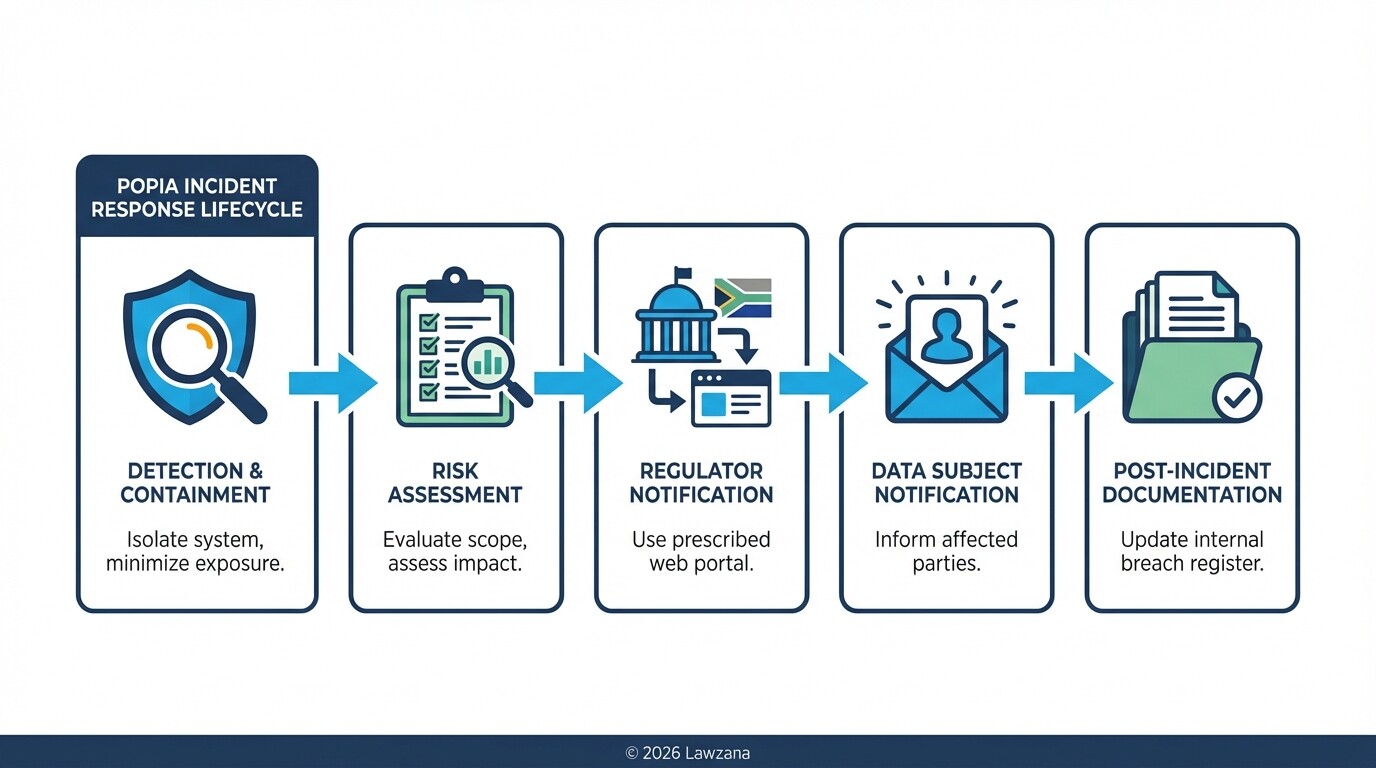
When there are reasonable grounds to believe that personal information has been accessed or acquired by an unauthorized person, POPIA mandates immediate action. Unlike some jurisdictions that provide a specific 72-hour window, South Africa requires notification "as soon as reasonably possible" after the discovery of the compromise.
Your internal protocol should include:
- Detection and Containment: Identify the source of the breach and take immediate steps to secure the data environment.
- Risk Assessment: Determine the scope of the breach, the type of information involved, and the potential impact on data subjects.
- Notification to the Regulator: Use the prescribed form on the Information Regulator's website to report the breach. You must provide a description of the incident and the measures you are taking to mitigate it.
- Notification to Data Subjects: You must notify affected individuals in writing (email or letter) or via a prominent notice on your website if their identity cannot be reached.
- Documentation: Maintain an internal breach register. Even if a small incident does not meet the threshold for reporting, you should document it to prove your "Accountability" under the 8 conditions.
What are the estimated costs for POPIA compliance?
The cost of compliance varies significantly based on the size of the firm and the volume of data processed. For an international firm entering the South African market, budgeting for a "POPIA Audit" and ongoing maintenance is essential to avoid fines that can reach R10 million.
Estimated costs in South African Rand (ZAR):
- Initial Legal Audit: R30,000 to R150,000. This involves mapping data flows, identifying gaps, and drafting the necessary privacy policies.
- PAIA Manual Drafting: R5,000 to R15,000. A statutory requirement for all private and public bodies.
- Staff Training Programs: R10,000 to R50,000. Compliance depends on employees understanding how to handle South African data securely.
- Cybersecurity Software Upgrades: R20,000 to R200,000+ per year. Implementing encryption, multi-factor authentication, and secure firewalls.
- External DPO/Consultant Retainer: R5,000 to R20,000 per month for firms that do not have an in-house compliance team in South Africa.
Common Misconceptions About POPIA
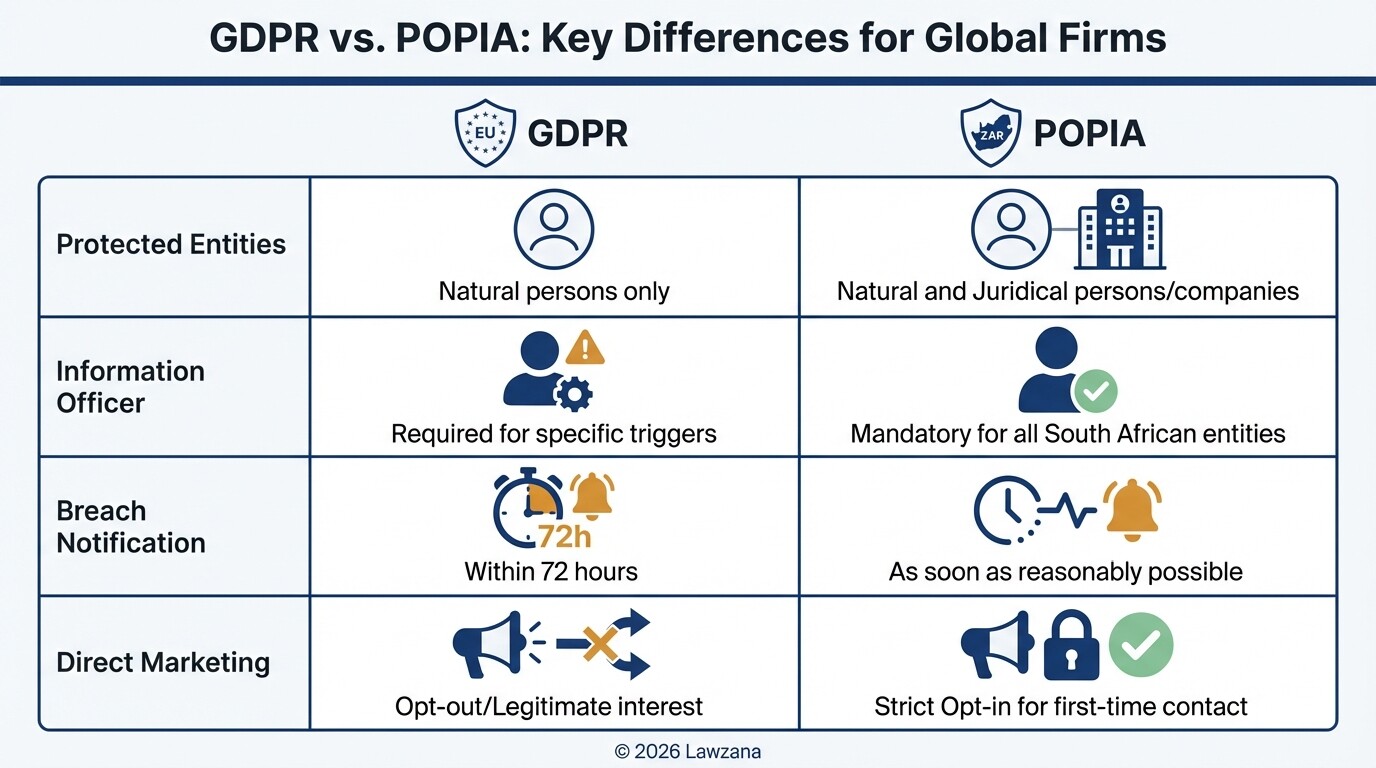
Misconception 1: "We are GDPR compliant, so we are automatically POPIA compliant." While GDPR and POPIA share many similarities, POPIA has unique requirements. For instance, POPIA protects "juridical persons" (companies and legal entities) as data subjects, whereas GDPR generally only applies to natural persons (individuals). You must update your privacy policy to include South African business entities.
Misconception 2: "POPIA doesn't apply to us because our servers are in the US." If you process information about South African residents and maintain a presence or use local resources (even human resources or local agents) to process that data, POPIA applies. The physical location of the server is less important than the "Responsible Party's" connection to South Africa.
Misconception 3: "Only large tech companies get fined." The Information Regulator has clarified that compliance is mandatory for all entities, regardless of size. Smaller firms are often targeted for audits if they experience a breach or if a disgruntled data subject files a formal complaint.
Frequently Asked Questions
Does POPIA apply to B2B data?
Yes. Unlike many global privacy laws, POPIA explicitly protects the data of "juridical persons." This means information about South African companies (e.g., their banking details or confidential business addresses) is protected the same way as an individual's personal data.
Can a firm be imprisoned for POPIA violations?
Yes. In extreme cases involving serious offenses-such as obstructing the Regulator or failing to comply with an enforcement notice-the Act allows for a prison sentence of up to 10 years for the Information Officer or directors.
Is there a grace period for new firms?
The general grace period for POPIA ended in July 2021. New international firms entering South Africa are expected to be compliant from the moment they begin processing local data.
When to Hire a Lawyer
Navigating South African privacy law requires more than just a template policy. You should consult a lawyer or a specialized compliance firm if:
- You are transferring large volumes of sensitive data (health, biometric, or children's data) outside of South Africa.
- You have experienced a data breach and need to manage the legal notification process to minimize liability.
- You are unsure if your existing global "Binding Corporate Rules" meet the specific adequacy standards of the South African Information Regulator.
- You need to draft a bespoke Data Transfer Agreement (DTA) for a high-value local partnership.
Next Steps
To begin your compliance journey, first identify your South African Information Officer and ensure they are registered with the Regulator. Conduct a thorough data mapping exercise to understand exactly where South African data enters your system and where it is stored globally. Finally, update your public-facing privacy policy and internal PAIA manual to reflect the specific protections afforded to South African data subjects, including both individuals and businesses.