South African Trade Law Compliance: Export Costs Guide
- Complying with South African export controls costs businesses between ZAR 50,000 and ZAR 150,000 annually, depending on trade volume and product classification.
- Proactive customs audits are significantly cheaper than tariff disputes, which trigger penalties of up to three times the value of the misclassified goods.
- Using Southern African Development Community (SADC) trade agreements and Special Economic Zones (SEZs) legally reduces cross-border delays and lowers tariff burdens.
- Appealing a customs decision by the South African Revenue Service (SARS) follows a strict administrative process, with costs ranging from ZAR 20,000 for basic appeals to over ZAR 500,000 for High Court litigation.
- Multinational exporters must hold a valid Customs Client Number (CCN) and the appropriate International Trade Administration Commission (ITAC) permits before initiating shipments.
Estimating Export Control and Customs Compliance Costs
Complying with South African export controls costs businesses between ZAR 50,000 and ZAR 150,000 annually in legal and administrative fees. These costs scale with trade volume and product classification. Following the rules set by local regulators prevents border delays and cargo seizures.
Any entity importing or exporting goods commercially must hold a unique Customs Client Number (CCN) issued by SARS. Additionally, exporters need an ITAC permit. Standard ITAC export permit applications take between 5 to 14 working days to process if all documentation is accurate. Multinational exporters must budget for initial registration and ongoing compliance maintenance. Failing to secure the right permits or using incorrect tariff codes results in immediate financial penalties.
| Compliance Activity | Estimated Cost (ZAR) | Frequency |
|---|---|---|
| SARS Customs Registration (CCN) | 5,000 to 15,000 | One-time (plus minor renewal fees) |
| ITAC Export Permit Applications | 10,000 to 30,000 | Per application/product category |
| Annual Customs Compliance Audit | 30,000 to 80,000 | Annually |
| Origin Determination Certificates | 5,000 to 20,000 | Per new product line |
South African Trade Compliance Checklist
A proactive compliance strategy prevents goods from being seized by Customs at South African ports. Use this checklist to ensure your export operations meet all local regulatory standards before shipping.
- Obtain a CCN: Ensure your business is registered as an exporter with SARS.
- Verify ITAC requirements: Check the International Trade Administration Commission (ITAC) control lists to determine if your specific goods require an export permit.
- Determine exact tariff headings: Classify your goods accurately under the Harmonized System (HS) used in Schedule 1 of the Customs and Excise Act.
- Secure certificates of origin: Obtain valid origin certificates if you are exporting under preferential trade agreements like the SADC protocol or the African Continental Free Trade Area (AfCFTA).
- Screen for restricted goods: Confirm your products do not fall under environmental, agricultural, or security restrictions that require clearance from other government departments.
Tariff Disputes vs. Proactive Legal Audits
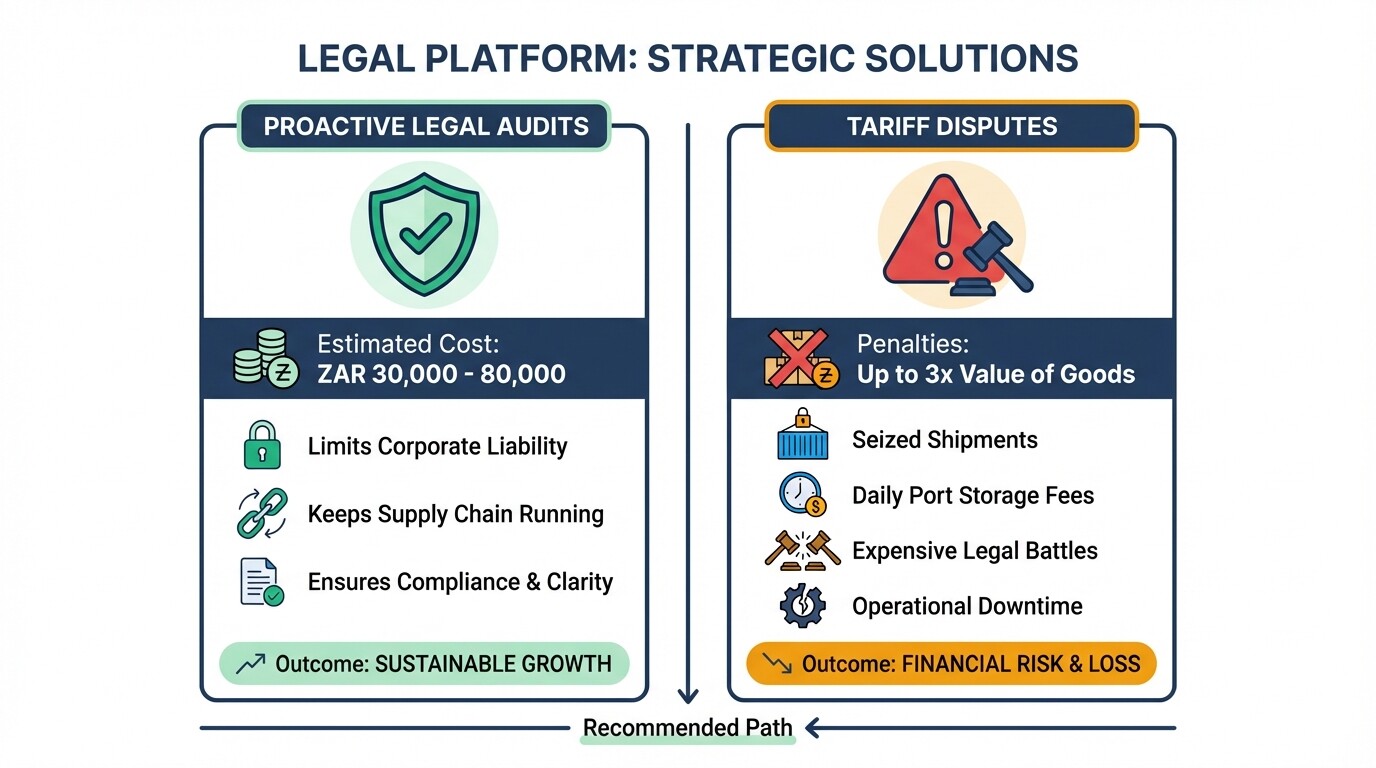
Investing ZAR 30,000 to ZAR 80,000 in a customs audit is cheaper than paying tariff dispute penalties, which reach up to three times the value of the goods. South African customs authorities strictly enforce valuation and classification rules under the Customs and Excise Act.
If SARS determines that an incorrect tariff code was used to intentionally evade duties or bypass restricted goods protocols, they have statutory authority to seize the shipment. When SARS detects a misclassification or undervaluation during a border inspection, they issue a letter of demand for underpaid duties plus administrative penalties.
A legal audit by trade specialists reviews your HS classifications, transfer pricing policies, and origin documentation before goods reach the border. This limits corporate liability and keeps your supply chain running. Companies that wait for SARS to initiate an audit face seized shipments, daily port storage fees, and legal battles that exceed the cost of early compliance measures.
Structuring Alternative Supply Chains to Minimize Trade Friction
Restructuring supply chains to use regional trade agreements or Special Economic Zones (SEZs) lowers tariff burdens and bypasses congested ports.
South Africa provides several legal mechanisms for multinational exporters. Establishing a presence in an SEZ like Coega or Dube TradePort offers Value-Added Tax (VAT) relief and employment tax incentives, as well as customs-controlled areas that defer duties. Exporters can also use bonded warehouses. A bonded warehouse lets a company import raw materials into South Africa duty-free, manufacture or assemble the final product, and export it without paying local consumption taxes. Following the South African Revenue Service (SARS) Customs and Excise guidelines ensures these structures comply with national law.
Navigating the Costs of Appealing Customs Decisions
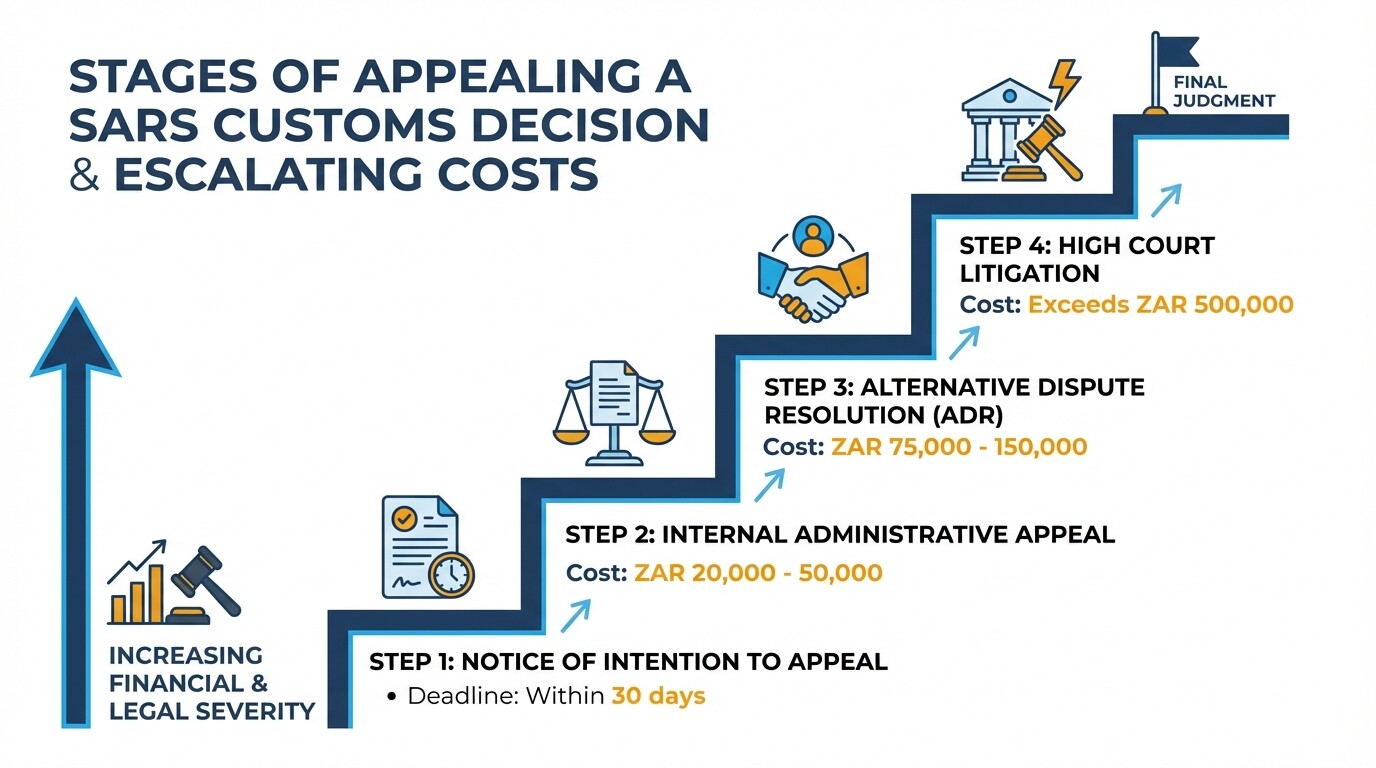
Appealing a SARS customs decision involves an internal administrative appeal followed by potential Alternative Dispute Resolution (ADR) or High Court litigation. Legal costs range from ZAR 20,000 to over ZAR 500,000. Exporters must strictly adhere to statutory deadlines.
If goods are detained or you receive a penalty assessment, you must submit a Notice of Intention to Appeal within 30 days. The internal administrative appeal costs between ZAR 20,000 to ZAR 50,000 in legal fees to draft technical arguments regarding tariff classification or valuation. If SARS rejects the internal appeal, exporters move to formal ADR. ADR is less formal than litigation but requires trade counsel, generally costing between ZAR 75,000 and ZAR 150,000. If ADR fails, the final step is the High Court of South Africa. High Court litigation often exceeds ZAR 500,000 and is reserved for high-value shipments or establishing legal precedents.
Local Trade Agents vs. In-House Legal Teams
Hiring a local South African customs clearing agent offers on-the-ground expertise and lower fixed costs compared to an in-house legal team. High-volume exporters, however, often prefer an internal team for long-term risk control. Multinational corporations weigh operational volume against the legal risks of outsourcing compliance.
| Feature | Local Trade Agent / Customs Broker | In-House Trade Legal Team |
|---|---|---|
| Average cost | Variable (ZAR 1,000 to 5,000 per clearance) | Fixed (ZAR 800,000+ annually per lawyer) |
| Expertise | Deep knowledge of local port procedures | Broad knowledge of corporate strategy and global trade |
| Liability | Exporter remains legally liable for agent errors | Direct internal accountability and oversight |
| Best for | Low to medium volume exporters | High volume exporters with complex supply chains |
Common Misconceptions About South African Trade Compliance
Exporters often operate under false assumptions about South African trade law, leading to penalties and shipment seizures.
- Forwarders assume legal liability: Businesses often believe hiring a freight forwarder transfers responsibility for accurate customs declarations. Under South African law, the exporter of record remains strictly liable for any misclassifications or under-declarations made by their agents.
- SADC exports skip customs: Exporters sometimes assume free trade agreements eliminate formal customs processing. While duties decrease or disappear, all goods leaving South Africa must be declared to SARS with valid certificates of origin.
- ITAC permits mean military goods: Exporters frequently overlook ITAC permit requirements for civilian goods. ITAC regulates scrap metal, agricultural products, and dual-use technologies, requiring explicit export permission.
When to Hire an International Trade Lawyer
Engage a South African international trade lawyer if SARS issues a letter of demand, seizes a shipment, or if you restructure your cross-border supply chain. Early legal intervention preserves your right to appeal and keeps administrative errors from escalating into litigation.
Trade lawyers manage the transition from a standard export model to a complex bonded warehouse or Special Economic Zone setup. They align internal compliance programs with local authority requirements. Connect with international trade lawyers in South Africa through the Lawzana directory to find vetted legal professionals specializing in customs disputes and export regulations.
Next Steps
Conduct an audit of your current tariff classifications and valuation methods. Review your contracts with local clearing agents to ensure compliance liabilities are clearly defined. Exporters lacking internal trade compliance expertise must consult a specialized trade attorney to establish a legal strategy before their next major shipment.