- Penalty Caps: Under the Commercial Law 2005, monetary penalties for breaches are capped at 8% of the value of the breached obligation portion, unless otherwise specified in specialized laws.
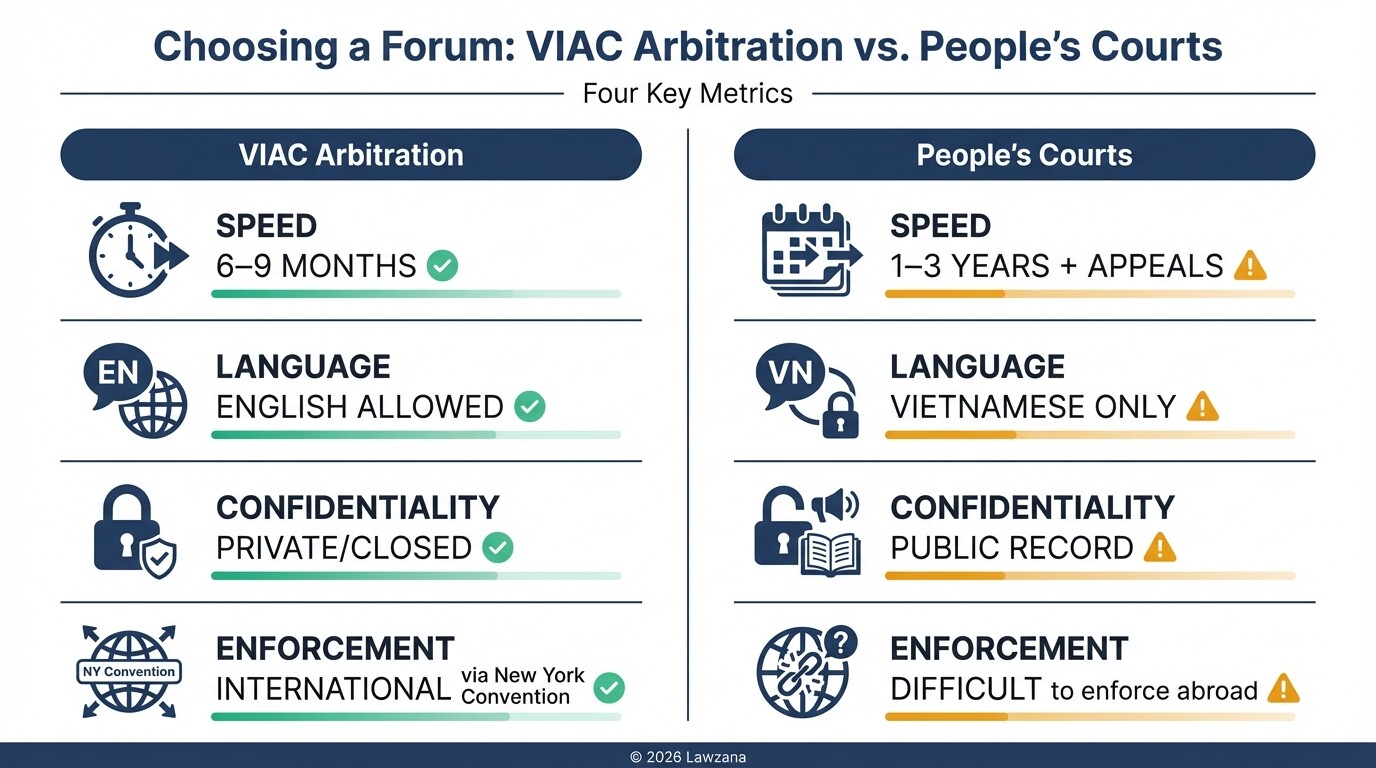
- Arbitration Preference: International brands should favor the Vietnam International Arbitration Centre (VIAC) over local courts to ensure neutrality, confidentiality, and faster resolution.
- Proof of Loss: While penalties are capped, "compensation for damages" is not; however, the claimant must provide rigorous evidence of actual, direct loss.
- Interim Measures: Asset freezing and preliminary injunctions are available but typically require the claimant to post a financial security bond with the court or tribunal.
- Quality Control (QC) Precision: Disputes often fail for brands because contracts use vague quality descriptors rather than technical specifications or Acceptable Quality Levels (AQL).
Manufacturing Dispute Mitigation Checklist and Sample Clauses
To resolve or prevent manufacturing disputes in Vietnam, your contract must move beyond generic templates and address local statutory limitations. Use this checklist and the sample language below to strengthen your legal standing.
Manufacturing Contract Checklist
- Detailed Specifications: Are technical drawings, material grades, and tolerances attached as an inseparable appendix?
- Inspection Rights: Does the contract grant the buyer the right to unannounced factory visits and third-party inspections during production?
- Penalty vs. Damage Distinction: Does the contract clearly distinguish between "Penalties" (subject to the 8% cap) and "Compensation for Damage" (not capped)?
- Governing Law and Forum: Is the dispute resolution forum clearly identified (e.g., VIAC) and the governing law set to the Laws of Vietnam?
- Language Supremacy: In bilingual contracts, is there a clause stating that the English version prevails in case of discrepancies?
Sample Dispute Resolution Clause (VIAC Optimized)
"Any dispute arising out of or in relation to this Contract shall be referred to and finally resolved by arbitration at the Vietnam International Arbitration Centre (VIAC) in accordance with its Rules of Arbitration. The number of arbitrators shall be [one or three]. The seat of arbitration shall be [Hanoi or Ho Chi Minh City], Vietnam. The language of the arbitration shall be English."
Sample Liquidated Damages and Compensation Clause
"In the event of a breach of delivery timelines, the Seller shall pay a penalty of 8% of the value of the delayed portion of the Goods. In addition to this penalty, the Seller shall be liable to compensate the Buyer for all actual losses, including but not limited to loss of profits and third-party claims, resulting from said breach, provided that the Buyer can demonstrate such losses in accordance with the Commercial Law of Vietnam."
Common Triggers for Breach in Vietnamese Garment and Tech Manufacturing
Breach of contract in Vietnam's manufacturing sector typically stems from capacity overestimation or unauthorized sub-contracting. As international demand fluctuates, Vietnamese suppliers may take on more orders than their production lines can handle, leading to significant delays or quality shortcuts.
In the garment industry, the most frequent trigger is the "substitution of materials." Suppliers may swap specified fabrics for lower-grade alternatives to maintain margins when raw material costs rise. In the tech and electronics sector, breaches often involve Intellectual Property (IP) leakage, where a supplier uses a brand's proprietary molds or designs to produce "overrun" stock for sale on secondary markets. Because Vietnamese law treats these as both contractual breaches and IP infringements, the legal remedy must be multi-pronged.
Enforcement of Liquidated Damages Clauses in Vietnamese Courts
Enforcing liquidated damages in Vietnam requires a clear understanding of Article 301 of the Commercial Law 2005. Vietnamese law differentiates between "penalties for breach" and "compensation for damage," a distinction that often confuses foreign investors.
If a contract specifies a "penalty," the court or arbitrator will strictly enforce the 8% cap relative to the value of the breached portion of the contract. Any amount stipulated above this cap is legally void and will be reduced. However, "compensation for damage" aims to put the non-breaching party in the position they would have been in had the breach not occurred. There is no statutory cap on compensation, but the burden of proof is high. You must provide a "Calculation of Loss" that includes direct costs and documented lost profits. For the best protection, contracts should explicitly state that the non-breaching party is entitled to both the 8% penalty and full compensation for proven damages.
Common Mistakes: Inadequate Quality Control Definitions
The most common mistake international brands make is using subjective language like "high quality," "industry standard," or "merchantable condition" in their manufacturing agreements. Under Vietnamese law, if a quality standard is not clearly defined, the court may default to the "standard applicable to the same type of goods" in the local market, which is often lower than international brand requirements.
To avoid this, contracts must incorporate specific Technical Data Sheets (TDS) and specify the "Acceptable Quality Level" (AQL). If a shipment fails an AQL 2.5 inspection, for example, the contract should define this failure as a material breach, giving the buyer the right to reject the entire lot. Without these objective metrics, a Vietnamese supplier can argue that the goods are functional and that the brand is "unreasonably" withholding payment, potentially turning the brand into the breaching party.
Alternatives to Court: Leveraging VIAC (Vietnam International Arbitration Centre)
The Vietnam International Arbitration Centre (VIAC) is the primary alternative to the local court system and is widely regarded as the most effective forum for resolving manufacturing disputes. Arbitration at VIAC offers several advantages over litigation in the People's Courts, including the ability to select arbitrators with specific technical expertise in garments or electronics.
Unlike court proceedings, which are conducted in Vietnamese and are generally public, VIAC proceedings can be conducted in English and are strictly confidential. This is vital for brands looking to protect their reputation and trade secrets. Furthermore, Vietnam is a signatory to the New York Convention, meaning VIAC awards are enforceable in over 160 countries. In practice, VIAC is significantly faster, with most cases concluding within 6 to 9 months, whereas court litigation can drag on for years through various levels of appeal.
Strategies for Asset Freezing and Preliminary Injunctions
When a dispute arises, the immediate risk is that the Vietnamese supplier will liquidate assets or move equipment to avoid a future judgment. To prevent this, brands can apply for "provisional urgent measures" under the Civil Procedure Code of Vietnam.
Common measures include:
- Distraint of disputed assets: Preventing the supplier from selling the specific goods or raw materials in question.
- Freezing bank accounts: Locking the supplier's funds up to the value of the claim.
- Prohibiting certain acts: Stopping the supplier from using proprietary molds or designs.
To obtain these measures, the claimant must usually provide a financial security. This typically involves depositing cash, gold, or a bank guarantee into a blocked account held by the court or tribunal. The security amount is usually set at a percentage of the value of the assets being frozen to compensate the supplier if the injunction is later found to be groundless.
Common Misconceptions About Vietnamese Contract Law
- "The 8% cap applies to everything": This is false. The cap only applies to "penalties." Actual damages and interest on late payments are not subject to this 8% limitation.
- "Foreign law is always better": Many brands insist on New York or English law. However, if the factory and assets are in Vietnam, a local court may refuse to enforce a foreign judgment if it conflicts with "basic principles of Vietnamese law." Using Vietnamese law with VIAC arbitration is often the most enforceable path.
- "An email isn't a contract": Under the Civil Code 2015, data messages (emails, Zalo, or WhatsApp messages) are recognized as valid written evidence of contractual agreements and amendments if they meet certain authenticity requirements.
FAQ
Can I terminate a manufacturing contract immediately if a supplier is late?
Immediate termination is only possible if "material breach" is clearly defined in the contract to include delivery delays. Otherwise, Vietnamese law usually requires you to provide a "reasonable" cure period before termination.
How much does it cost to start a VIAC arbitration?
Fees are based on the "value of the dispute." For a claim of $100,000 USD, the arbitration fee is approximately 4% to 6%, though this percentage decreases as the claim value increases.
Will a Vietnamese court enforce a judgment from my home country?
Enforcement of foreign court judgments in Vietnam is difficult and rare, as it requires a bilateral treaty or the principle of reciprocity. This is why arbitration (via the New York Convention) is the preferred method for international brands.
When to Hire a Lawyer
You should consult a Vietnamese legal expert if:
- The value of the disputed goods exceeds $50,000 USD.
- The supplier is holding your proprietary molds, equipment, or raw materials and refusing to return them.
- You need to apply for an emergency asset freeze to prevent the supplier from disappearing.
- You are drafting a master manufacturing agreement and need to ensure your "compensation" clauses are enforceable despite the 8% penalty cap.
Next Steps
- Audit Your Current Contracts: Review your existing agreements for the 8% penalty cap and the specificity of your Quality Control (QC) metrics.
- Document Everything: Collect all correspondence (emails, chat logs) and inspection reports related to the breach.
- Issue a Formal Notice: Send a formal "Notice of Default" via registered mail to the supplier's registered office address in Vietnam to establish a timeline for the dispute.
- Consult an Arbitrator: If the dispute remains unresolved after 15 days, contact a legal advisor to prepare a Request for Arbitration with VIAC.