


- Foreign investors acquiring Canadian businesses must comply with the Investment Canada Act (ICA). Recent amendments introduce stricter pre-closing filing requirements for 2026.
- Acquisitions involving sensitive technologies, critical minerals, or personal data trigger mandatory extended national security screening, even for minority investments.
- Financial thresholds for automatic "net benefit" reviews are indexed annually. These range from CAD 528 million to over CAD 1.3 billion, depending on the buyer's origin and trade agreements.
- Failing to file a required pre-implementation notification carries fines of up to CAD 500,000 per day and the risk of forced divestiture.
- Buyers can minimize delays through early consultation and by structuring mitigation undertakings before formal filing.
Financial thresholds for automatic ICA reviews in 2026
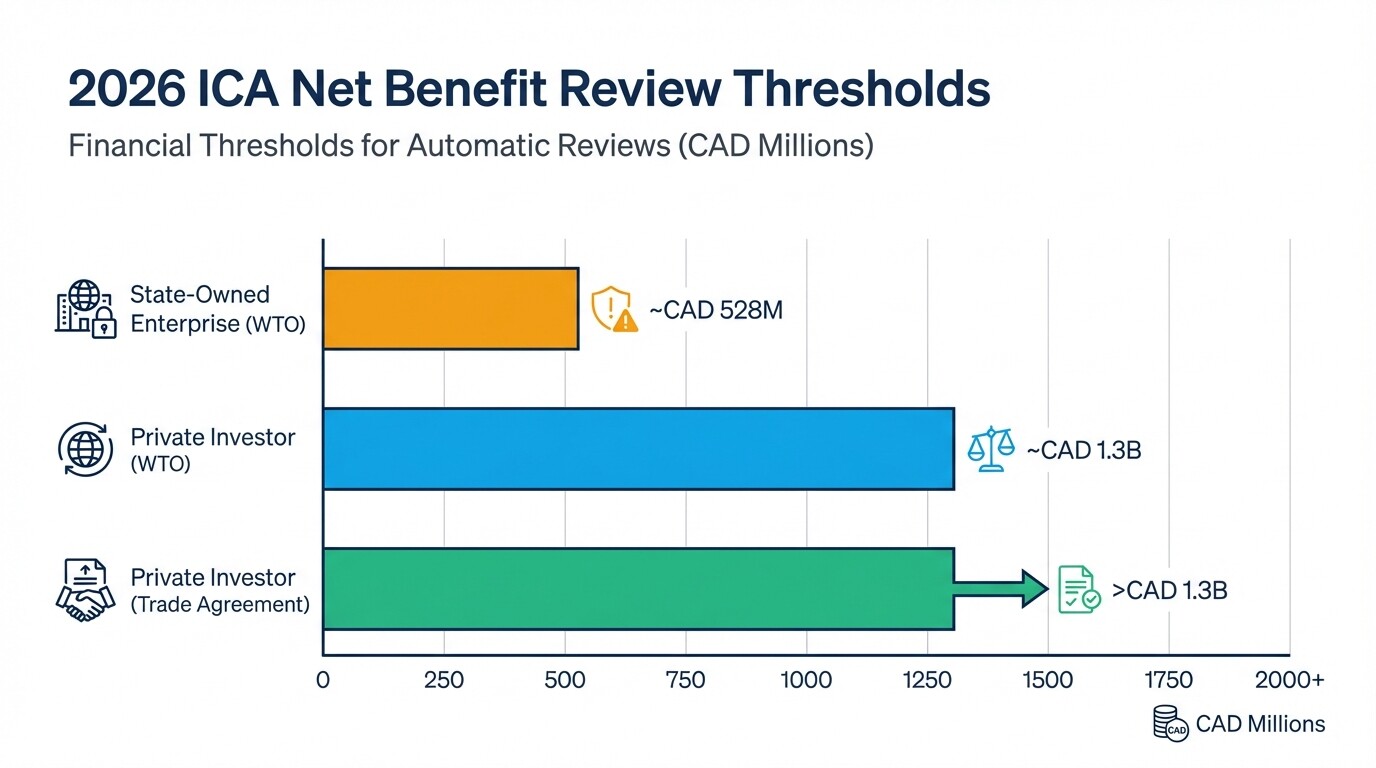
The financial thresholds for an automatic "net benefit" review under the Investment Canada Act depend on the buyer's home country and whether they are a state-owned enterprise. If an acquisition exceeds these annually indexed values, the buyer must secure ministerial approval before closing the deal.
The Canadian government indexes these thresholds every year based on GDP growth. For 2026, foreign buyers must evaluate their transactions against three primary investor categories.
First, private investors from countries with direct trade agreements with Canada (such as the United States, the European Union, and Japan) face the highest threshold. This is typically over CAD 1.3 billion in enterprise value.
Second, private investors from World Trade Organization (WTO) member states without a specific bilateral trade agreement face a lower threshold. This generally sits around CAD 1.3 billion in enterprise value.
Finally, state-owned enterprises face strict scrutiny. The government evaluates any acquisition by a state-owned enterprise from a WTO member state based on book value. This threshold is set significantly lower, usually around CAD 528 million.
You can verify the exact indexed amounts for the current calendar year directly on the Innovation, Science and Economic Development Canada (ISED) thresholds page.
How expanded national security screening impacts cross-border tech acquisitions
The modernized national security screening rules require foreign acquisitions involving sensitive technologies to undergo pre-closing reviews, regardless of transaction size. This applies to deals involving artificial intelligence, quantum computing, critical minerals, and large-scale personal data processing.
Under the updated framework, the Canadian government requires buyers in prescribed technology sectors to file a notification before closing. Previously, many of these transactions only required a post-closing notification. The updated rules allow the Minister of Innovation, Science and Industry to pause transactions, request technical blueprints, and assess whether the foreign acquirer has ties to foreign governments.
For cross-border tech acquisitions, minority investments and early-stage venture capital rounds are now subject to regulation. If a foreign entity acquires a non-controlling stake in a Canadian tech startup with sensitive intellectual property, the transaction will trigger a national security review. Dealmakers must build longer conditional closing periods into their purchase agreements to account for this.
2026 ICA Review Timeline: Filing to Approval
The standard Investment Canada Act review process takes between 45 and 200 days. This timeline depends heavily on whether the transaction triggers a national security review. Foreign acquirers should build these statutory timelines into their merger agreements.
The table below outlines the mandatory waiting periods and review phases under the updated rules.
| Phase | Timeframe | Regulatory Action |
|---|---|---|
| Initial filing | Day 1 | Buyer files the Application for Review or pre-implementation notification. The statutory clock begins once ISED certifies the filing as complete. |
| Net benefit review | Days 1 to 45 | The Minister evaluates the economic benefit to Canada. This period can be extended by 30 days at the Minister's discretion. |
| Security screening | Days 1 to 45 | Security agencies assess the deal simultaneously. If they identify risks, the Minister issues a notice of potential national security review. |
| Extended security review | Days 45 to 90 | An active national security review pauses the transaction. The government has another 45 days to investigate and request information. |
| Final decision | Days 90 to 200+ | The Governor in Council issues a final order to block the deal, authorize it with mitigation conditions, or allow it to proceed. Further extensions require buyer consent. |
Penalties for failing to file pre-implementation notifications
Foreign acquirers who fail to file mandatory pre-implementation notifications under the Investment Canada Act face financial penalties and potential deal unwinding. Recent amendments increased enforcement mechanisms to deter companies from bypassing national security protocols.
If an international buyer closes a transaction in a prescribed sensitive sector without filing the required pre-implementation notice, the government can issue fines of up to CAD 500,000 for every day the violation continues. This daily penalty accumulates quickly.
Beyond monetary fines, the Minister can seek court injunctions to stop the integration of the target company. If a closed deal presents a realized threat to national security, the Canadian government can order a forced divestiture. This requires the foreign buyer to sell off the acquired Canadian assets, completely voiding the merger.
Strategies to prevent delays during the mandatory review period
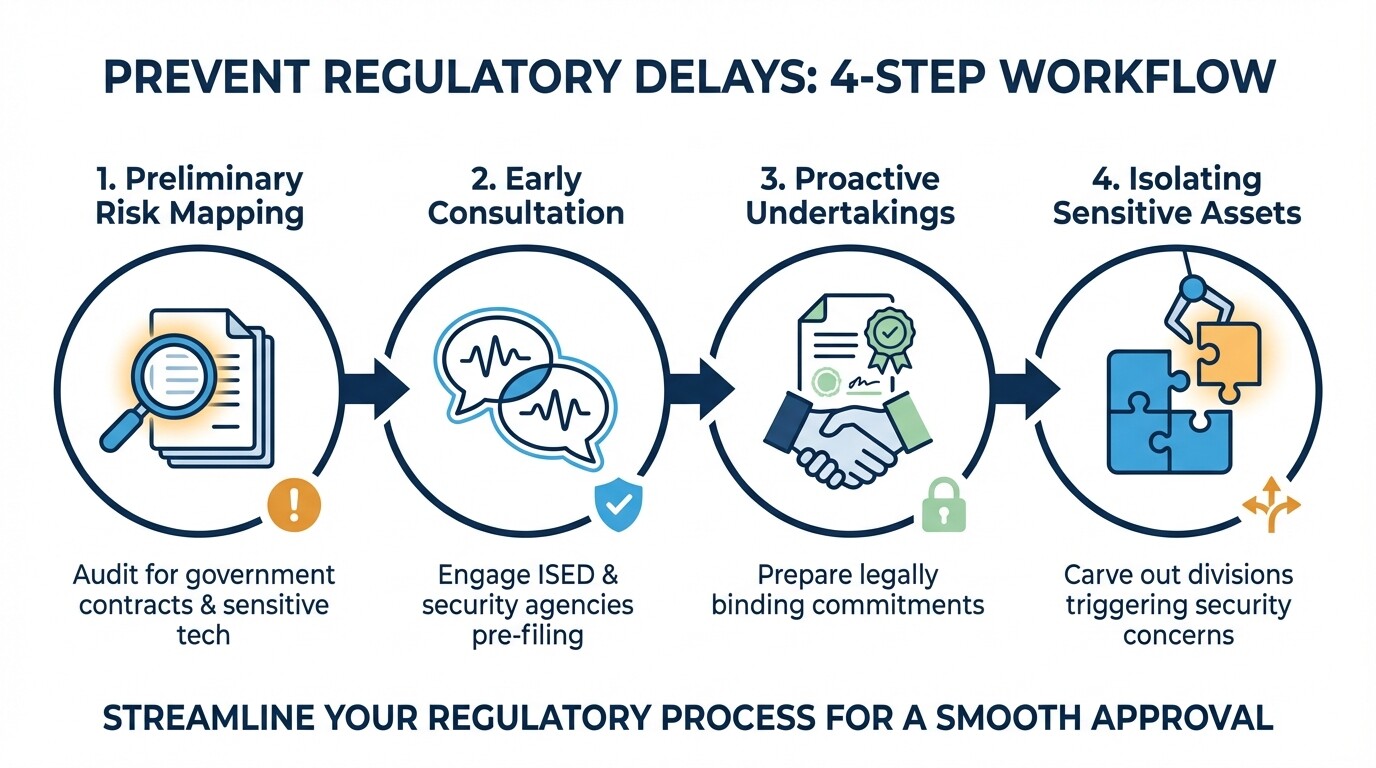
Buyers can prevent regulatory delays by identifying national security risks early and engaging with the Investment Review Division before formal filing. Structuring the deal to account for regulatory requirements keeps a transaction on schedule.
To streamline the review process, acquirers should execute these steps during due diligence:
- Preliminary risk mapping: Audit the Canadian target company for government contracts, sensitive technology patents, and critical mineral assets before signing a letter of intent.
- Early consultation: Use the pre-filing consultation process to discuss the transaction with ISED and security agencies to gauge potential friction.
- Proactive undertakings: Prepare legally binding commitments, such as maintaining a Canadian headquarters or retaining local employees, to submit with the initial application.
- Isolating sensitive assets: If a target company has a specific division that triggers national security concerns, consider carving out and excluding that division from the acquisition.
Common Misconceptions About Canadian Foreign Investment Reviews
Minority investments. Many international investors assume that acquiring less than 50 percent of a Canadian company exempts them from regulatory scrutiny. The Investment Canada Act's national security provisions apply directly to minority investments and joint ventures. The government can investigate and block the acquisition of a small equity stake if it involves sensitive data or technology.
Post-closing notifications. Historically, buyers could acquire non-sensitive small businesses and notify the government within 30 days after closing. Under the modernized rules, acquisitions in prescribed sectors like artificial intelligence and quantum computing require a mandatory pre-closing notification, regardless of the transaction's financial size.
Frequently Asked Questions
What qualifies as a state-owned enterprise under Canadian M&A law?
A state-owned enterprise is any entity owned, controlled, or directly influenced by a foreign government. This includes sovereign wealth funds, government pension plans, and private corporations whose board members are appointed by foreign state officials.
How long does a standard net benefit review take if no security issues arise?
A standard net benefit review is generally completed within 45 days. The Minister of Innovation, Science and Industry has the authority to extend this initial period by an additional 30 days to finalize the economic evaluation.
Can a blocked acquisition be appealed in Canadian courts?
Decisions made by the Governor in Council regarding national security reviews are highly discretionary. A buyer can file an application for judicial review in the Federal Court. However, the court will only examine whether the government followed correct legal procedures, not whether the national security assessment was factually correct.
Are asset purchases treated differently than share purchases?
Both asset purchases and share purchases are subject to the Investment Canada Act. If a foreign investor acquires substantially all the assets used in carrying on a Canadian business, the transaction is treated as an acquisition of control. It faces the exact same threshold calculations and national security screenings as a share purchase.
When to Hire a Lawyer
Foreign acquirers should retain Canadian legal counsel during the preliminary term sheet phase of a cross-border transaction. Navigating the Investment Canada Act requires specialized knowledge, particularly when assessing whether a target company's operations fall under the prescribed sensitive technology categories. A lawyer will evaluate statutory thresholds, manage communications with the Investment Review Division, and draft mitigation undertakings to help secure ministerial approval.
Next Steps
To move forward with a cross-border acquisition in Canada, conduct a regulatory audit of your target company to identify potential national security triggers or net benefit threshold requirements. Gather detailed information regarding the target's supply chain, government contracts, and data processing activities. Once you have this baseline data, connect with specialized Merger & Acquisition Lawyers in Canada to formulate your regulatory filing strategy and draft pre-implementation notifications.
