


How Foreign Subsidiaries in Canada Can Comply With 2026 Export Controls
Key Takeaways
Navigating the 2026 updates to Canadian trade regulations requires foreign subsidiaries to localize their compliance protocols rather than relying entirely on global corporate frameworks. The revised regulatory environment enforces strict localized auditing and screening measures.
- Distinct Legal Frameworks: Canada's Special Economic Measures Act operates independently of US OFAC regulations, requiring local subsidiaries to run Canada-specific denied party screenings.
- Strict Audit Timelines: Under 2026 guidelines, subsidiaries must finalize their mandatory annual export compliance audits within 90 days of their corporate fiscal year-end.
- Permit Requirements: Exporting controlled technology or dual-use goods demands a formal permit from Global Affairs Canada via the EXCOL system before any transfer happens.
- Proactive Mitigation: Voluntarily disclosing violations to the Canada Border Services Agency can substantially reduce corporate fines and protect executives from liability.
Canada's SEMA vs. US OFAC Regulations: Key Differences
While the US Office of Foreign Assets Control (OFAC) relies on extensive extraterritorial reach, Canada's Special Economic Measures Act (SEMA) enforces targeted sanctions specific to Canadian geopolitical interests and domestic operations. Foreign subsidiaries located in Canada must comply with SEMA independently, even if their parent company's OFAC alignment appears comprehensive.
Multinational corporations often struggle when navigating the conflicting demands of these two regulatory bodies. Understanding the jurisdictional boundaries is critical for preventing cross-border compliance failures.
| Feature | Canada (SEMA) | United States (OFAC) |
|---|---|---|
| Primary Focus | Targeted sanctions aligned with Canadian foreign policy and UN mandates. | Broad comprehensive sanctions with aggressive extraterritorial enforcement. |
| Jurisdictional Reach | Applies to any person in Canada and any Canadian citizen or business abroad. | Applies to US persons globally, foreign entities dealing in US dollars, and US-origin goods. |
| Screening Lists | Consolidated Canadian Autonomous Sanctions List. | Specially Designated Nationals (SDN) List and Sectoral Sanctions Identifications. |
| Facilitation Rules | Prohibits Canadians from facilitating transactions that would be illegal if done directly. | Strict prohibitions on US persons approving or supporting foreign subsidiary actions with sanctioned parties. |
2026 Compliance Timeline: The 90-Day Audit Requirement
Starting in 2026, foreign subsidiaries operating in Canada must complete their mandatory annual export compliance audits within 90 days of their corporate fiscal year-end. Failure to meet this strict deadline can trigger automatic regulatory reviews and potentially result in severe administrative monetary penalties.
This audit must thoroughly examine all cross-border transactions, technology transfers, and internal compliance training records from the preceding year. Corporations should structure their audit process to capture these critical components:
- Transaction Review: Sample and evaluate all exports, re-exports, and deemed exports (technology transfers to foreign nationals within Canada) for proper permit authorization.
- Screening Protocol Check: Verify that the subsidiary's automated compliance software successfully updated and checked against the most current Canadian sanctions lists throughout the year.
- Recordkeeping Audit: Ensure all export documentation, including end-user certificates and customs declarations, are securely retained for the mandatory six-year period.
- Corrective Action Implementation: Document any discrepancies found during the year and log the exact corrective measures taken to prevent recurrence.
How to Apply for Export Permits Through Global Affairs Canada
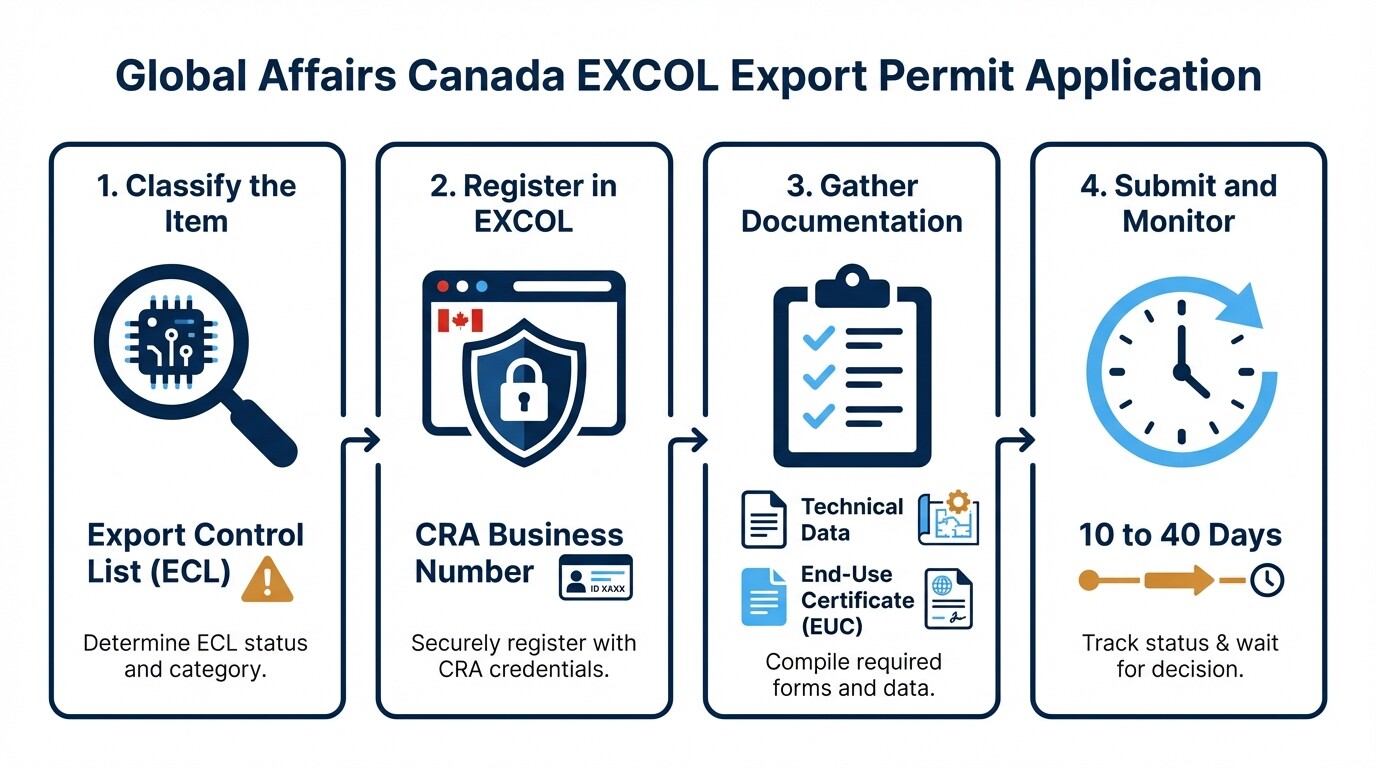
Exporting controlled technology and dual-use goods from Canada requires a formal permit from Global Affairs Canada (GAC) before any physical or electronic transfer occurs. Businesses must submit all applications through the Export Controls On-Line (EXCOL) system, ensuring all technical specifications and end-user details are accurately documented.
Dual-use goods are items designed for commercial use but possess capabilities that could be adapted for military applications. To secure an export permit under the Export and Import Permits Act, foreign subsidiaries must follow a highly structured submission process:
- Classify the Item: Determine the exact item control number against Canada's Export Control List (ECL). If unsure, you can request an advisory opinion from GAC.
- Register in EXCOL: Create a recognized business profile within the EXCOL portal using your Canada Revenue Agency business number.
- Gather Required Documentation: Prepare technical data sheets, commercial invoices, and a signed End-Use Certificate (EUC) from the foreign buyer detailing exactly how the technology will be utilized.
- Submit and Monitor: File the application through EXCOL. Processing times typically range from 10 to 40 days, depending on the destination country and the sensitivity of the controlled technology.
Common Misconceptions About Canadian Export Controls
Many multinational companies mistakenly assume that mirroring their parent company's compliance program will fully satisfy Canadian regulatory authorities. This approach leaves local Canadian subsidiaries vulnerable to severe domestic sanctions violations and border seizures.
Relying Solely on Parent Company Screening Lists
The most frequent compliance failure occurs when a Canadian subsidiary relies entirely on its US or EU parent company's denied party screening software. Foreign lists do not automatically include all entities designated under Canadian law. A subsidiary must actively screen against the Consolidated Canadian Autonomous Sanctions List to ensure they are not transacting with parties explicitly targeted by the Canadian government.
Assuming US Authorizations Cover Canadian Operations
Another major risk is assuming that an export license granted by the US Department of Commerce covers the re-export of that item from Canada. Canada maintains its own sovereign Export Control List. Even if an item entered Canada legally under a US license, shipping it to a third country requires a distinct export permit from Global Affairs Canada.
Step-by-Step Process for Voluntarily Disclosing an Export Violation
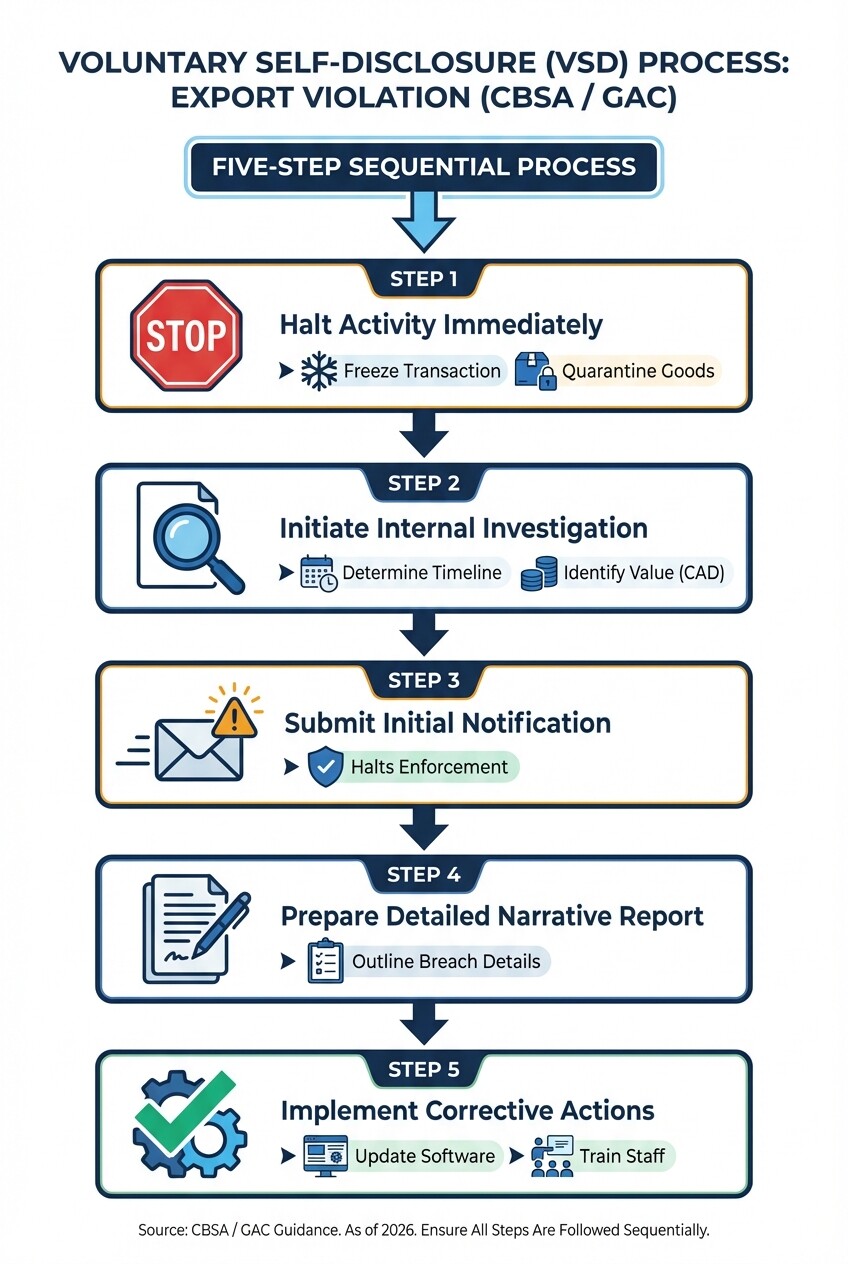
Submitting a voluntary disclosure to the Canada Border Services Agency (CBSA) or Global Affairs Canada can significantly mitigate corporate penalties and protect executives from personal liability. This procedure must be initiated immediately upon discovering a breach of export laws or sanctions protocols.
A well-structured voluntary disclosure demonstrates corporate transparency and a commitment to regulatory adherence. Execute the following steps to manage the disclosure effectively:
- Halt the Violating Activity Immediately: The moment a non-compliant shipment or technology transfer is discovered, freeze the transaction and quarantine the affected goods or data.
- Initiate an Internal Investigation: Assign an internal compliance team or external counsel to determine how the violation occurred, the timeline, the parties involved, and the financial value of the transaction.
- Submit an Initial Notification: File a preliminary disclosure to the CBSA or GAC to establish your intent to cooperate. This halts immediate aggressive enforcement actions while you gather facts.
- Prepare the Detailed Narrative Report: Draft a comprehensive report outlining the nature of the violation, the specific legislation breached, and all supporting documentation.
- Implement Corrective Actions: Detail the specific software updates, personnel training, or protocol shifts your subsidiary has enacted to ensure the violation will never happen again.
Frequently Asked Questions
What are dual-use goods under Canadian law?
Dual-use goods are materials, software, or technologies that have legitimate civilian commercial applications but can also be used in military, aerospace, or weapons development. Examples include advanced navigation sensors, certain telecommunications equipment, and specific chemical compounds.
Can a foreign subsidiary use its parent company's export permits?
No. Export permits are legally bound to the specific applicant entity operating within the exporting jurisdiction. A subsidiary located in Canada must apply for its own unique permits through Global Affairs Canada, regardless of the parent company's global authorizations.
What are the penalties for violating Canada's Special Economic Measures Act?
Violations of SEMA are criminal offenses. Corporations can face unlimited financial fines, while corporate directors and officers can face individual fines and up to five years of imprisonment for willfully participating in or ignoring sanctions breaches.
When to Hire an Export Controls Lawyer
Engaging legal counsel is critical when establishing localized compliance protocols or navigating active enforcement actions. An experienced lawyer ensures your corporate framework satisfies domestic regulations without violating your global corporate obligations.
You should consult a legal professional immediately if you discover a potential sanctions violation, need to structure your 90-day annual audit protocols, or face delays classifying complex controlled technology. Proper legal guidance is also vital when drafting end-user agreements for high-risk export destinations. Finding experienced sanctions & export controls lawyers in Canada will help protect your operations and executive team from enforcement risks.
Next Steps for Corporate Compliance
Foreign subsidiaries must act proactively to align their operations with the 2026 export control landscape. Start by auditing your current denied party screening software to confirm it actively pulls real-time data from Canadian government registries. Next, formalize a localized compliance manual that explicitly addresses the 90-day post-fiscal year audit requirement. Finally, train your logistics and sales teams to identify dual-use triggers so that they know exactly when to escalate a transaction for Global Affairs Canada permit review.