


- Importers of green technology must register with the CBSA Assessment and Revenue Management (CARM) system to post financial security and pay duties.
- Using the correct Harmonized System (HS) codes grants certain environmental goods duty-free status under agreements like CUSMA.
- Acquiring mandatory Canadian safety and energy efficiency certifications takes three to nine months before import.
- Importers have exactly 90 days to dispute a customs ruling or penalty assessment before losing the right to appeal.
- Structuring vendor agreements with multi-sourcing and compliance clauses protects supply chains from border disruptions.
CBSA Import Regulations for Environmental Technology (2026)
The Canada Border Services Agency (CBSA) requires all commercial importers to manage their duties and taxes through the digital CARM Client Portal. For green technology importers, failing to post the required financial security through this system will result in goods being held at the border.
The enforcement of CARM changes how foreign manufacturers interact with Canadian customs. Rather than relying entirely on customs brokers, importers of record must take direct responsibility for their financial accounts with the CBSA.
To remain compliant, importers must:
- Register on CARM: Create an account on the Client Portal and delegate authority to a customs broker.
- Post an RPP bond: Secure a Release Prior to Payment surety bond or post a cash deposit directly with the CBSA. This allows goods to clear customs before final duties are paid.
- Review NRCan standards: Confirm your products meet the standards set by Natural Resources Canada, which regulates energy-consuming products like solar inverters and EV chargers.
Import Compliance Checklist
Proactive documentation prevents border delays and satisfies CBSA requirements. Use this checklist to verify your readiness before shipping environmental technology into Canada:
- Establish importer status: Obtain a Canadian Business Number (BN) and register for an import-export account. Foreign companies can operate as Non-Resident Importers (NRIs) without a physical corporate office in Canada.
- Identify HS codes: Assign the correct 10-digit Harmonized System classification for every component to determine tariff rates.
- Determine origin: Secure a valid Certificate of Origin to claim preferential tariff treatments under free trade agreements.
- Verify certifications: Confirm products bear recognized safety marks (like CSA or cUL) and meet NRCan energy efficiency standards.
- Submit advance data: Ensure the carrier submits advance cargo and conveyance data to the CBSA prior to arrival.
- Prepare commercial invoices: Include detailed descriptions, CAD or USD values, country of origin, and vendor details.
Tariff Classification and Tax Exemptions
Classifying green technology under the Harmonized System allows importers to reduce or eliminate import taxes. Misclassifying goods causes overpaid duties, retroactive reassessments for up to four years, and Administrative Monetary Penalty System (AMPS) fines.
Importers can use the Canada-United States-Mexico Agreement (CUSMA) or the General Preferential Tariff (GPT) to reduce costs. You can verify current rates through the official CBSA Customs Tariff schedule.
| Technology Category | Typical HS Chapter | Potential Exemptions | Applicable Agreements |
|---|---|---|---|
| Solar panels and cells | Chapter 85 | Duty-free under Most-Favored-Nation (MFN) rates | CUSMA, CPTPP, MFN |
| Wind turbine components | Chapter 84 or 85 | End-use exemptions for renewable energy generation | CUSMA, CETA |
| EV lithium-ion batteries | Chapter 85 | Duty-free if regional value content rules are met | CUSMA |
| Water purification systems | Chapter 84 | Duty-free under environmental goods provisions | MFN, CETA, CPTPP |
Timelines for Compliance Certifications
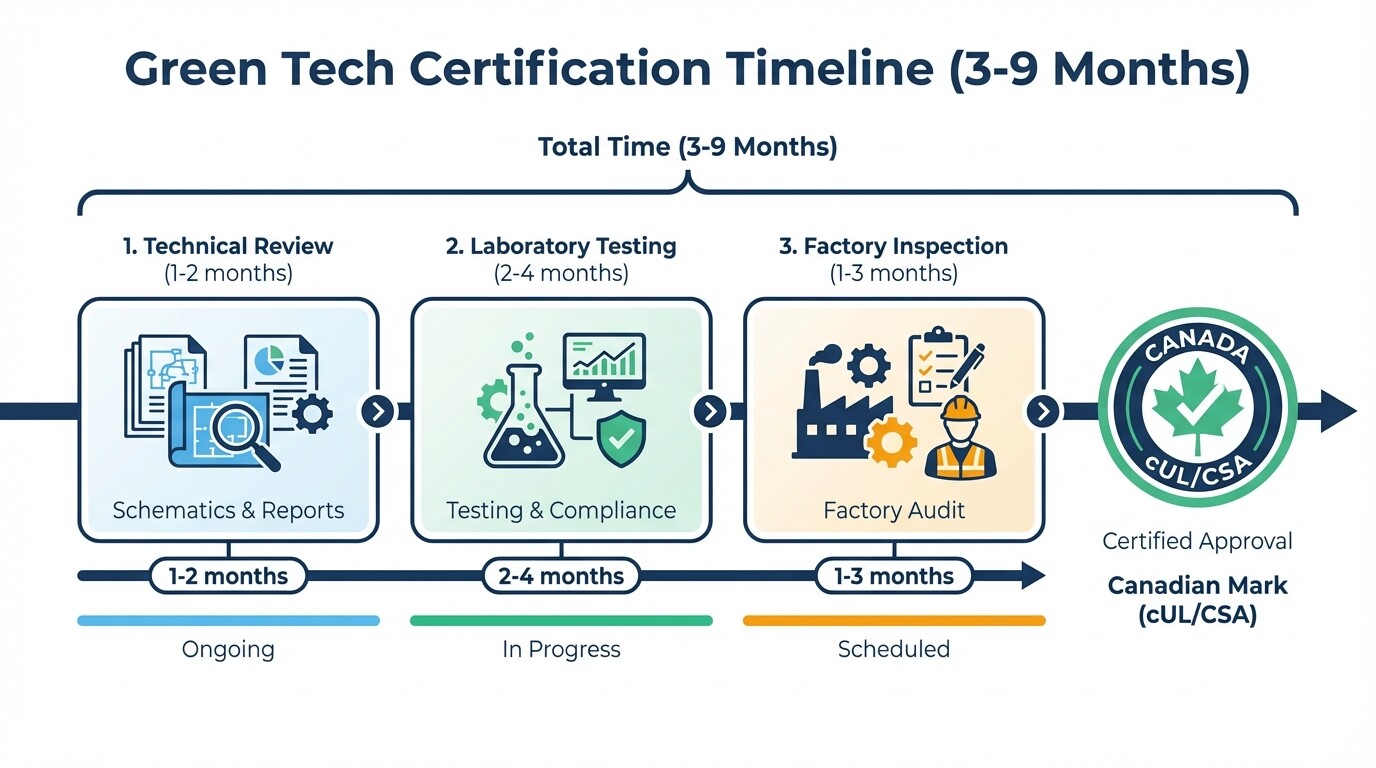
Securing safety and environmental certifications for green tech takes between three to nine months depending on product complexity. Goods must carry recognized marks from bodies like the Canadian Standards Association (CSA) before they legally enter the Canadian market.
Foreign manufacturers often underestimate the time required to meet Canadian domestic standards, which are strictly enforced at the border. Incorporating these timelines into your market entry strategy prevents supply chain bottlenecks.
Typical processing phases include:
- Technical review (1 to 2 months): Submit product schematics, materials lists, and international test reports to a certification body.
- Laboratory testing (2 to 4 months): Test the product to ensure it meets Canadian electrical codes and environmental safety standards.
- Factory inspection (1 to 3 months): Complete on-site audits of the manufacturing facility to guarantee quality control and issue the Canadian certification mark.
Managing Customs Disputes
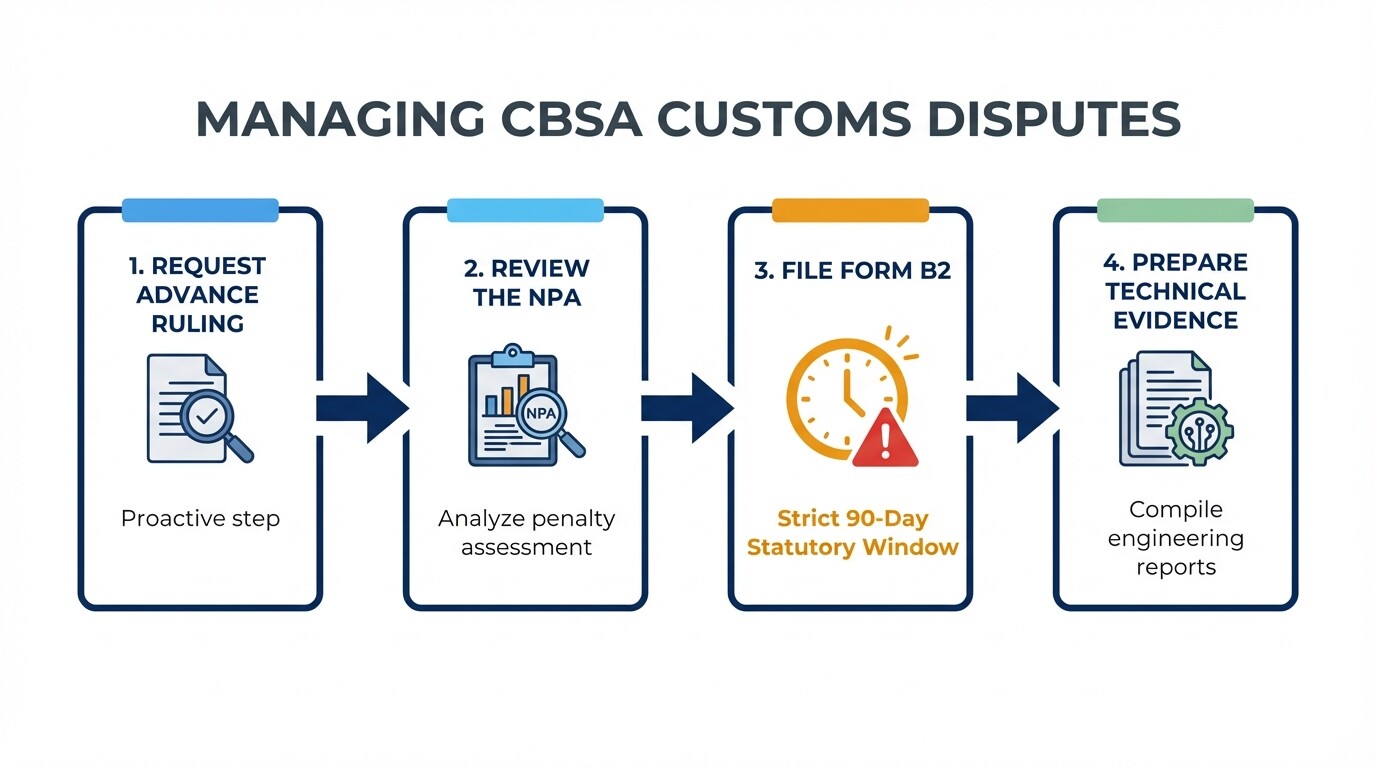
If the CBSA disputes a product's tariff classification or origin, importers can request a formal re-determination before escalating to costly litigation. Filing an appeal within exactly 90 days of the CBSA's initial decision is a strict legal requirement to preserve your rights.
Customs disputes arise when an officer reclassifies a component into a higher-duty HS code or rejects a Certificate of Origin. Handling these disputes requires technical documentation and a clear understanding of trade law.
Steps to manage customs disputes:
- Request an advance ruling: Apply for a binding National Customs Ruling (NCR) on tariff classification or origin to prevent disputes before importing.
- Review the NPA: Analyze the Notice of Penalty Assessment to identify the specific contravention code cited by the CBSA.
- File Form B2: Submit a formal request for re-determination within the 90-day statutory window.
- Prepare technical evidence: Compile engineering reports and product specifications to support the classification claim.
Supply Chain Risks and Vendor Agreements
Relying on a single supplier for green tech components exposes importers to delays during trade disputes. Structuring vendor agreements with sourcing and compliance clauses ensures continuous supply. Importers must verify the country of origin against the Canadian International Trade Tribunal (CITT) active measures list to avoid anti-dumping duties on products like solar panels.
Modern international trade requires contracts that anticipate customs enforcement actions, such as forced labor import bans. Embedding compliance requirements into your vendor agreements shifts the liability of non-compliance back to the foreign manufacturer.
Sample Compliance Clause "Supplier warrants that all goods provided under this Agreement comply with all applicable Canadian import laws, including the Customs Act and the Special Import Measures Act. If the Supplier is unable to deliver goods compliant with Canadian environmental or origin requirements for a period exceeding 30 days, the Purchaser reserves the right to activate secondary vendor agreements without penalty. Supplier agrees to indemnify Purchaser for any CBSA penalties, delayed border clearances, or reassessed duties resulting from inaccurate origin declarations or forced labor compliance violations originating from Supplier's supply chain."
Common Misconceptions About Tech Imports
Importers sometimes misunderstand how free trade agreements and international standards apply in Canada. These assumptions lead to detained shipments and financial penalties.
- US certifications do not automatically apply. While the US and Canada share similar standards, a UL or FCC mark is not sufficient. Products must bear a "cUL" or specific Canadian mark to prove compliance with Canadian electrical codes.
- Free trade agreements still require paperwork. Duty-free does not mean documentation-free. You must provide a valid Certificate of Origin and accurate commercial invoices to claim duty-free status under agreements like CUSMA.
- The customs broker does not assume legal liability. Under Canadian law, the Importer of Record is legally and financially responsible for all customs declarations, even if a licensed broker submits the paperwork.
When to Hire an International Trade Lawyer
Customs audits, penalty appeals, and multi-jurisdictional supply chains require legal oversight. You should retain legal counsel if you receive a Notice of Penalty Assessment, face an anti-dumping investigation, or need to escalate a CBSA dispute to the Canadian International Trade Tribunal. Working with international trade law lawyers in Canada ensures your customs defense is protected by solicitor-client privilege.
Next Steps for Your Import Strategy
Start by conducting a tariff classification review of your product catalog to confirm HS codes and identify duty exemptions. Register your business on the CARM Client Portal and secure a customs bond ahead of your first shipment. Audit vendor agreements to confirm suppliers are contractually obligated to provide the origin and compliance documentation required by the CBSA.