


- Most Canadian provinces operate on an "opt-out" basis, meaning you are automatically included in a class action if you meet the criteria and live in the province where the case was filed.
- You do not pay any upfront legal fees to participate; lawyers are paid a percentage of the settlement only if the case is successful.
- Claiming compensation requires specific timelines, often ranging from 6 to 12 months after a settlement is officially approved by the court.
- While basic participation requires little effort, claiming higher-tier damages for identity theft requires documented proof of financial or psychological harm.
- If you wish to sue the company individually for the same breach, you must formally opt-out by the court-ordered deadline or you lose that right forever.
How do you know if you are part of a certified class action in Canada?
You are a member of a certified class action if you meet the specific "class definition" described in the court-approved notice, which usually targets individuals whose personal data was compromised during a specific timeframe. Companies are legally required to notify potential class members via direct email or mail if they have your contact information, though notice is also provided through public advertisements and social media.
To verify your membership, you can check the following resources:
- The Canadian Bar Association (CBA) Database: The CBA Class Action Database maintains a registry of ongoing and historical cases across Canada.
- Dedicated Settlement Websites: Almost every major privacy breach (such as those involving banks, retail chains, or social media platforms) will have a specific website (e.g., www.CompanyDataSettlement.ca) where you can enter your email to check eligibility.
- Court Notices: Look for a "Notice of Certification." This document outlines exactly who is included, the nature of the claims, and the legal issues being resolved.
What is the difference between opt-in and opt-out regimes in Canadian courts?
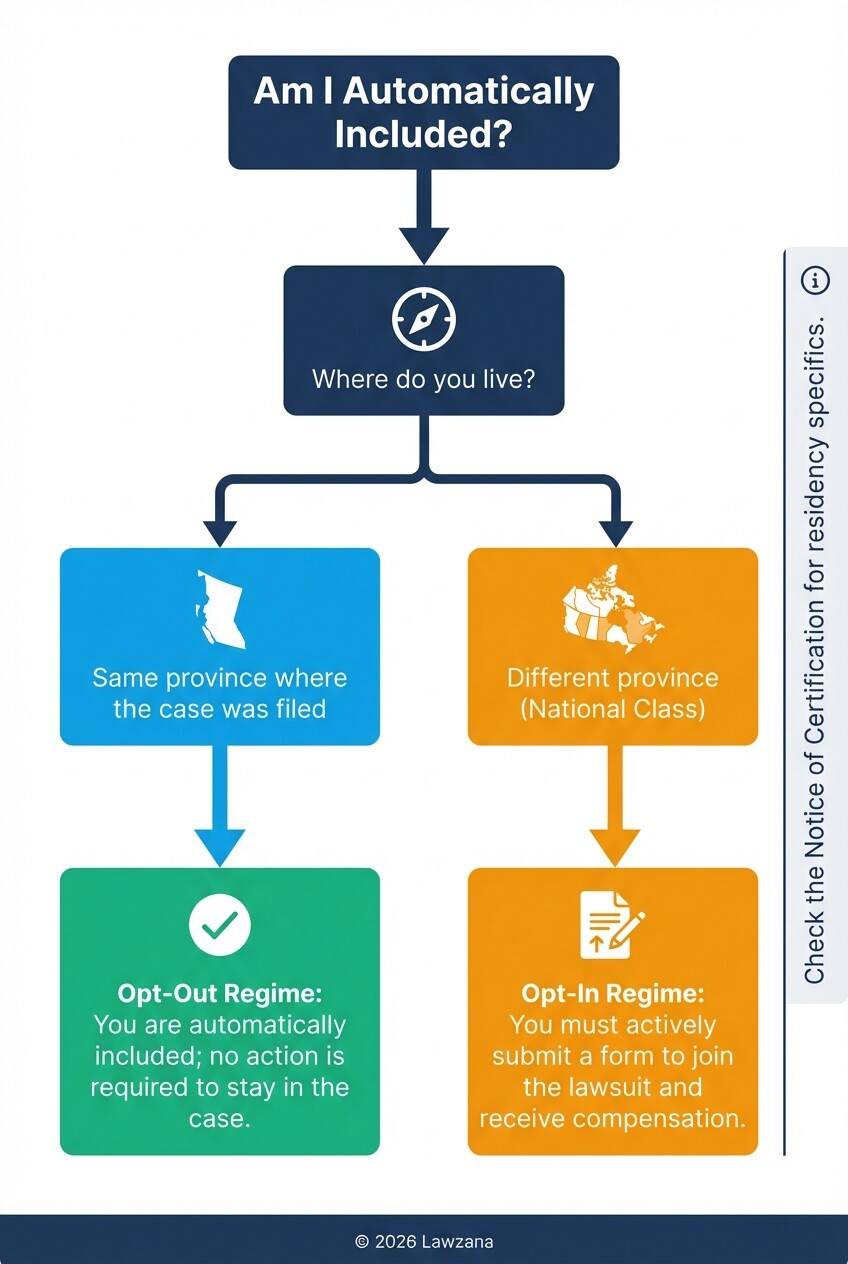
In Canada, the legal framework for class actions varies by province, but the majority of jurisdictions utilize an "opt-out" regime for residents. This means that if a court in Ontario, British Columbia, or Quebec certifies a class action, every resident who fits the class description is legally bound by the outcome unless they proactively take steps to remove themselves.
The rules change depending on where you live and where the case is filed:
| Feature | Opt-Out Regime | Opt-In Regime |
|---|---|---|
| Who it applies to | Residents of the province where the lawsuit is filed. | Non-residents of the province where the lawsuit is filed. |
| Action Required | None; you are automatically included in the lawsuit and any settlement. | You must submit a form to be included in the class and receive benefits. |
| Legal Rights | You lose the right to sue the company individually unless you opt-out. | You retain the right to sue individually unless you choose to join. |
| Provinces | Most provinces (e.g., Ontario, BC, Alberta, Quebec). | Varies; typically applies to "National Classes" for residents in other provinces. |
If you are a resident of Ontario and a class action is certified in Ontario, you are "in" by default. If you live in Nova Scotia but the case is in Ontario, you may need to "opt-in" to be part of the national class, depending on how the court structures the order.
What evidence of harm is required for privacy breach claims?
To receive a baseline payment in a Canadian privacy class action, you generally only need to prove you were a customer or user during the breach period. However, if the settlement offers "tiered" compensation, you must provide documented evidence of "actual loss" or "compensable harm" to qualify for higher payouts.
Commonly accepted evidence in Canadian privacy cases includes:
- Financial Records: Bank or credit card statements showing unauthorized transactions directly linked to the breach.
- Out-of-Pocket Expenses: Receipts for credit monitoring services, identity theft insurance, or legal fees paid to restore your identity.
- Time Logs: A detailed record of the hours spent resolving the breach (e.g., calling banks, changing passwords), as some settlements compensate for "lost time" at an hourly rate.
- Professional Reports: If claiming psychological distress, a Canadian court typically requires a diagnosis or records from a healthcare professional showing the breach caused significant anxiety or trauma.
How do contingency fees work for plaintiffs in Canadian class actions?
Class action lawyers in Canada work on a contingency fee basis, meaning they are only paid if the case is won or settled out of court. The "Representative Plaintiff" (the person who starts the case) and the class members do not pay hourly rates or retainers, as the law firm carries the financial risk of the litigation.
Key aspects of the Canadian fee structure include:
- Judicial Oversight: A judge must review and approve the legal fees to ensure they are fair. The court looks at the complexity of the case and the results achieved.
- Percentage Caps: Fees typically range from 20% to 33% of the total settlement amount.
- Disbursements: These are costs like expert witness fees and court filing fees. In a successful case, these are usually reimbursed from the settlement before the remainder is distributed to the class.
- No-Costs Protection: In some provinces, the law firm or a third-party funder (like the Class Proceedings Fund in Ontario) protects the Representative Plaintiff from having to pay the defendant's legal costs if the case is lost.
What are the timelines for filing a claim after a settlement is approved?
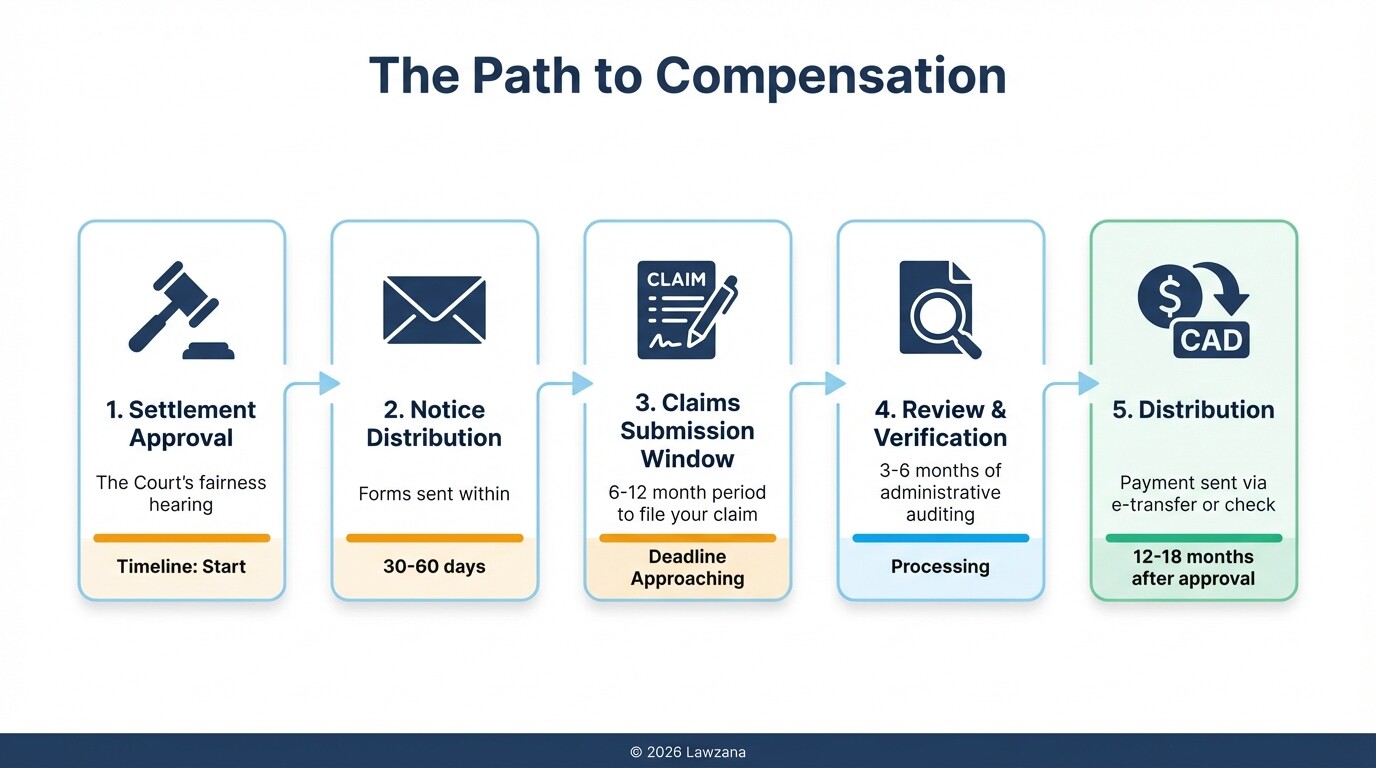
Once a settlement is approved by a Canadian court, a strict "Claims Period" begins, which usually lasts between six and twelve months. This is the window during which you must submit your claim form; failing to meet this deadline results in a total loss of your right to any compensation from that specific settlement.
The typical timeline follows these stages:
- Settlement Approval: The court holds a "Fairness Hearing" to ensure the deal is reasonable.
- Notice Distribution: The Claims Administrator sends out forms via email or mail within 30 to 60 days of approval.
- Claims Submission: You submit your documentation (online or by mail). This window is your only opportunity to act.
- Review and Verification: The administrator reviews claims for fraud or errors, which can take 3 to 6 months.
- Distribution: Funds are usually sent via e-transfer or check within 12 to 18 months after the initial settlement approval.
Common Misconceptions About Privacy Class Actions
Myth 1: "I'll get a massive payout for a simple email leak."
In Canada, privacy breach settlements often focus on "nominal damages" for minor leaks. Unless your Social Insurance Number (SIN) was stolen and led to actual identity theft, payouts are often between $50 and $200 CAD. Large multi-million dollar figures seen in headlines are the total pool to be split among thousands of people.
Myth 2: "I have to hire my own lawyer to join the class."
You do not need your own lawyer to be part of a class action. The "Class Counsel" (the law firm that filed the case) represents the entire group. You only need your own lawyer if you decide to opt-out and pursue a private, individual lawsuit.
Myth 3: "If I don't sign up now, I can't be part of the case."
For opt-out provinces, you are already part of the case the moment it is certified. You only need to "sign up" (file a claim) once a settlement has been reached. Signing up for a "mailing list" on a law firm's website is not the same as filing a legal claim, though it helps ensure you receive the final notice.
FAQs
Can I sue a company individually after a class action settlement?
Only if you opted out of the class action by the specified court deadline. If you did not opt-out, you are legally barred from filing an individual lawsuit against that company for the same breach once the class action is resolved.
What happens if I moved out of Canada after the breach?
If you were a Canadian resident at the time of the breach, you are typically still eligible. You may need to provide proof of your previous Canadian address or account details to the Claims Administrator during the filing process.
Is the compensation from a class action taxable in Canada?
Generally, no. Compensation for personal damages, such as those resulting from a privacy breach or personal injury, is not considered taxable income by the Canada Revenue Agency (CRA).
When to Hire a Lawyer
While you do not need a personal lawyer to participate in a class action, you should consult with one if you have suffered extraordinary damages that far exceed the "average" member of the class. For example, if a data breach led to a loss of hundreds of thousands of dollars, a ruined credit score, or the loss of a business, the standard class action payout will not make you whole. In these rare cases, opting out to pursue an individual "high-stakes" lawsuit may be the better financial decision.
Next Steps
If you believe your data was part of a Canadian privacy breach, take these immediate actions:
- Preserve Evidence: Save any notification emails from the company, take screenshots of your account settings, and keep records of any suspicious activity on your bank statements.
- Check the CBA Registry: Visit the Canadian Bar Association Database to see if a case has already been filed for your specific breach.
- Monitor Your Credit: Use services like TransUnion or Equifax Canada to monitor for identity theft, as this documentation will be vital if a settlement is reached.
- Watch for the Notice: If the case is certified, look for a "Notice of Certification" in your inbox or mail. Note the "Opt-Out" deadline immediately if you intend to sue privately.