


Divorce for NRIs: Legal Jurisdiction and Enforcement of Foreign Decrees in India
Navigating a divorce while living abroad presents a unique set of legal challenges for Non-Resident Indians (NRIs). While a foreign court may grant a divorce based on the laws of your country of residence, that decree is not automatically recognized in India unless it satisfies specific criteria under Indian law. Understanding the intersection of international private law and the Indian Code of Civil Procedure is essential to ensuring your marital status, property rights, and parental responsibilities remain protected in your home country.
Is a foreign divorce decree valid in India?
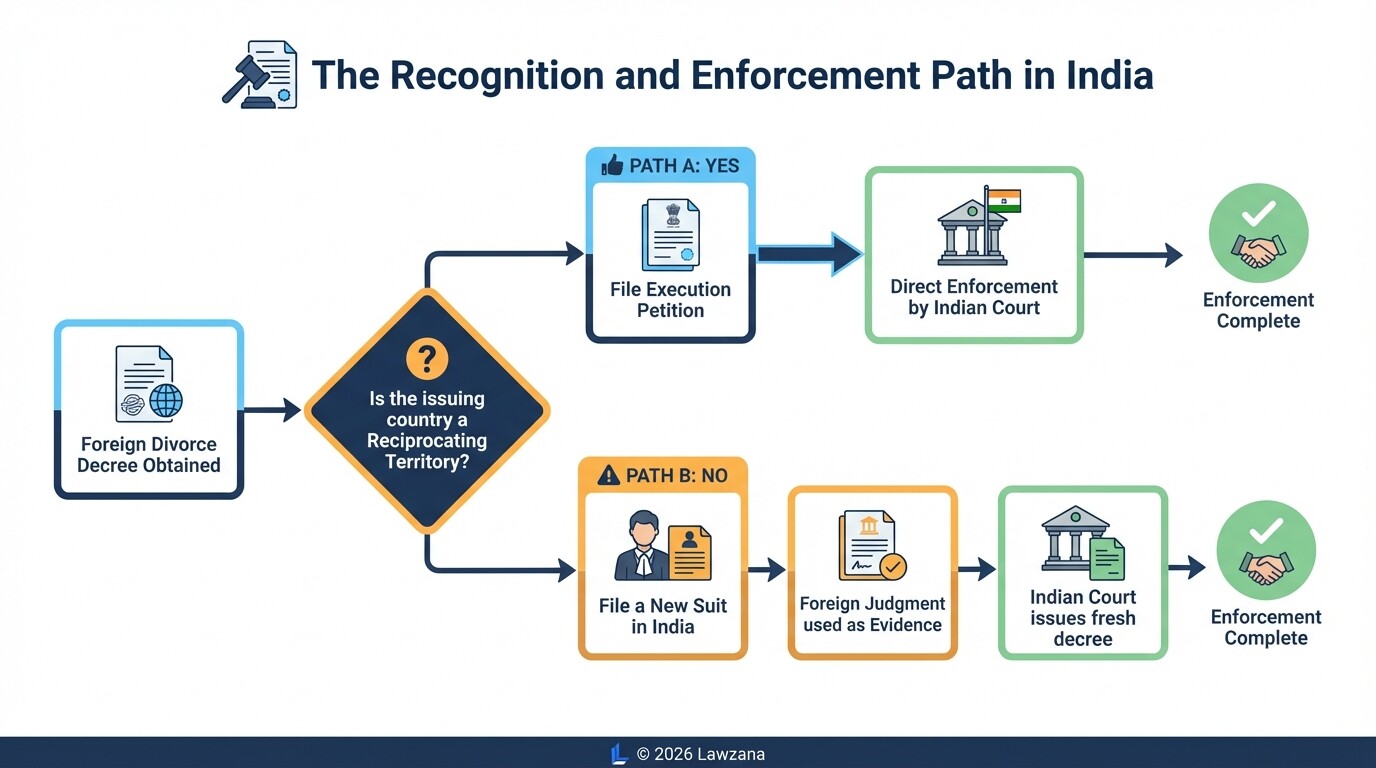
A foreign divorce decree is legally valid in India as long as it is issued by a court of competent jurisdiction and does not violate the principles of Indian law. For the decree to be conclusive, it must be recognized under Section 13 of the Code of Civil Procedure (CPC), 1908. If a decree is obtained through mutual consent in a foreign country, Indian courts usually view it as valid because both parties submitted to the foreign court's jurisdiction.
The distinction between mutual and contested divorces is critical. If one spouse obtains an "ex-parte" decree (a judgment where the other spouse did not participate) in a foreign court, that decree is often challenged in India. Indian courts may declare such decrees invalid if the respondent was not properly served or if the grounds for divorce are not recognized under the specific Indian marriage act the couple was wed under.
How do you register a foreign divorce in India?
To make a foreign decree enforceable, you must file a petition for recognition or execution in an Indian family court. If the foreign country has a "reciprocating" agreement with India, the decree can be executed as if it were passed by a local court. If not, a new suit must be filed based on the foreign judgment.
What are the requirements under Section 13 of the Code of Civil Procedure?
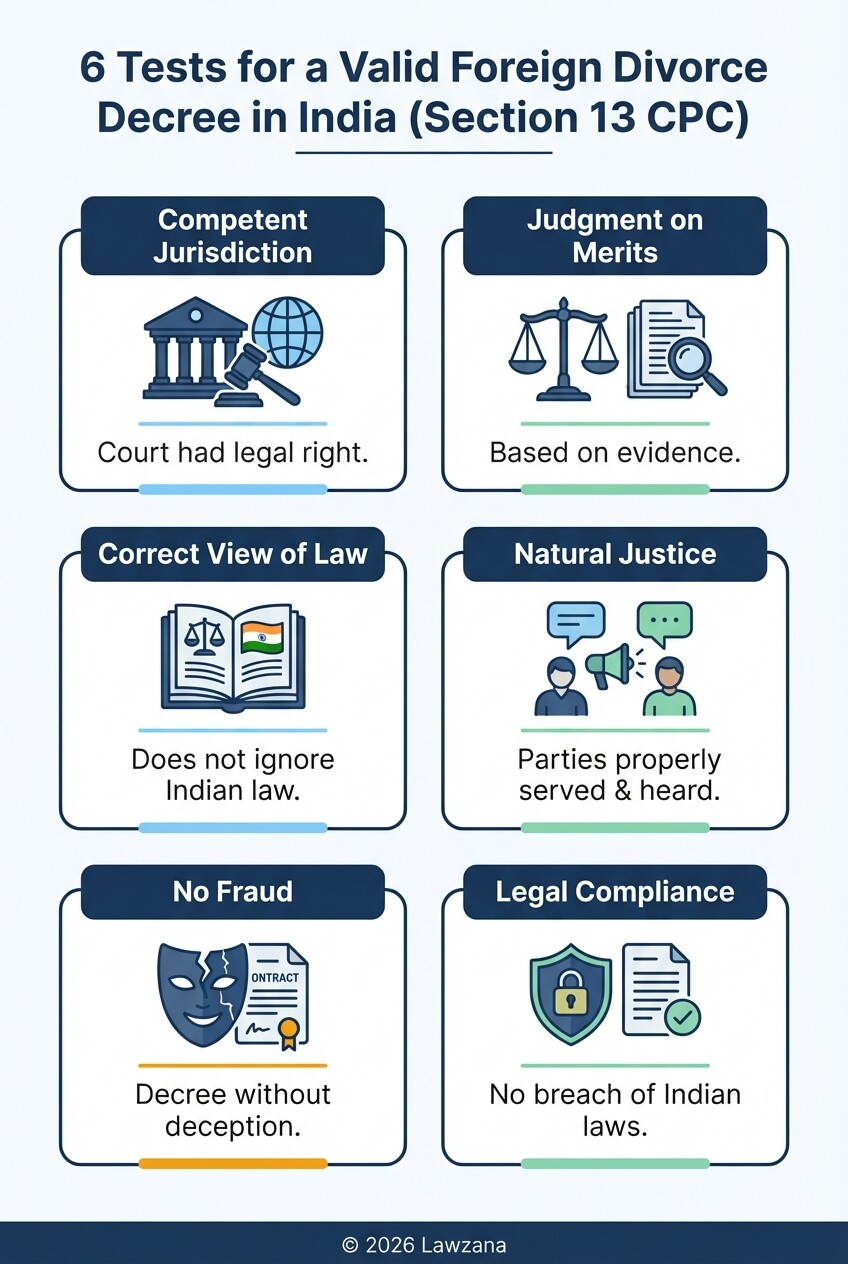
Section 13 of the CPC defines the conditions under which a foreign judgment is considered "conclusive" in India. A foreign decree will be rejected if it was not pronounced by a court of competent jurisdiction, if it was not given on the merits of the case, or if it appears to be founded on an incorrect view of international law.
To ensure your foreign divorce is recognized in India, it must avoid these six specific pitfalls:
- Competent Jurisdiction: The foreign court must have the legal authority to hear the case, usually based on the domicile or residence of the parties.
- Merits of the Case: The court must have examined the evidence and facts rather than just granting a default judgment because one party failed to appear.
- International Law/Indian Law: The judgment must not be based on a refusal to recognize the applicable Indian law, such as the Hindu Marriage Act.
- Natural Justice: Both parties must have been given a fair opportunity to be heard and properly served with legal notices.
- Fraud: The decree must not have been obtained through deception or by withholding material facts from the foreign court.
- Breach of Law: The judgment must not sustain a claim founded on a breach of any law in force in India.
What happens if a foreign decree fails these tests?
If any of these conditions are met, the foreign decree is considered "null and void" in India. This means that in the eyes of the Indian government, the parties are still legally married, which can lead to charges of bigamy if one party remarries.
What are the grounds for divorce under the Hindu Marriage Act vs. Special Marriage Act?
The legal grounds for divorce for NRIs depend on the Act under which the marriage was registered in India. The Hindu Marriage Act (HMA), 1955 applies to Hindus, Sikhs, Jains, and Buddhists, while the Special Marriage Act (SMA), 1954 applies to inter-faith couples or those who chose a civil registration.
Under both Acts, the primary grounds for a contested divorce include:
- Cruelty: Mental or physical harm that makes living together impossible.
- Adultery: Voluntary sexual intercourse outside of marriage.
- Desertion: Abandonment by one spouse for a continuous period of at least two years.
- Conversion: One spouse ceasing to be Hindu by converting to another religion (specifically under HMA).
- Mutual Consent: Both parties agree to the divorce and have lived separately for one year.
How does residency affect these filings?
NRIs can file for divorce in India if the marriage was solemnized in India, if the respondent resides in India, or if the couple last resided together in India. Many NRIs prefer filing in India to ensure the decree is bulletproof against future legal challenges regarding Indian assets.
How are child custody and property division handled for NRIs?
Child custody and property division are the most contentious aspects of NRI divorces because foreign orders are often not binding on Indian courts. In India, the principle of parens patriae applies, meaning the court acts as the ultimate guardian of the child and will prioritize the "welfare of the child" above any foreign custody arrangement.
Regarding property, Indian courts have exclusive jurisdiction over immovable assets (land and houses) located within India. A foreign court cannot order the transfer of a flat in Delhi or a farm in Punjab.
Key Challenges and Solutions:
- Mirror Orders: To ensure a foreign custody order is followed in India, parents often seek a "Mirror Order" from an Indian court that reflects the foreign court's terms.
- Movable Assets: Bank accounts or investments held in India are subject to Indian succession and matrimonial laws.
- Repatriation: If a child is brought to India in violation of a foreign court order, the Indian court will conduct an independent inquiry to decide if the child should be returned or stay in India based on their best interests.
Can an Indian court change a foreign alimony order?
Yes, if the alimony awarded by a foreign court is significantly lower than what is required under Indian standards of living or if the foreign court did not consider the husband's Indian assets, an Indian court may grant additional maintenance under Indian law.
How to prevent anti-suit injunctions in international matrimonial cases?
An anti-suit injunction is a court order that prevents one party from starting or continuing legal proceedings in another jurisdiction. In NRI cases, a spouse might file for divorce in India to "pre-empt" a filing in a foreign country where the laws regarding alimony or property division might be less favorable to them.
To successfully obtain or prevent an anti-suit injunction, the court considers:
- Forum Conveniens: Which court is the most appropriate and convenient for the parties to litigate in?
- Vexatious Litigation: Is the foreign suit being filed simply to harass the other spouse?
- Timing: Generally, the court where the case is filed first holds significant weight, but Indian courts will intervene if they feel the foreign proceedings are oppressive.
How do you protect your interests?
If you suspect your spouse is about to file for divorce in a foreign country to avoid Indian laws (especially regarding property), you should immediately consult an Indian lawyer to file a "Caveat" or an anti-suit injunction petition in the relevant Indian Family Court.
Common Misconceptions about NRI Divorce
Myth 1: A "No-Fault" divorce from the US or UK is always valid in India. Reality: Many Indian marriage laws do not recognize "irretrievable breakdown of marriage" as a ground for divorce (though this is slowly changing through Supreme Court precedents). If the divorce was contested and granted only on "no-fault" grounds, it might be challenged in India.
Myth 2: If I get a divorce abroad, I don't need to do anything in India. Reality: To update your marital status on your Indian passport, sell property as a single person, or ensure you aren't accused of bigamy upon remarriage, you must have the foreign decree formally recognized by an Indian court or through a declaration suit.
Myth 3: The foreign court will divide my ancestral property in India. Reality: Foreign courts lack the jurisdiction to pass orders on Indian real estate. You will likely need a separate legal proceeding in India to settle property disputes.
FAQs
Can NRIs file for divorce by mutual consent through Power of Attorney?
Yes, but most Indian courts now require the parties to appear via video conferencing for the statement recording. While a Power of Attorney can file the petition, the "physical" presence (even virtual) of the spouses is mandatory for the final decree.
How long does a mutual consent divorce take in India for NRIs?
Typically, it takes 6 to 18 months. There is a mandatory six-month "cooling-off" period, though the Supreme Court of India has ruled that this can be waived in certain circumstances if the couple has been separated for a long time.
What is the cost of an NRI divorce in India?
Legal fees vary widely based on the complexity and the city. Professional fees for a mutual consent divorce can range from ₹50,000 to ₹2,00,000, while contested divorces involving property and custody can cost significantly more.
When to Hire a Lawyer
You should consult an Indian legal expert specializing in NRI matrimonial law if:
- Your spouse has filed for divorce in a foreign country without your consent.
- You own significant immovable property in India that needs to be protected or divided.
- You have children and there is a risk of one parent relocating them to India permanently.
- You need to enforce a foreign alimony or child support order against a spouse residing in India.
- You were married under the Hindu Marriage Act but are seeking a divorce in a country with vastly different legal grounds.
Next Steps
- Gather Documents: Secure your original marriage certificate, copies of your foreign residence permits, and details of all Indian assets.
- Verify Jurisdiction: Determine if your marriage was registered under the HMA or SMA to identify the correct grounds for filing.
- Consult Locally and Abroad: Speak with a lawyer in your country of residence AND an expert in India to understand how a decree in one country will impact your rights in the other.
- Consider Mediation: If possible, aim for a mutual consent settlement, as this is the most secure way to ensure the divorce is recognized in both jurisdictions without lengthy litigation.