- Tech firms using Ireland as their European headquarters fall under the primary jurisdiction of the Irish Data Protection Commission (DPC) via the "One-Stop-Shop" mechanism.
- Compliance in 2026 requires more than just a privacy policy; it necessitates documented Data Protection Impact Assessments (DPIAs) for all high-risk processing activities.
- Non-EU companies must appoint a local Data Protection Officer (DPO) or an EU Representative to remain compliant with Article 27 of the GDPR.
- Data breaches involving personal data must be reported to the DPC within 72 hours of discovery unless the risk to individuals is unlikely.
- Cross-border data transfers now require rigorous Transfer Impact Assessments (TIAs) alongside Standard Contractual Clauses (SCCs).
GDPR Compliance Audit Checklist for 2026
GDPR compliance for tech firms is a continuous state of readiness rather than a one-time setup. To pass a 2026 audit in Ireland, firms must demonstrate "accountability" by maintaining a comprehensive paper trail of all data decisions and risk assessments.
Use the following checklist to evaluate your firm's current compliance posture:
- Data Mapping: Maintain a Record of Processing Activities (ROPA) that identifies what data is collected, where it is stored, and who has access to it.
- Legal Basis: Document the specific legal basis (Consent, Contract, Legal Obligation, or Legitimate Interest) for every data processing stream.
- Privacy Notices: Ensure "Layered" privacy notices are accessible, written in plain English, and updated to reflect 2026 processing technologies (e.g., AI/ML training).
- Vendor Management: Verify that all third-party processors have signed Data Processing Agreements (DPAs) that meet Article 28 requirements.
- Subject Access Requests (DSARs): Establish a repeatable workflow to respond to user data requests within the 30-day statutory limit.
- Security Protocols: Implement "Privacy by Design" and "Privacy by Default" in the software development lifecycle (SDLC), including encryption and pseudonymization.
- International Transfers: Confirm that any data leaving the EEA is protected by an Adequacy Decision, SCCs, or Binding Corporate Rules.
Documentation Required for a Data Protection Impact Assessment (DPIA)
A DPIA is a mandatory process for any processing likely to result in a high risk to the rights and freedoms of individuals, such as large-scale profiling or monitoring. For tech firms in Ireland, the DPC expects a formal document that analyzes the necessity and proportionality of the data usage.
The following documentation must be included in a standard DPIA:
- System Description: A detailed flowchart of data assets, including collection points, storage locations, and third-party API integrations.
- Necessity Assessment: A written justification explaining why the data collection is necessary to achieve the business objective and why less intrusive methods were rejected.
- Risk Register: A list of potential threats (e.g., data leaks, unauthorized access, algorithmic bias) and their estimated impact on the end-user.
- Mitigation Measures: A specific list of technical and organizational safeguards (e.g., multi-factor authentication, data minimization) designed to reduce identified risks to an acceptable level.
- Sign-off: Formal approval from the Data Protection Officer and, in some cases, evidence of consultation with the affected data subjects or their representatives.
Common Mistakes in Cross-Border Data Transfer Legal Agreements
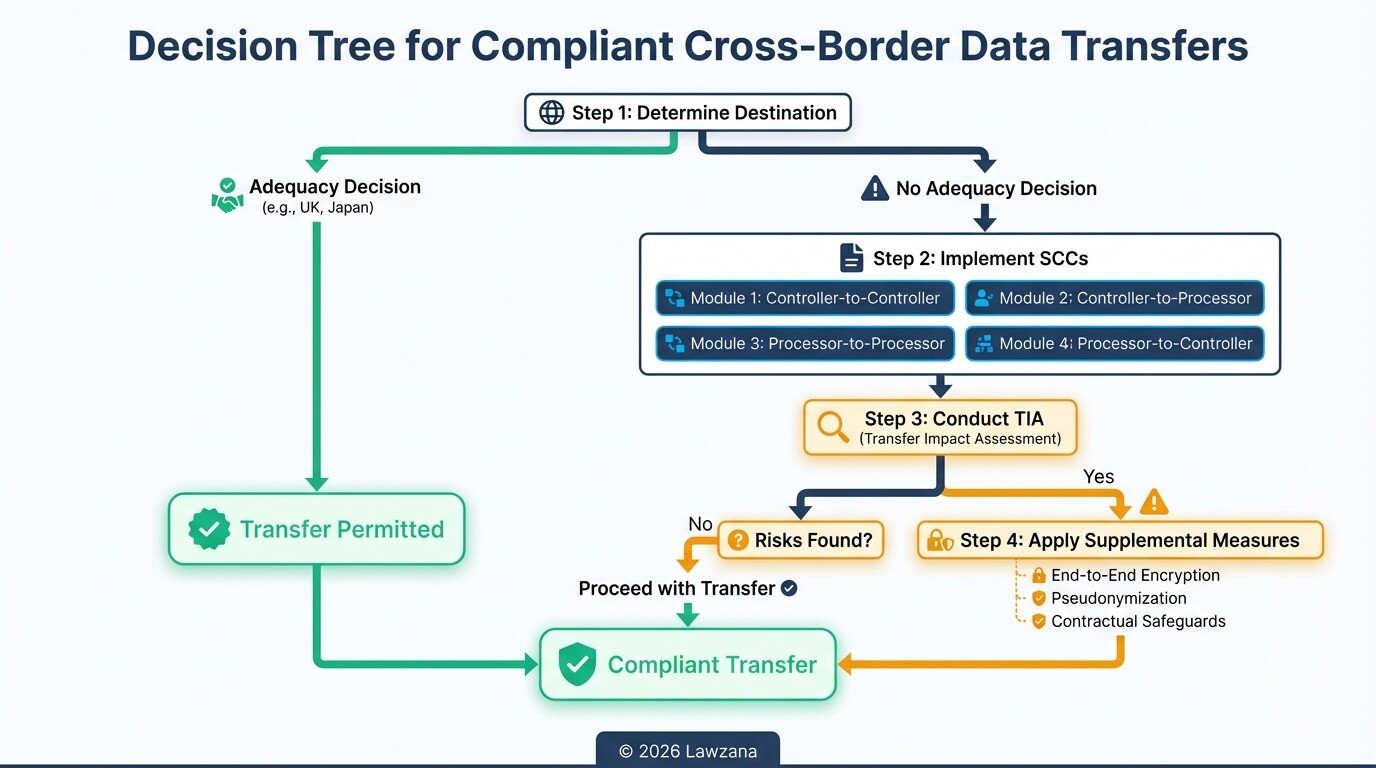
Many tech firms fail their audits because they rely on outdated Standard Contractual Clauses (SCCs) without performing the required supplemental analysis. In the post-Schrems II legal landscape, simply signing a contract is insufficient for transferring data from Ireland to jurisdictions like the US or India.
The most frequent errors include:
- Ignoring Transfer Impact Assessments (TIAs): Firms often fail to document the legal climate of the receiving country. You must assess whether local surveillance laws undermine the protections offered by your contract.
- Generic SCC Modules: The EU provides four different modules for SCCs (Controller-to-Controller, Controller-to-Processor, etc.). Using the wrong module renders the agreement legally void.
- Lack of "Supplementary Measures": If a TIA identifies risks, you must implement additional safeguards, such as end-to-end encryption where the key is held exclusively in Ireland/EU.
Sample Data Transfer Clause Language
When drafting or updating your international data transfer agreements, ensure your clauses are specific. Below is a sample provision for a 2026-compliant agreement:
"The Parties agree that for any transfer of Personal Data from the EEA to a third country not recognized by the European Commission as providing an adequate level of protection, the Standard Contractual Clauses (Module Two: Controller to Processor) shall be incorporated by reference. The Data Importer warrants that it has no reason to believe that the laws and practices in the third country of destination prevent it from fulfilling its obligations under the SCCs, as documented in the Transfer Impact Assessment dated [Insert Date]."
Managing Breach Notifications Within the Mandatory 72-Hour Window
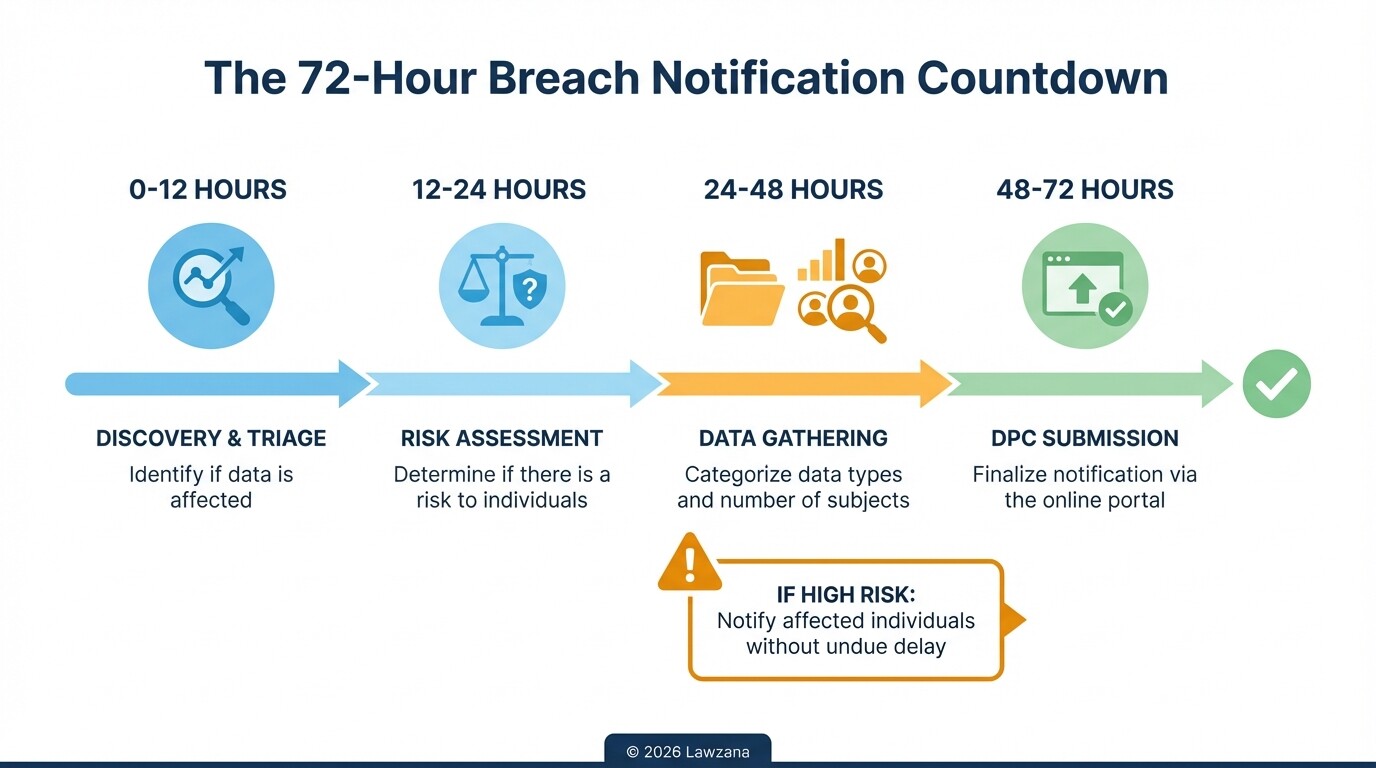
Under the GDPR, tech firms must notify the Irish Data Protection Commission of a personal data breach within 72 hours of becoming aware of it. This timeline is unforgiving and applies regardless of weekends or Irish public holidays.
The 72-hour window requires a pre-defined Incident Response Plan (IRP) consisting of these steps:
- Identification: The moment any employee or automated system detects a potential breach, the "clock" begins.
- Triage: The DPO must immediately determine if the breach poses a risk to individuals. If no risk is found (e.g., the stolen data was fully encrypted and the key is safe), notification may not be required, but the decision must be documented.
- Internal Reporting: Information security teams must provide the DPO with the nature of the breach, the categories of data involved, and the approximate number of data subjects.
- DPC Notification: If a risk is present, the firm must submit the official notification form via the DPC's online portal. If all information is not available within 72 hours, the notification can be provided in phases.
- Communication: If the breach is "high risk," the firm must also notify the affected individuals directly without undue delay.
Comparative Look at Irish vs. Global Data Privacy Standards
Ireland follows the GDPR, which is often considered the "Gold Standard" of privacy, but tech firms entering from the US or Asia may find the enforcement style of the Irish DPC unique. While the US relies on a patchwork of state laws (like CCPA/CPRA), Ireland provides a centralized regulatory gateway for the entire EU.
| Feature | Ireland (GDPR) | United States (CCPA/CPRA) |
|---|---|---|
| Primary Philosophy | Privacy as a Fundamental Human Right | Privacy as a Consumer Protection Right |
| Opt-in vs. Opt-out | Strict Opt-in for most processing | Often Opt-out (Right to Object) |
| Max Fine | €20M or 4% of global turnover | $7,500 per intentional violation |
| DPO Requirement | Mandatory for many tech/data firms | Not generally required by law |
| Enforcement | Centralized (Data Protection Commission) | Decentralized (AGs / Privacy Agency) |
Appointing a Data Protection Officer for Non-EU Companies
Tech firms headquartered outside the European Union that offer goods or services to individuals in Ireland must navigate specific representative requirements. Failure to have a designated point of contact within the EU is a common trigger for DPC investigations and administrative fines.
If your firm is based in the US, UK, or elsewhere, you must fulfill these roles:
- The EU Representative (Article 27): This is a person or entity located in Ireland (or another EU member state where your users are located) who acts as a local point of contact for the DPC and data subjects. This is mandatory for most non-EU firms.
- The Data Protection Officer (Article 37): A DPO is required if your core activities involve "regular and systematic monitoring of data subjects on a large scale" or processing sensitive "special category" data.
- Independence: The DPO must report directly to the highest management level and cannot be given instructions on how to perform their tasks. In 2026, the DPC heavily scrutinizes "conflicts of interest," meaning your CTO or Head of Marketing generally cannot serve as the DPO.
Common Misconceptions
Small Tech Startups are Exempt from GDPR
Many founders believe the GDPR only applies to "Big Tech" giants. In reality, the law applies to any entity, regardless of size, that processes the personal data of individuals in the EU. Small firms are often targeted by the DPC because they lack the sophisticated security infrastructure of larger competitors.
Consent is the Only Way to Process Data
Tech firms often clutter their UX with unnecessary consent pop-ups. Under Irish law, "Legitimate Interest" or "Performance of a Contract" are often more appropriate and robust legal bases for processing data. Over-reliance on consent can be risky, as consent can be withdrawn at any time, potentially halting your core service.
FAQ
What is the fine for GDPR non-compliance in Ireland?
The DPC can issue administrative fines of up to €20 million or 4% of a company's total global annual turnover for the preceding financial year, whichever is higher. They also have the power to issue "ban" orders, forcing a company to stop processing data entirely.
Does GDPR apply if my servers are located in the US?
Yes. The GDPR is extra-territorial. If you are targeting users in Ireland or monitoring their behavior (e.g., via cookies or app tracking), you must comply with Irish data laws regardless of where your servers or headquarters are located.
How long do I have to respond to a data request?
You must respond to a Subject Access Request (SAR) without undue delay and at the latest within one month. This can be extended by a further two months for complex cases, but you must notify the user of the extension within the first month.
When to Hire a Lawyer
Navigating the Irish DPC's regulatory environment requires more than just technical settings; it requires legal strategy. You should consult a commercial lawyer in Ireland if:
- You are planning an Initial Public Offering (IPO) or a major M&A transaction where data is a primary asset.
- You have received a formal "Notice of Inquiry" or "Draft Decision" from the Data Protection Commission.
- You are implementing high-risk technologies such as facial recognition, AI-driven profiling, or large-scale biometric processing.
- You are drafting complex multi-party data-sharing agreements with international partners.
Next Steps
- Conduct a Gap Analysis: Audit your current data practices against the 2026 checklist provided above.
- Update Documentation: Ensure your Record of Processing Activities (ROPA) and DPIAs are current and physically stored in a location accessible to your DPO.
- Appoint Local Representation: If you are a non-EU firm, legally appoint an Article 27 Representative in Ireland immediately.
- Train Your Team: Conduct a breach response simulation to ensure your IT and legal teams can meet the 72-hour notification deadline.
- Review Vendor Contracts: Audit your DPAs to ensure they reflect the latest EU Standard Contractual Clauses.