- Commercial contract termination in Malaysia is governed by the Contracts Act 1950 and established common law principles.
- Only a breach of a "condition" or a fundamental "innominate term" typically grants the right to terminate the agreement; a breach of "warranty" usually only allows for damages.
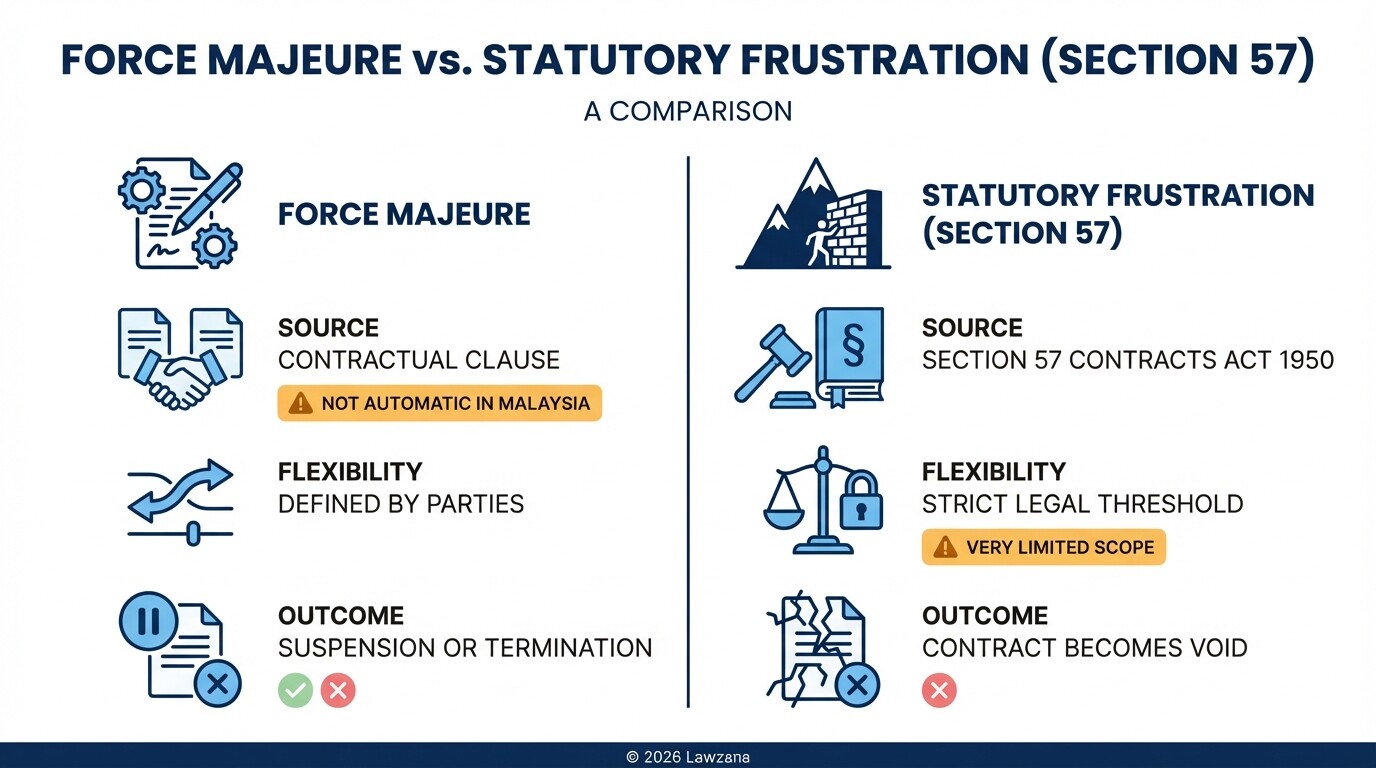
- Force Majeure is not a statutory right in Malaysia and must be explicitly drafted into the contract to be enforceable.
- Section 75 of the Contracts Act 1950 stipulates that "liquidated damages" clauses are subject to the court's assessment of reasonable compensation.
- Formal notice must be served according to the specific "Notice" provisions in the agreement to avoid a claim of "wrongful repudiation."
Sample Termination Clauses and Procedural Checklist
Terminating a commercial contract without a clear contractual framework or legal basis can result in a counter-suit for wrongful termination. In Malaysia, the courts strictly scrutinize whether the terminating party followed the agreed-upon mechanics of the "Notice" clause.
Sample Termination for Cause Clause
"Either Party may terminate this Agreement with immediate effect by giving written notice to the other Party if the other Party commits a material breach of any term of this Agreement and (if such breach is remediable) fails to remedy that breach within thirty (30) days of that Party being notified in writing to do so."
Sample Termination for Convenience Clause
"Either Party may terminate this Agreement at any time, without cause, by providing ninety (90) days' prior written notice to the other Party. During the notice period, both Parties shall continue to fulfill their respective obligations under this Agreement."
Contract Termination Checklist
| Step | Action Item | Legal Consideration |
|---|---|---|
| 1 | Identify the Breach | Determine if it is a breach of a condition, warranty, or innominate term. |
| 2 | Check the Notice Clause | Verify the required method of delivery (e.g., registered mail, hand delivery). |
| 3 | Issue a "Notice to Remedy" | If the breach is remediable, provide the contractually mandated period to fix it. |
| 4 | Mitigate Losses | Take active steps to reduce your financial exposure following the breach. |
| 5 | Document Everything | Maintain a paper trail of all performance failures and communication. |
| 6 | Formal Notice of Termination | Issue a final, clear notice stating the specific grounds for termination. |
Distinguishing Between Conditions and Warranties
In Malaysia, the right to terminate a contract depends heavily on the classification of the term that was breached. Under the Contracts Act 1950 and case law, terms are generally categorized as conditions, warranties, or innominate terms.
Conditions
A condition is a fundamental term that goes to the very root of the contract. If a condition is breached, the non-defaulting party has the right to treat the contract as repudiated, terminate the agreement immediately, and sue for damages.
Warranties
A warranty is a secondary or collateral term. A breach of warranty does not give the non-defaulting party the right to terminate; they are only entitled to claim damages for the loss suffered.
Innominate Terms
Malaysian courts often apply the "Innominate Term" test. This looks at the effect of the breach rather than the label of the term. If the breach "deprives the innocent party of substantially the whole benefit" of the contract, termination is permitted. This approach provides flexibility but requires a deep analysis of the specific facts of the case.
The Role of Force Majeure and Frustration
Force Majeure clauses protect parties from liability when extraordinary events beyond their control prevent them from fulfilling their obligations. In Malaysia, there is no "implied" right to Force Majeure; it is purely a creature of contract.
Drafting Force Majeure in Malaysia
Because the Contracts Act 1950 does not define Force Majeure, the specific wording of your clause is paramount. Courts will interpret these clauses strictly. If an event (like a pandemic or government-mandated lockdown) is not listed or covered by general language like "acts of God" or "unforeseeable circumstances," the clause may not apply.
Statutory Frustration (Section 57)
If your contract lacks a Force Majeure clause, you may rely on Section 57(2) of the Contracts Act 1950, which covers "Frustration." A contract is frustrated when an event occurs after the contract is signed that makes the performance impossible or unlawful. However, the threshold for frustration in Malaysia is very high; mere "difficulty" in performing or "economic hardship" is not enough to frustrate a contract.
Statutory Notice and Communication Requirements
A failure to provide notice in the exact manner prescribed by the contract can render a termination invalid. In Malaysia, "Time is of the essence" is a critical concept under Section 56 of the Contracts Act 1950.
If a party fails to perform at the specified time and "time is of the essence," the contract becomes voidable at the option of the innocent party. If time is not of the essence, the contract does not become voidable, but the innocent party can claim compensation for any loss.
To terminate legally, you must:
- Follow the Contractual Address: Send the notice to the registered office or the specific address mentioned in the "Notices" section.
- Use the Correct Medium: If the contract specifies "Registered Post," an email may not be legally sufficient unless the contract allows for electronic communication.
- Respect the Cure Period: If the contract allows 14 days to remedy a breach, terminating on day 12 is a breach in itself.
Alternatives to Termination: Variation and Novation
Termination is often the "nuclear option." In many B2B scenarios in Malaysia, parties prefer to modify the existing relationship to accommodate changing market conditions or operational hurdles.
Variation of Terms
Under Section 63 of the Contracts Act 1950, if the parties agree to substitute a new contract for it, or to rescind or alter it, the original contract need not be performed. This is often done through a "Supplemental Agreement" or an "Addendum." It requires the mutual consent of all signing parties and usually needs fresh "consideration" (value exchanged), though Section 64 allows a party to dispense with or remit the performance of a promise.
Novation
Novation occurs when a new party is substituted for one of the original parties. This is common during corporate restructurings or M&A activity in Malaysia. Unlike an assignment (where only rights are transferred), novation transfers both rights and obligations. A valid novation requires the consent of the original parties and the new party.
Recovery of Damages and Mitigation of Losses Checklist
When a contract is terminated due to a breach, the innocent party is entitled to compensation. Malaysian law follows the principles laid out in Section 74 and Section 75 of the Contracts Act 1950.
The Section 74 Rule (Hadley v Baxendale)
You can recover damages that:
- Naturally arose in the usual course of things from the breach.
- Were "within the contemplation of the parties" at the time they made the contract as the probable result of a breach.
Liquidated Damages (Section 75)
Malaysia does not strictly follow the UK's distinction between "penalties" (unenforceable) and "liquidated damages" (enforceable). Under Section 75, the court will award "reasonable compensation" not exceeding the amount named in the contract, regardless of whether actual damage is proven. However, the Federal Court has clarified that the claimant must still prove their loss unless it is difficult to assess.
Mitigation Checklist
If you terminate a contract, you have a legal duty to minimize your losses.
- Seek Alternatives: If a supplier fails, immediately look for a replacement at market rates.
- Stop Incurring Costs: Do not continue spending money on a project that you know has been terminated.
- Record Efforts: Keep a log of quotes from other vendors or attempts to resell goods to prove to the court that you tried to mitigate.
Common Misconceptions
"I can terminate because the other party is 'difficult' to work with."
In Malaysia, unless you have a "Termination for Convenience" clause, you cannot end a contract simply because the relationship has soured. There must be a specific breach of a condition or a fundamental term.
"Force Majeure applies automatically to every contract."
This is false. Force Majeure is a contractual right, not a statutory one. If it is not in your written agreement, you must rely on the much stricter doctrine of "Frustration" under Section 57.
"If I name a sum as 'Liquidated Damages,' the court will automatically award that exact amount."
No. Under Section 75, Malaysian courts will only award what they deem "reasonable compensation." You should be prepared to justify how that sum was calculated.
Frequently Asked Questions
Can I terminate a contract verbally in Malaysia?
While the Contracts Act 1950 recognizes oral contracts, most commercial agreements require termination to be in writing. Even without a written clause, a verbal termination is difficult to prove in court and carries high legal risk.
What happens if I terminate a contract "wrongfully"?
If you terminate without valid legal grounds, you are in "repudiatory breach." The other party can accept your wrongful termination as an end to the contract and sue you for the full value they would have received had the contract been completed.
How long do I have to sue for a breach of contract in Malaysia?
The limitation period for a breach of contract claim is generally six (6) years from the date the breach occurred, as per the Limitation Act 1953.
When to Hire a Lawyer
Navigating contract termination in Malaysia requires a balance of statutory knowledge and strategic communication. You should consult a lawyer if:
- The contract value exceeds RM100,000, making the risk of a damages claim significant.
- The breach involves "Innominate Terms" where the right to terminate is legally gray.
- You are dealing with a government-linked company (GLC) or an international entity with complex jurisdictional clauses.
- You need to issue a "Notice to Remedy" or a "Notice of Termination" to ensure it complies with the latest Malaysian Federal Court rulings.
Next Steps
- Review the "Termination" and "Notices" sections of your current agreement.
- Audit the performance of the other party to determine if the breach constitutes a "condition" or a "warranty."
- Document all correspondence related to the breach, including dates, times, and specific failures.
- Consult a qualified Malaysian legal professional to draft the formal termination notice to ensure you do not inadvertently trigger a breach yourself.