- The Netherlands Commercial Court (NCC) is a specialized chamber of the Amsterdam District Court that conducts all proceedings entirely in English.
- To access the NCC, parties must actively "opt-in" through a written agreement or a specific forum selection clause in their contract.
- The court applies Dutch civil law or any other applicable law while offering the speed and procedural flexibility often found in international arbitration.
- NCC judgments are enforceable across the European Union under the Brussels I-bis Regulation and globally via the Hague Choice of Court Convention.
- Litigation costs at the NCC are predictable, featuring fixed court fees and a "loser pays" system that helps deter frivolous claims.
Sample NCC Choice of Forum Clause
To bring a dispute before the Netherlands Commercial Court, parties must include a specific jurisdiction clause in their contract. This clause ensures that both the Amsterdam District Court and the English-language NCC chamber have the authority to hear the case.
Recommended Clause for New Contracts: "All disputes arising out of or in connection with this agreement shall be submitted to the exclusive jurisdiction of the Amsterdam District Court, the Netherlands. The parties agree that the proceedings will be conducted in English before the Netherlands Commercial Court (NCC) in accordance with the NCC Rules of Procedure."
Recommended Clause for Existing Disputes: "The parties hereby agree that the dispute regarding [insert description of matter] shall be submitted to the exclusive jurisdiction of the Amsterdam District Court, Netherlands, and shall be settled by the Netherlands Commercial Court (NCC) in the English language."
Jurisdictional Requirements for the NCC
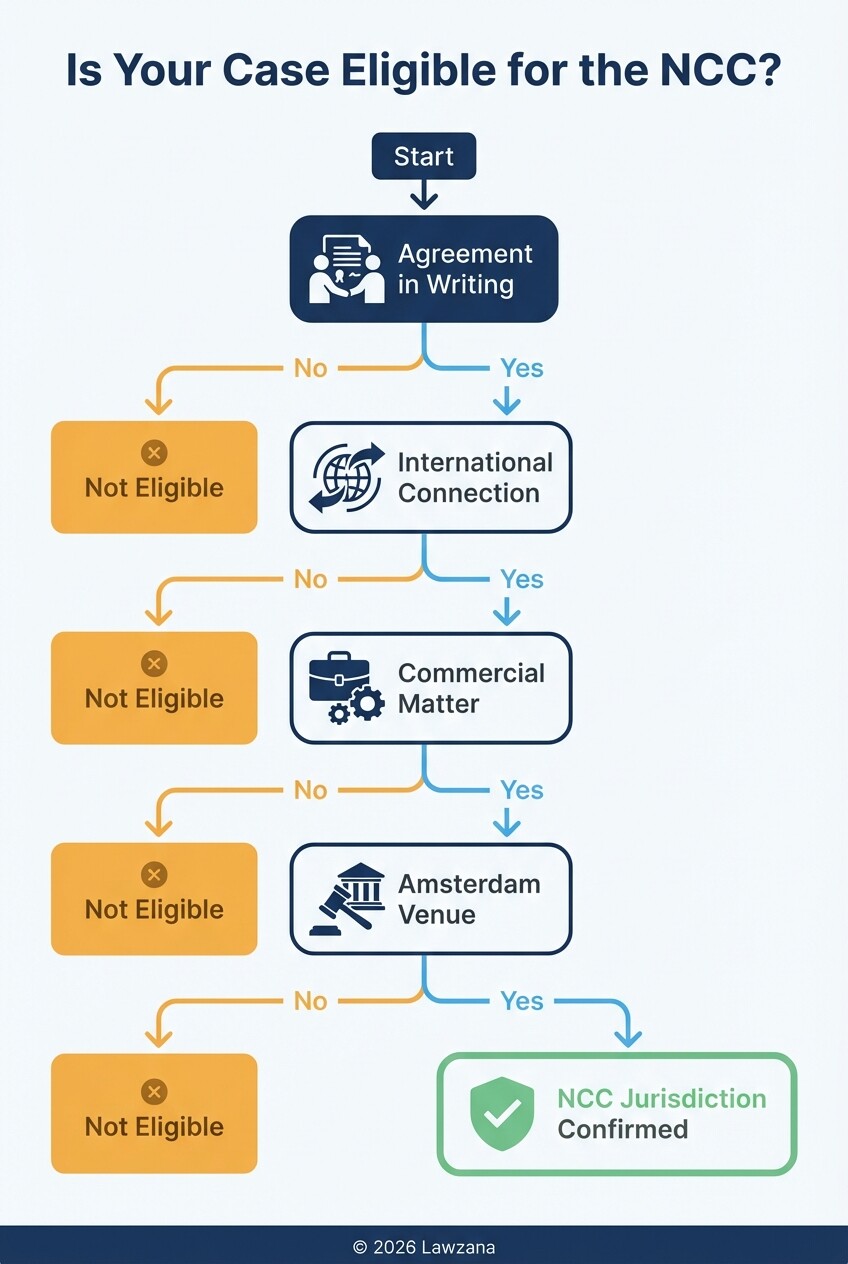
To litigate before the Netherlands Commercial Court, a case must meet four specific criteria regarding language, forum, internationality, and the nature of the dispute. These requirements ensure the court remains a specialized venue for complex business matters rather than routine local litigation.
- Agreement in Writing: Both parties must explicitly agree in writing that proceedings will be in English before the NCC.
- International Connection: The dispute must have an international element, such as parties based in different countries, a contract governed by foreign law, or business activities spanning multiple jurisdictions.
- Commercial Matter: The case must involve a commercial dispute. This typically includes M&A transactions, complex financing, international trade, or intellectual property disputes.
- Amsterdam Venue: The Amsterdam District Court must have jurisdiction, either through the parties' agreement or through statutory law.
Benefits of English-Language Proceedings in a Civil Law Jurisdiction
The NCC combines the predictability of a civil law system with the accessibility of the English language. This allows international companies to avoid the high costs of translation while benefiting from a court system that prioritizes codified laws and judicial efficiency over the lengthy discovery processes found in common law jurisdictions.
- No Translation Costs: All documents, evidence, and oral testimony are submitted and conducted in English, saving thousands of euros in certified translation fees.
- Expert Judges: NCC judges are seasoned commercial specialists with extensive experience in international law and a high level of English proficiency.
- Civil Law Predictability: Unlike common law systems that rely heavily on varying precedents, the Dutch civil law system is based on clear statutes, providing more certainty in commercial outcomes.
- Active Case Management: Judges take an active role in the proceedings to narrow the issues early, which prevents cases from dragging on for years.
Costs and Timeline of NCC Litigation
Litigation in the NCC is generally faster and more cost-effective than in London, New York, or traditional Dutch courts. The court operates with a fixed fee structure and strictly enforced timelines to ensure that business disputes are resolved at the speed of global commerce.
| Feature | NCC (District Court Level) | Traditional Dutch Court |
|---|---|---|
| Court Fee | €15,000 (fixed) | Capped at €5,737 |
| Language | English | Dutch |
| Average Duration | 12 to 18 months | 18 to 24+ months |
| Legal Fees | Recoverable (capped) | Recoverable (capped) |
While the initial court fee for the NCC is higher than in regular Dutch courts, the total cost of litigation is often lower because the process is more streamlined and eliminates translation requirements. The "loser pays" rule applies, meaning the prevailing party can recover a portion of their legal fees, although these are subject to court-approved caps based on the complexity of the case.
Enforcing NCC Judgments Globally
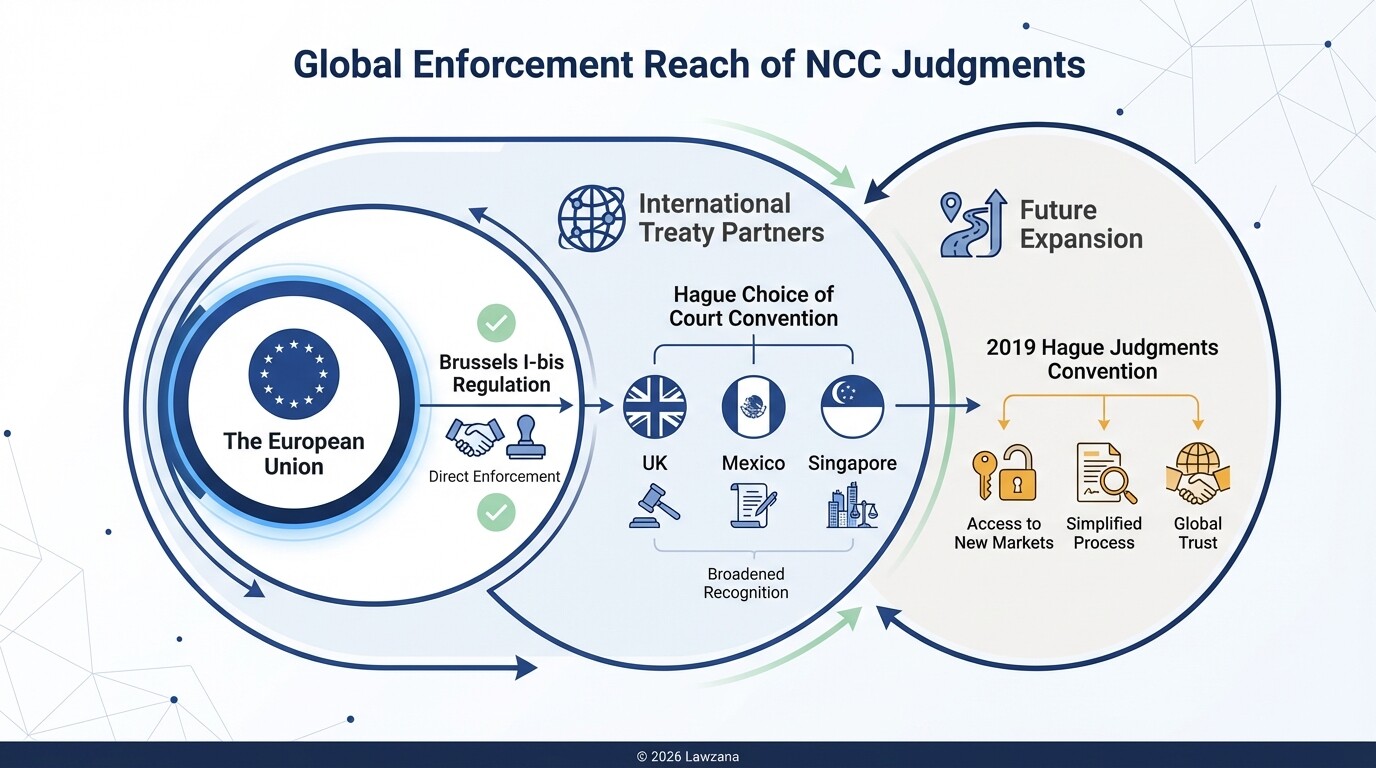
Judgments issued by the NCC are high-value instruments that carry the same legal weight as any other Dutch court ruling. Because the Netherlands is a member of the EU and various international treaties, these judgments can be enforced seamlessly across borders.
- European Union: Under the Brussels I-bis Regulation, an NCC judgment is directly enforceable in any other EU member state without the need for a special declaration of enforceability.
- Hague Choice of Court Convention: This treaty ensures that NCC judgments are recognized in participating non-EU countries, including the United Kingdom, Mexico, and Singapore.
- The 2026 Outlook: As more countries ratify the 2019 Hague Judgments Convention, the global reach of NCC rulings will continue to expand, making it an even more attractive venue for cross-border enforcement.
Digital Courtroom Procedures and Remote Participation
The NCC is a "digital-first" court designed to accommodate parties located anywhere in the world. Through its proprietary i-Court system, the court facilitates entirely paperless litigation and remote participation for hearings.
- The i-Court System: This secure portal allows parties to file documents, track deadlines, and communicate with the court 24/7.
- Remote Hearings: If witnesses or counsel cannot travel to Amsterdam, the NCC frequently uses high-definition video conferencing to conduct hearings and take testimony.
- Digital Evidence: The court is equipped to handle massive digital evidence sets, which is essential for modern commercial disputes involving extensive email chains or technical data.
Common Misconceptions
Myth 1: The NCC is only for Dutch companies.
The NCC was specifically built for international parties. In many cases, neither party has a headquarters in the Netherlands. As long as the parties agree to the jurisdiction and the case is international in nature, the court is open to them.
Myth 2: You must use Dutch law in the NCC.
The NCC is a forum, not a choice of law. While it is a Dutch court, the judges are experts at applying foreign laws. If your contract states that the laws of New York or Germany apply, the NCC will hear the case using those legal frameworks while following its own English-language procedural rules.
Myth 3: It is as expensive as international arbitration.
While the NCC offers many of the benefits of arbitration, such as specialized judges and English proceedings, it is significantly cheaper. Parties do not have to pay for the hourly rates of the arbitrators or the administrative fees of an arbitration institute, only the fixed court fee.
FAQ
Can I appeal an NCC decision?
Yes. Appeals from the NCC District Court are heard by the NCC Court of Appeal (NCCA), which also conducts proceedings entirely in English.
Does the NCC handle small claims?
No. The NCC is specifically designed for complex, high-value commercial disputes where the interest at stake or the complexity of the matter justifies the specialized English-language procedure.
Is the NCC a private court?
No. The NCC is a public court within the Dutch judiciary. While the proceedings are in English, they are part of the official state court system, providing the highest level of legal certainty and public accountability.
When to Hire a Lawyer
You should engage a commercial litigation lawyer if you are drafting an international contract and want to ensure a neutral, English-speaking venue for potential disputes. If a dispute has already arisen, immediate legal counsel is necessary to evaluate whether your case meets the NCC's jurisdictional requirements and to draft the necessary opt-in agreements. A lawyer is also required for the formal filing of claims and for navigating the specific NCC Rules of Procedure.
Next Steps
- Review Existing Contracts: Identify clauses that currently mandate litigation in local languages or expensive jurisdictions.
- Draft Opt-In Language: Use the sample clauses provided above to update your standard terms and conditions.
- Consult a Specialist: Reach out to a Dutch firm specializing in international commercial litigation to discuss the feasibility of moving your disputes to the NCC.
- Visit Official Resources: Review the Netherlands Commercial Court website for the latest fee schedules and procedural rules.