Key Takeaways
Unregistered use offers almost no legal protection against infringement in the Philippines. You must formally register your brand assets with the Intellectual Property Office of the Philippines (IPOPHL) to secure your rights.
- The Philippines follows a strict "first-to-file" rule. The first entity to file a trademark application generally holds the rights, regardless of who used it first.
- An unopposed trademark application takes 4 to 6 months to certify.
- Filing costs depend on your business size and the number of Nice Classification classes your application covers.
- You must file periodic Declarations of Actual Use (DAU) to prove your brand operates actively in the Philippine market.
- Effective enforcement requires registering your assets with Philippine Customs and coordinating with administrative bodies.
The IPOPHL Registration Checklist
Filing your brand assets with IPOPHL requires a specific sequence of actions. Follow these steps to prevent avoidable rejections.
- Run a clearance search: Search the IPOPHL trademark database before filing. Confirm your proposed mark does not conflict with existing registrations.
- Assign classifications: Categorize your goods or services using the international Nice Classification system. One application can cover multiple classes, but fees increase per class.
- File the application: Submit your trademark application online through the IPOPHL e-TM system. Non-resident foreign applicants must appoint a resident agent or a local law firm.
- Pass the examination: An IPOPHL examiner reviews the application for legal and formal requirements. If they find issues, they issue an "Office Action" that requires a formal legal response.
- Wait through publication: Approved marks are published in the IPOPHL e-Gazette for 30 days. Third parties use this window to formally oppose your registration.
- Receive the certificate: If no one opposes the mark within 30 days, IPOPHL issues the Certificate of Registration.
You can find official regulatory guidelines on the Intellectual Property Office of the Philippines (IPOPHL) website.
Registration Timeline and Maintenance
A standard, unopposed trademark application takes 4 to 6 months to reach final certification. Patents take significantly longer, often requiring 3 to 4 years due to technical examinations.
Initial filing and formality checks take 2 to 4 weeks. Once the examiner passes the application, the mandatory publication period lasts exactly 30 days. Administrative processing and certificate issuance take another 1 to 2 months. If the examiner raises objections, responding to Office Actions delays the process by several months.
A Philippine trademark registration is valid for 10 years from the issuance date. You can renew it indefinitely for consecutive 10-year terms by paying renewal fees and filing mandatory use declarations.
Declarations of Actual Use (DAU)
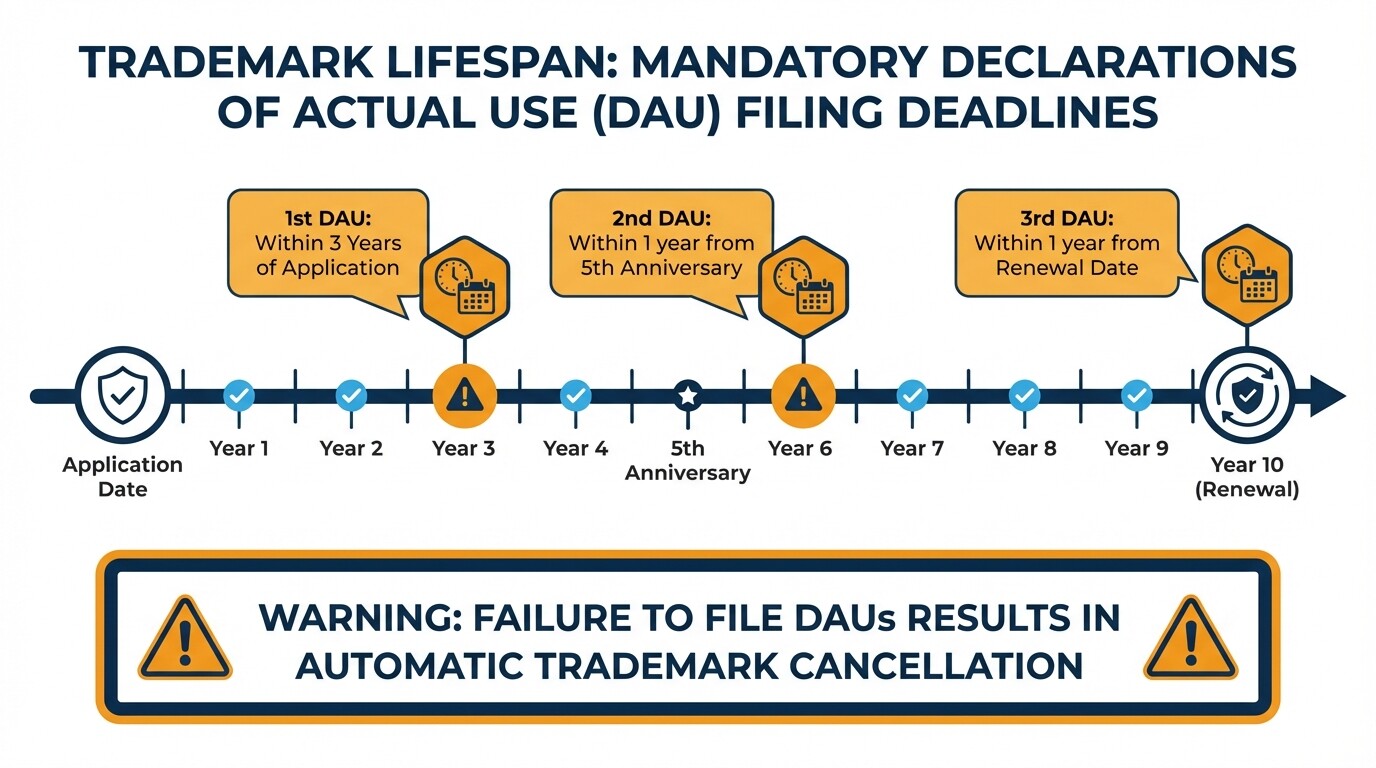
To maintain your trademark, you must submit a sworn DAU to IPOPHL proving the mark is active in Philippine commerce. You must file a DAU at three specific intervals:
- Within three years of your application date.
- Within one year from the fifth anniversary of registration.
- Within one year from your renewal date.
Failure to file a DAU results in the automatic cancellation of your trademark.
Multi-Class Trademark Application Costs
IPOPHL calculates application fees per class. The rates depend on whether your business qualifies as a Small Entity (assets of PHP 100 million or less) or a Big Entity (assets exceeding PHP 100 million).
Filing a multi-class application broadens your protection across different product lines. IPOPHL does not offer volume discounts, so the base fee applies to every claimed class.
| Fee Type | Small Entity (Under PHP 100M) | Big Entity (Over PHP 100M) |
|---|---|---|
| Basic Filing Fee (Per Class) | PHP 1,200 | PHP 2,600 |
| Publication Fee (Upon Filing) | PHP 900 | PHP 900 |
| Issuance of Certificate Fee | PHP 600 | PHP 1,000 |
| Publication Fee (Upon Issuance) | PHP 900 | PHP 900 |
Note: These government base fees exclude legal representation costs, document legalization for foreign applicants, and standard 1% legal research fees added by IPOPHL.
Handling Trademark Oppositions
Third parties have 30 days from publication in the IPOPHL e-Gazette to oppose your application. When an opposition is filed, the Bureau of Legal Affairs issues a Notice to Answer. You have 30 days to file a Verified Answer.
Opposers typically rely on a few common arguments:
- Confusing similarity: The opposer claims your mark looks or sounds like their registered mark, confusing consumers.
- Well-known status: The opposer argues their mark is internationally famous and your registration dilutes their brand, even if they have no local registration.
- Descriptiveness: Competitors argue your mark is generic and should remain free for public use.
Defending an opposition involves showing differences between the marks, proving you created the brand independently, or negotiating a co-existence agreement.
Strategies Against Local Counterfeiters
Brand owners enforce their IP rights in the Philippines through border control, administrative action, and criminal prosecution.
- Customs recordation: Register your trademark or patent with the Bureau of Customs. This allows port agents to flag, seize, and destroy imported counterfeit goods before they enter local distribution.
- Administrative actions: You can file a complaint with the IPOPHL Bureau of Legal Affairs. This route is generally faster and cheaper than civil litigation. The Bureau issues injunctions, awards damages, and orders the destruction of counterfeit goods.
- Criminal raids: Rights holders coordinate with the National Bureau of Investigation (NBI) or the Philippine National Police (PNP) to dismantle large-scale operations. These agencies secure search warrants, execute raids, and file criminal charges.
Common Misconceptions About Philippine IP
Clarifying how Philippine IP law actually works prevents costly gaps in your brand strategy.
DTI or SEC registration does not protect your trademark. Registering a business name with the Department of Trade and Industry (DTI) or the Securities and Exchange Commission (SEC) gives you the right to operate under that trade name. It grants no intellectual property rights over the brand name or logo. You must secure an IPOPHL registration for exclusive commercial use.
Prior use does not guarantee ownership. The Philippines uses a "first-to-file" system. If another entity registers your logo first, they own the rights, even if you used it for years prior. Challenging a registered mark in a cancellation proceeding is expensive and difficult to win.
Foreign trademarks have no automatic local authority. Intellectual property rights are strictly territorial. A US or EU trademark carries no legal weight in the Philippines. You must file a direct national application with IPOPHL or designate the Philippines through the Madrid Protocol to get local protection.
When to Hire a Lawyer
Hire an IP lawyer before filing, especially when managing multi-class registrations, foreign applications, or examiner objections. A legal expert conducts clearance searches to identify conflicts early, assigns your Nice Classifications efficiently, and tracks required DAU filings.
If you are bringing your brand into the Philippine market or need to stop local infringement, consult experienced corporate and commercial lawyers in the Philippines. Prepare by gathering your brand assets, documenting any local commercial use, and defining the specific products you want to protect.