

- For residential lease renewals after July 1, 2024, the 25% rent increase cap has expired; increases are now limited by the 12-month average of the Consumer Price Index (TÜFE).
- Landlords cannot evict tenants without a valid legal ground defined in the Turkish Code of Obligations, even if the lease term expires.
- Mandatory mediation is a prerequisite for filing any lawsuit regarding rental disputes in Turkey as of September 1, 2023.
- Security deposits are legally limited to a maximum of three months' rent and should ideally be kept in a dedicated bank escrow account.
- Rent determination lawsuits (Kira Tespit) can only be filed after a tenant has occupied a property for five consecutive years.
Is the 25% Rent Increase Cap Still in Effect for 2024 and 2025?
The mandatory 25% rent increase cap for residential properties in Turkey officially ended on July 1, 2024. For all lease renewals occurring after this date, the maximum allowable rent increase is determined by the 12-month average of the Consumer Price Index (TÜFE), as published monthly by the Turkish Statistical Institute.
This shift marks a return to the standard regulations under the Turkish Code of Obligations. For tenants and landlords navigating the 2024-2025 period, here is how the new (and returning) rules apply:
- Calculation Method: The increase is calculated based on the TÜFE average from the month the lease is renewed. For example, if your lease renews in October, you must use the September 12-month average report.
- Contractual Freedom: Landlords and tenants can agree on an increase lower than the TÜFE average, but any clause in a contract demanding an increase higher than the TÜFE average for residential units is legally invalid.
- Commercial Property: Note that commercial leases were never subject to the 25% cap; they have consistently followed the TÜFE average rule.
- Enforcement: If a landlord demands a 50% increase while the TÜFE average is 65%, that is legal. If they demand 80%, the tenant is legally protected to pay only the TÜFE-indexed amount.
What are the Legal Grounds for Eviction Under the Turkish Code of Obligations?
In Turkey, a residential lease does not automatically terminate simply because the contract period ends; it automatically renews for one year under the same conditions. To evict a tenant, a landlord must provide specific legal grounds stipulated in the Turkish Code of Obligations (TBK) No. 6098.
The law is generally protective of tenants, meaning landlords must prove one of the following "just causes" to regain possession of the property:
- Personal Necessity: The landlord (or their spouse, children, or parents) requires the property for their own residence or business. This must be a genuine, urgent need, not a pretext for higher rent.
- The 10-Year Rule: After a lease has been renewed for 10 consecutive years (making the total duration 11 years), a landlord can terminate the lease without stating a specific reason, provided they give a three-month notice prior to the end of the next extension year.
- Written Commitment to Evacuate (Tahliye Taahhütnamesi): If the tenant signed a document after the lease started, promising to vacate by a specific date, the landlord can enforce this through a court or execution office.
- Major Reconstruction: If the building requires significant renovation or needs to be demolished for safety, the landlord can request eviction. However, they cannot rent it to someone else for three years after the work is finished unless they offer it to the previous tenant first.
- Two Justified Notices: If a tenant fails to pay rent twice within a single lease year and the landlord sends two formal notices (via a Notary Public), the landlord can file for eviction.
How Does Mandatory Mediation Work for Rental Disputes?
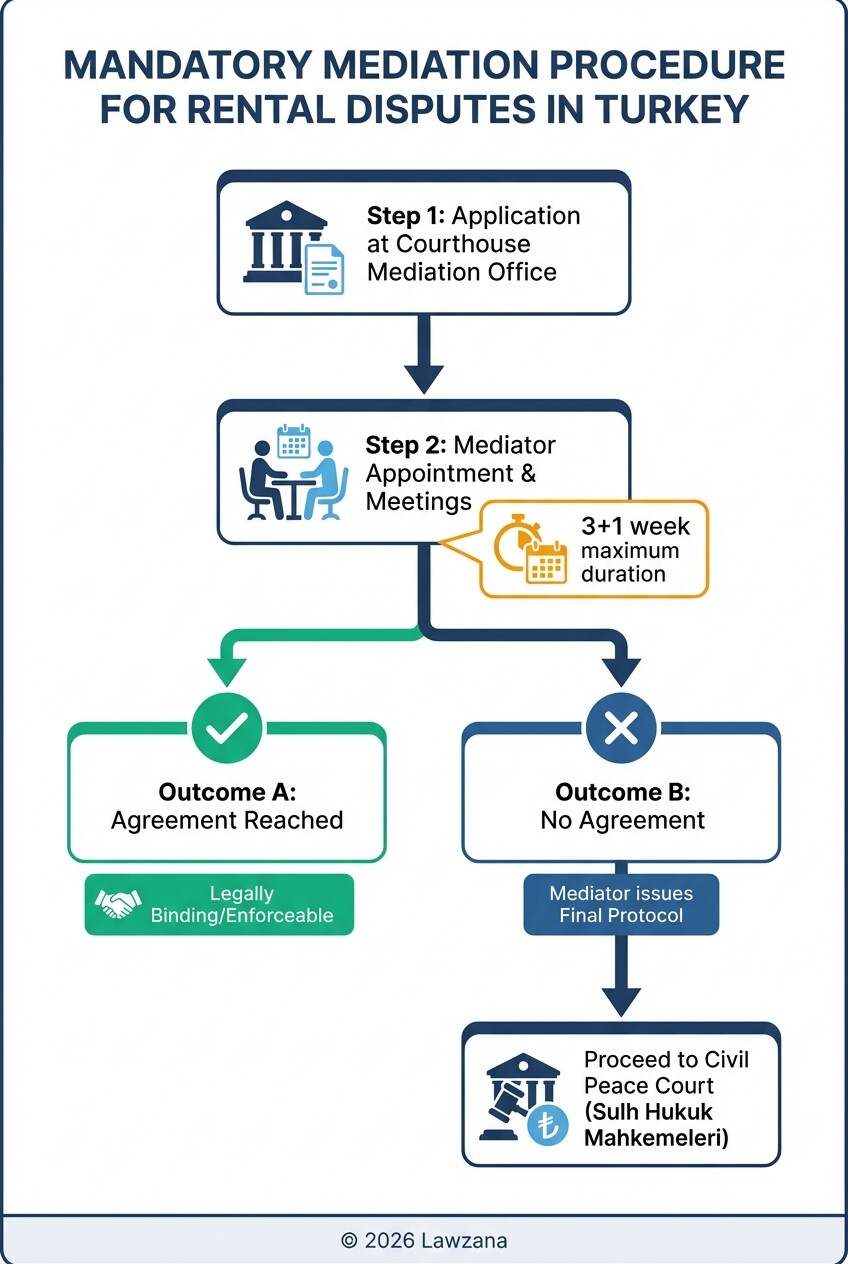
As of September 1, 2023, you cannot file a lawsuit for a rental dispute in Turkey without first going through the mandatory mediation process (Arabuluculuk). This system was implemented to reduce the heavy burden on Turkish Civil Courts caused by the surge in property litigation.
The mediation process is designed to be faster and cheaper than a full trial. Here is how the procedure unfolds for foreigners:
- Application: Either the landlord or the tenant applies to the mediation office at the local courthouse.
- Timeline: The mediator has three weeks (extendable by one week) to help the parties reach an agreement.
- The Outcome: If an agreement is reached, it is signed and holds the same legal weight as a court order. If no agreement is reached, the mediator issues a "Final Protocol of Non-Agreement," which is a mandatory document required to file a lawsuit in the Civil Peace Courts (Sulh Hukuk Mahkemeleri).
- Cost: If an agreement is reached, the parties split the mediator's fee. If no agreement is reached and a lawsuit follows, the mediation costs are initially covered by the state but may be charged to the losing party at the end of the trial.
How Can Tenants Retrieve Security Deposits from Uncooperative Landlords?
Under Article 342 of the Turkish Code of Obligations, a security deposit (Depozito) cannot exceed three months' rent and must be returned to the tenant if no damage beyond normal wear and tear has occurred. Disputes often arise when landlords refuse to return these funds at the end of the lease.
To protect yourself and ensure the return of your deposit, follow these legal steps:
- Escrow Accounts: Lawfully, the deposit should be deposited into a time-deposit savings account in the tenant's name, which cannot be withdrawn without the consent of both parties or a final court decision.
- Moving-Out Protocol: Upon vacating, always create a "Delivery Report" (Teslim Tesellüm Tutanağı) signed by both parties, confirming the state of the property and the return of keys.
- Legal Notice: If the landlord refuses to pay, send a formal notice through a Turkish Notary Public (İhtarname). This officially documents the demand and sets a deadline for payment.
- Enforcement (İcra): If the landlord still refuses, you can initiate an enforcement proceeding (İlamsız İcra Takibi) at the local Execution Office. If the landlord objects to this, you may then need to file a lawsuit to cancel the objection.
| Feature | Legal Requirement (Turkey) |
|---|---|
| Maximum Amount | 3 Months' Rent |
| Deposit Type | Cash or Negotiable Instruments |
| Return Period | Usually within 3 months of lease end (if no claims) |
| Key Statute | Turkish Code of Obligations, Art. 342 |
What is a 'Fair Market Rent' (Kira Tespit) Lawsuit?
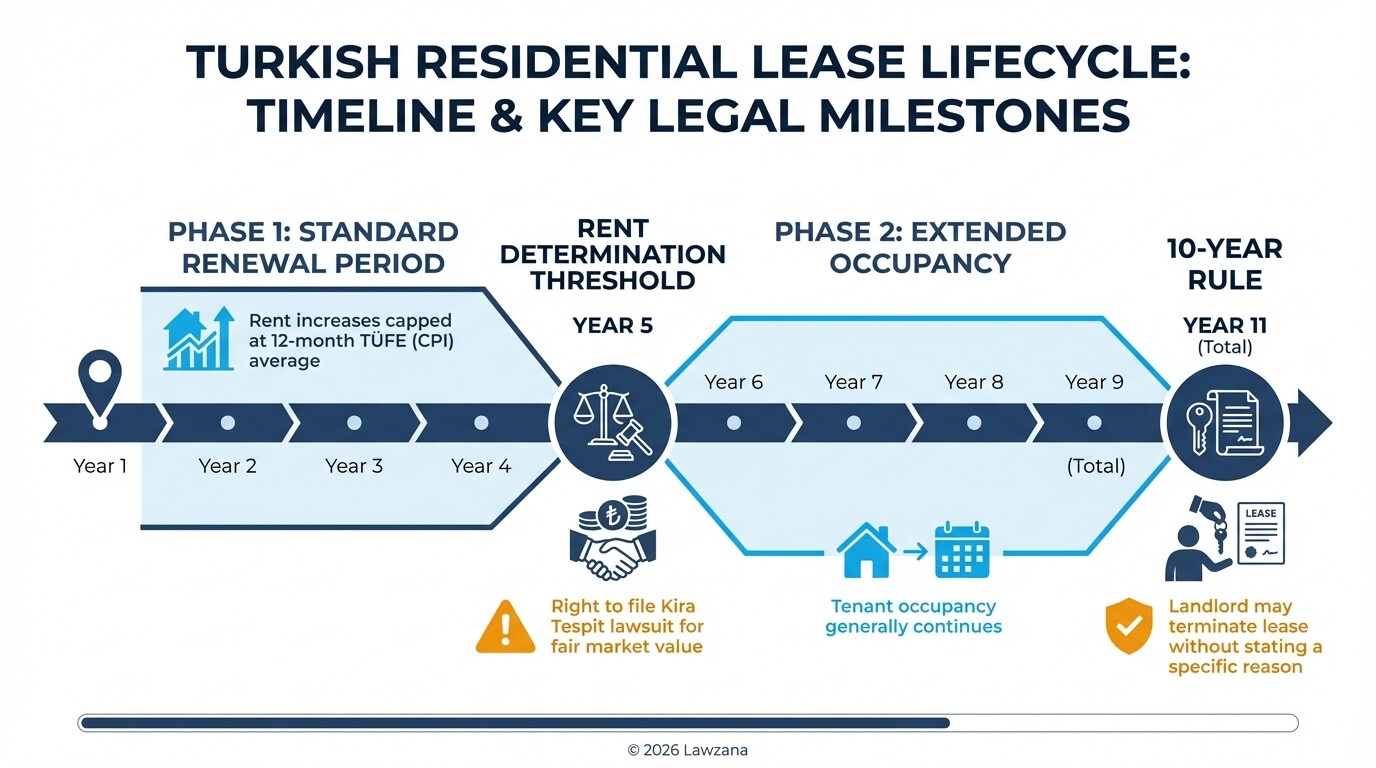
A Rent Determination Lawsuit (Kira Tespit Davası) is a legal action used to align a rental price with current market conditions when the legal CPI-based increase is no longer sufficient or fair. This is frequently used by landlords in high-inflation areas like Istanbul, Antalya, or Bodrum.
Foreigners should be aware of the specific timing and criteria for these lawsuits:
- The 5-Year Threshold: You can only file for rent determination once the tenant has completed five years of residency. Before five years, the rent increase is strictly capped at the CPI average.
- Court Criteria: The judge does not simply look at high prices on listing sites. They consider the property's age, location, square footage, and current market value, but they also apply an "Equitable Discount" (usually 10-20%) for the existing tenant.
- Process: The court will appoint an expert witness (Bilirkişi) to inspect the property and provide an appraisal report.
- Effective Date: If the lawsuit is filed at least 30 days before the start of the new lease term, the new rent determined by the court will apply to that upcoming year.
Common Misconceptions About Turkish Rental Law
Myth 1: "I can evict my tenant immediately if I sell the house." Reality: If a property is sold, the new owner inherits the existing lease. To evict the tenant for personal use, the new owner must send a notary notice within one month of purchase and can only file an eviction lawsuit six months after the purchase date.
Myth 2: "If I don't have a written contract, I have no rights." Reality: Verbal lease agreements are legally binding in Turkey. However, proving the terms (rent amount, start date) is significantly harder. Bank transfer records showing "rent payment" for specific months serve as strong evidence of a legal tenancy.
Myth 3: "The landlord can enter my home whenever they want for inspections." Reality: Landlords must give reasonable notice and visit at appropriate times. Unauthorized entry into a rented property can constitute the crime of "Violation of Housing Immunity" under the Turkish Penal Code.
FAQ
Can my landlord demand rent in USD or EUR?
While the Law on the Protection of the Value of the Turkish Currency generally prohibits rent in foreign currency between Turkish residents, certain exceptions apply to foreigners. However, once a foreign currency rent is set, it usually cannot be increased for three years under specific conditions.
How much does it cost to file a rental lawsuit in Turkey?
Initial court fees and expert witness fees generally range between 5,000 TL and 15,000 TL, depending on the case's complexity. This does not include private legal fees or the mandatory mediation costs if an agreement is reached.
What happens if I don't pay my rent for one month?
The landlord can start an execution proceeding for the unpaid rent. You will have 30 days to pay after receiving the "payment order." If you fail to pay within these 30 days, the landlord gains the right to request your eviction through the Execution Court.
When to Hire a Lawyer
Navigating the Turkish legal system as a foreigner can be daunting due to language barriers and the procedural technicalities of the Civil Peace Courts. You should consult a lawyer if:
- You have received a formal notice (İhtarname) from a Notary Public.
- You are being pressured to sign a "Commitment to Evacuate" retroactively.
- Your landlord is demanding a rent increase significantly higher than the 12-month CPI average.
- You need to initiate a mandatory mediation process but are not fluent in Turkish.
- You have been locked out of your property or your utilities have been illegally cut off.
Next Steps
- Verify your renewal date: Check your contract to see when your next rent increase is due and calculate the current 12-month CPI average.
- Review your payment records: Ensure all rent has been paid via bank transfer with the correct description ("Kira ödemesi") to avoid claims of default.
- Check for a "Tahliye Taahhütnamesi": Review your initial paperwork to see if you signed an eviction commitment, as this changes your legal leverage significantly.
- Initiate Mediation: If a dispute is unavoidable, contact the local courthouse mediation office to begin the mandatory pre-trial phase.