- Act fast on breaches: If a developer misses construction deadlines or delays the title deed (TAPU) transfer, you must formally place them in default via a Notary Public before initiating a lawsuit.
- Secure interim injunctions: When suing for a title deed transfer, request a precautionary measure (ihtiyati tedbir) to freeze the property and prevent the developer from selling it.
- Citizenship impacts: Stalled transactions jeopardize Turkish Citizenship by Investment applications. You must recover funds or force the deed transfer quickly.
- Invalid contracts: Off-plan sales contracts signed only at a developer's office are void for transferring property. They must be drafted and notarized by a Turkish Notary Public.
2026 Property Valuation Rules for Citizenship by Investment
Starting in 2026, Turkey applies stricter, centrally assigned property valuation rules to prevent price manipulation in Citizenship by Investment applications. The government aims to eliminate the practice of developers artificially inflating property appraisals to meet the $400,000 USD citizenship threshold.
Currently, foreign buyers must obtain a real estate valuation report from a Capital Markets Board (SPK) licensed appraiser. Under the new rules, buyers and developers cannot choose their own appraisers. Instead, the General Directorate of Land Registry and Cadastre (TKGM) assigns an independent appraiser through a centralized algorithm. If you are in a dispute with a developer who promised citizenship based on an inflated off-plan valuation, you must act before stricter auditing mechanisms invalidate your application. Resolving valuation disputes requires an independent legal assessment to prove the actual amount paid versus the officially recorded deed value.
Common Mistakes When Buying Off-Plan Properties
Foreign investors often lose money by signing private, unnotarized sales agreements directly at a developer's sales office and transferring funds without legal safeguards. Under Turkish law, a promise to sell real estate is legally binding only if executed as a Preliminary Real Estate Sales Contract (Gayrimenkul Satış Vaadi Sözleşmesi) at an official Notary Public.
When buying off-plan (maket üzerinden) properties, avoid these errors:
- Skipping the notary: Signing a standard contract without a Notary Public makes the agreement void for demanding the property. You can only sue for a refund under "unjust enrichment" (sebepsiz zenginleşme).
- No land registry check: Investors often pay deposits without checking the TAPU registry for existing mortgages, liens, or construction servitudes (kat irtifakı) encumbering the land.
- Ignoring developer history: Transferring funds to newly formed LLCs with no completed projects leaves you vulnerable. If a developer enters formal bankruptcy mid-construction, your claim merges into the bankruptcy estate (iflas masası), turning you into an unsecured creditor.
- Personal account payments: Making payments outside formal banking channels or to a director's personal account makes it difficult to prove the transaction was for the specific real estate investment.
Pre-Litigation Checklist for Contract Breaches
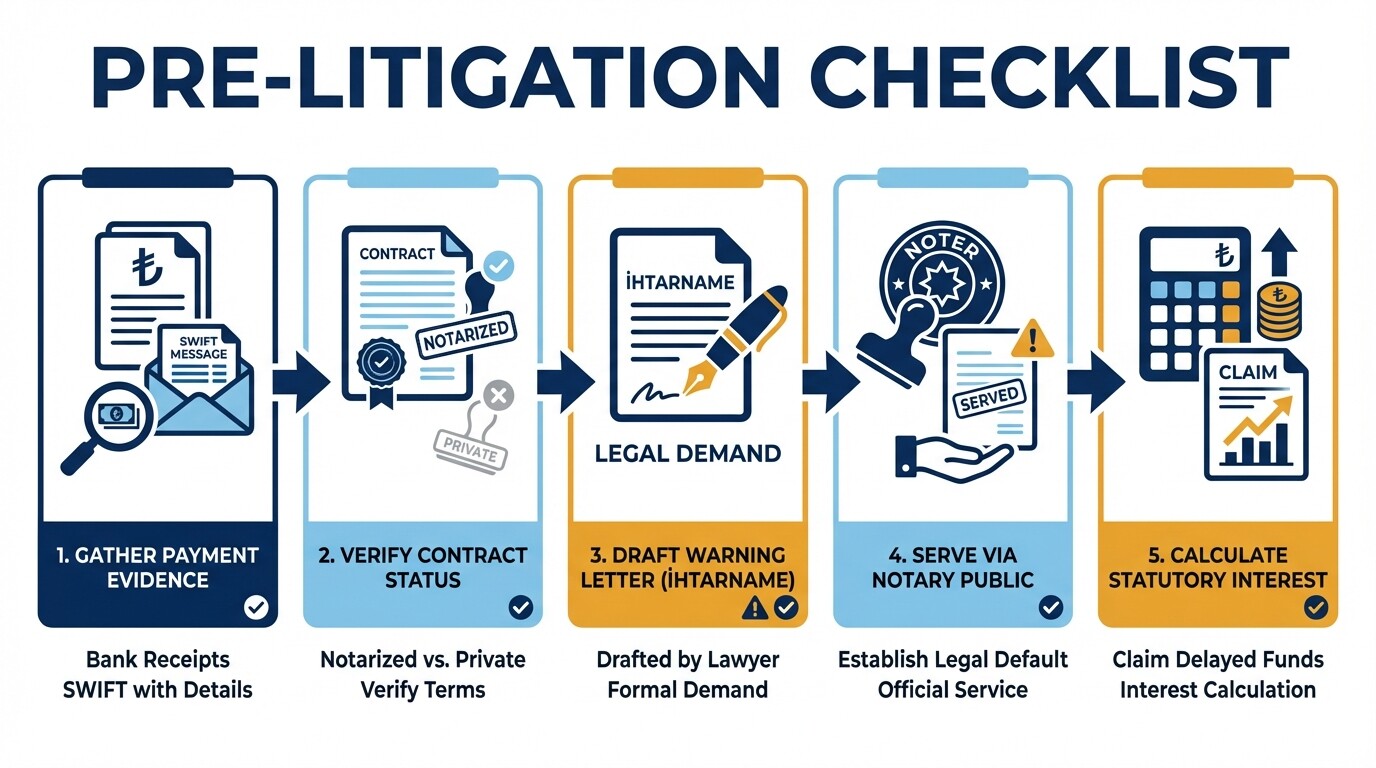
Before filing a formal lawsuit in Turkey, you must notify the breaching party to establish legal default (temerrüt). Courts require documented proof you gave the developer a final opportunity to fulfill their contractual obligations.
Under the Law on the Protection of the Consumer No. 6502, developers have a maximum of 36 months to deliver an off-plan property. If they fail to meet this deadline, you can terminate the contract and demand a full refund with interest. Follow this checklist to secure your pre-litigation standing:
- Payment evidence: Collect all bank transfer receipts (SWIFT/EFT documents) explicitly stating the project name, apartment number, and the phrase "real estate payment" in the description.
- Contract status: Confirm whether your contract is officially notarized or a private agreement. This dictates whether you can demand the property itself or only a financial refund.
- Formal legal notice: Have a Turkish lawyer draft a warning letter (İhtarname) demanding immediate performance or the return of funds within a specific timeframe (usually 7 to 14 days).
- Notary delivery: Serve the İhtarname through a Turkish Notary Public to carry legal weight in court and start the clock on default interest.
- Calculate interest: Once the deadline in the notice expires, claim statutory commercial advance interest on your delayed funds.
Initiating a Formal Lawsuit for the Title Deed
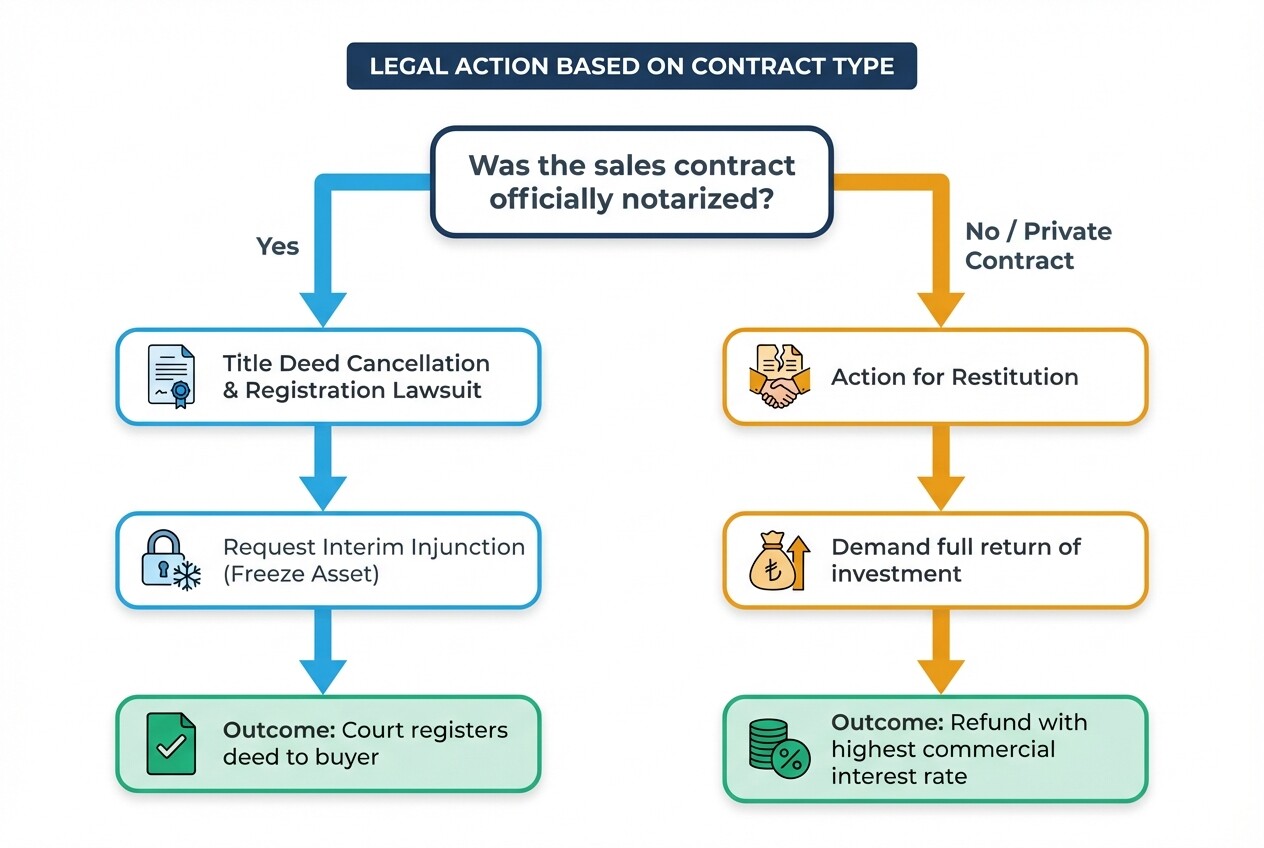
To sue a developer who fails to transfer the Title Deed, file a Title Deed Cancellation and Registration Lawsuit (Tapu İptal ve Tescil Davası) in the Consumer Court or Civil Court of First Instance where the property is located. This legal action asks the judge to cancel the developer's ownership and register the property in your name.
If you signed a valid, notarized Preliminary Sales Contract and fulfilled your payment obligations, the court has the authority to bypass the developer entirely. The first step in this lawsuit is requesting an interim injunction (ihtiyati tedbir). Once granted, this injunction is annotated on the property's registry file at the TAPU office, freezing the asset. This prevents the developer from selling the disputed unit or using it as collateral for a bank loan during the trial.
If your contract was not notarized, or if the building violates zoning laws and cannot legally receive a title deed, your lawsuit pivots to an Action for Restitution. This demands the full return of your investment plus the highest commercial interest rate applicable from the payment date.
Timeline and Legal Fees for Dispute Resolution
A standard real estate litigation case in Turkey takes between 18 and 36 months to reach a final verdict at the trial court level. Appeals extend the timeline by 12 to 24 months. Because Turkish courts operate on a written procedure system, disputes are resolved through exchanged petitions and expert reports rather than courtroom trials.
Litigation costs are tied to the value of the disputed property.
| Expense Category | Expected Cost / Percentage | Note |
|---|---|---|
| Court Filing Fees | ~1.7% of the claim amount | Proportional fee paid to the state to initiate the claim (Harç). |
| Expert Witness Fees | 5,000 - 15,000 TRY | For court-appointed engineers or financial experts to assess the site or funds. |
| Attorney Fees | 10% - 15% of property value | Governed by the Turkish Bar Association's minimum fee tariff; often a base fee plus a success percentage. |
| Notary & Translations | 10,000 - 25,000 TRY | For Power of Attorney, translated passports, and serving legal notices. |
Note: If you win the case, the court orders the losing party to reimburse your official state filing fees and a statutory portion of your legal costs.
Common Misconceptions About Turkish Real Estate Disputes
Invalid private contracts. Even if your private contract is legally invalid for forcing a title deed transfer, Turkish law prohibits unjust enrichment. You have the right to reclaim every dollar paid to the developer, usually with interest.
Physical presence. You do not need to be in Turkey to resolve property disputes. By granting a Special Power of Attorney (Özel Vekaletname) at a Turkish Consulate in your home country, a local lawyer can initiate legal notices, file lawsuits, and attend hearings on your behalf.
Government guarantees. The Turkish government does not underwrite or guarantee private real estate transactions. If a developer goes bankrupt or fails to deliver, your citizenship application stalls unless you sue for the title deed or pivot your investment into a safe alternative using recovered funds.
Next Steps to Recover Your Investment
You should engage legal counsel the moment a developer misses a major contractual milestone, ignores your requests for the TAPU transfer, or asks for unexpected additional payments. Delaying action allows developers to liquidate assets or transfer the property you paid for to a third party.
If your Turkish property investment stalls, organize your payment receipts, sales contracts, and correspondence with the developer. Do not sign settlement or addendum documents the developer offers without legal review, as these often contain clauses forcing you to waive your right to sue. You can find experienced lawsuits and disputes lawyers in Turkey through Lawzana to evaluate your contract and draft your pre-litigation notice.