Cross-Border Debt Recovery and Corporate Restructuring in Turkey
- Foreign bankruptcy decrees require formal recognition by a Turkish court before they are enforceable against local assets.
- Securing interim injunctions is the first step to prevent Turkish debtors from dissipating assets during prolonged disputes.
- Turkey's Concordato mechanism shields domestic companies from execution proceedings. Foreign creditors must act quickly to register their claims.
- Out-of-court settlements are the most cost-effective recovery strategy when structured as directly enforceable notarized protocols.
- Commercial debt recovery requires strict adherence to timelines under the Turkish Execution and Bankruptcy Law.
Checklist for Cross-Border Debt Recovery
Recovering commercial debts from a Turkish entity requires a sequenced approach to secure assets. This checklist outlines the immediate steps foreign creditors must take to protect their financial interests.
- Verify solvency status: Check the Turkish Trade Registry Gazette to confirm if the debtor has entered Concordato (restructuring) or bankruptcy proceedings.
- Translate and apostille documentation: Ensure all commercial contracts, invoices, and foreign court judgments are translated into Turkish, notarized, and apostilled for use in Turkish courts.
- Calculate the debt: Creditors can initiate proceedings based on the original foreign currency of the contract. However, foreign currency claims are evaluated against the Central Bank of the Republic of Turkey's exchange rates, and the debtor retains the right to pay in Turkish Lira at the effective exchange rate on the payment date.
- File for an interim injunction: Petition the commercial court to freeze the debtor's bank accounts and real estate before initiating formal recovery proceedings.
- Issue a demand letter: Send a notarized default notice through a Turkish Notary Public to formally establish the debtor's default status.
- Initiate execution proceedings: File an application with the relevant Turkish Execution Office based on the debtor's registered headquarters.
Recognizing and Enforcing Foreign Bankruptcy Decrees
Foreign bankruptcy decrees are not automatically valid in Turkey. Creditors or foreign bankruptcy trustees must file a formal recognition and enforcement lawsuit (tenfiz) before a Turkish commercial court under the International Private and Civil Procedure Law.
To enforce a foreign bankruptcy judgment, the Turkish court verifies specific criteria. The foreign judgment must be final and binding under the laws of the issuing country. There must also be a reciprocal agreement between Turkey and the issuing jurisdiction, established either through a bilateral treaty or legal practice. The court verifies the foreign decree does not violate Turkish public policy. Until the court grants this recognition, a foreign bankruptcy trustee cannot seize or liquidate the debtor's assets located within Turkey.
Navigating Concordato Proceedings
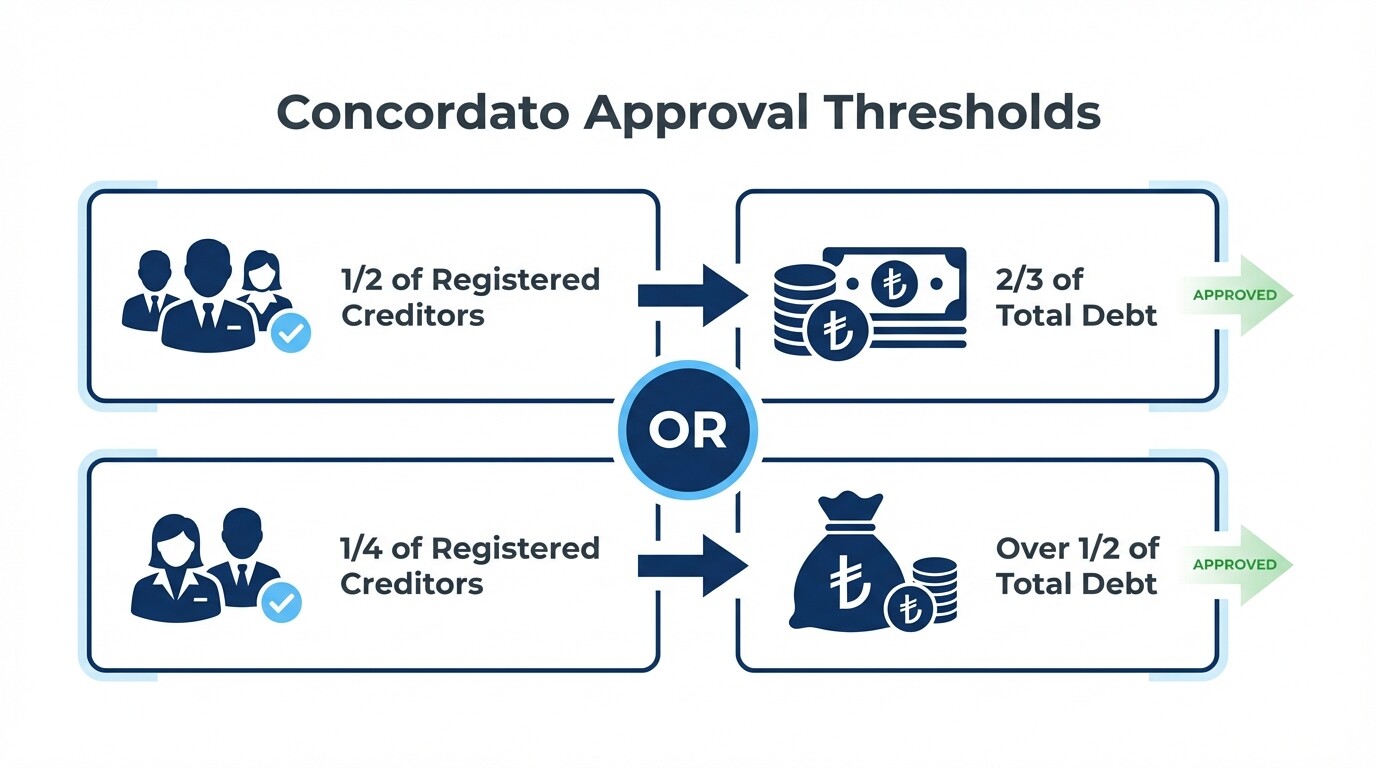
Concordato is Turkey's primary corporate restructuring mechanism. It allows financially distressed companies to shield themselves from execution proceedings while negotiating debt repayment. Foreign creditors must monitor Turkish registry announcements and register their receivables within a strict 15-day window set by the court-appointed commissioner.
When a Turkish company enters Concordato, ongoing execution proceedings halt, and no new proceedings can begin. As a foreign creditor, you must submit your claims with apostilled supporting documents directly to the Concordato commissioner. Once the commissioner accepts your claim, you earn the right to vote in the creditors' assembly.
The restructuring project requires the affirmative votes of either half of the registered creditors holding two-thirds of the total debt, or one-fourth of the registered creditors holding over half of the total debt. Failing to participate strips you of your voting rights and binds you to terms negotiated by domestic creditors.
Securing Interim Injunctions
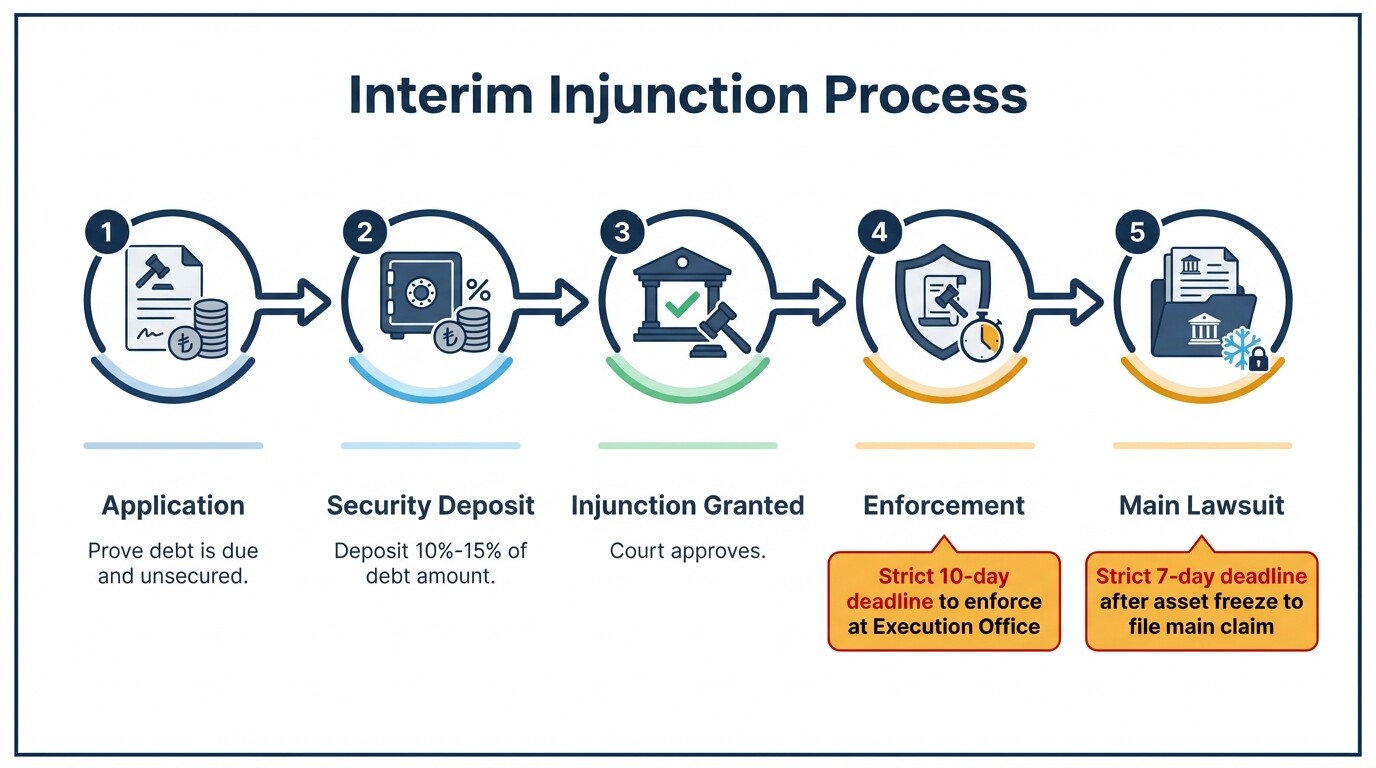
An interim injunction (ihtiyati haciz) allows creditors to legally freeze a Turkish debtor's bank accounts, movable assets, and real estate before obtaining a final court decision. To secure this preliminary attachment, creditors must prove to a Turkish commercial court that the commercial debt is due and unsecured.
Turkish courts require the creditor to deposit a security guarantee to compensate the debtor if the underlying claim is later proven invalid. This deposit is typically set between 10% and 15% of the total debt amount. If the debt is not yet due, a creditor can still obtain an interim injunction by proving the debtor has no fixed domicile, is attempting to hide assets, or plans to flee the jurisdiction. After the court grants the injunction, the creditor has 10 days to enforce it through the Execution Office and must file the main lawsuit or standard execution proceeding within 7 days of the asset freeze.
Execution and Bankruptcy Timelines
Turkish commercial debt recovery timelines vary based on the selected procedure, the debtor's willingness to contest the claim, and the local court's backlog. Standard execution proceedings based on a liquid document (like a promissory note) are swift, while full bankruptcy litigation takes years.
Foreign creditors do not need a physical presence in Turkey to initiate these procedures; they can issue a power of attorney to local legal counsel. A foreign creditor can also file for direct bankruptcy against a Turkish debtor if the debt is proven by a finalized court judgment or if the debtor has suspended their payments entirely.
All proceedings are governed by the Execution and Bankruptcy Law (Law No. 2004), which dictates specific statutory deadlines for both creditors and debtors. The official text is maintained on the Turkish official legislation portal.
| Legal Procedure | Average Timeline | Description |
|---|---|---|
| Uncontested Execution | 1 to 3 months | Rapid process if the debtor does not file an objection within 7 days of receiving the payment order. |
| Contested Execution | 12 to 18 months | If the debtor objects, the creditor must file an "action for the annulment of the objection" in commercial court. |
| Concordato Process | Up to 23 months | Includes a 5-month temporary grace period and up to an 18-month definitive grace period for restructuring. |
| Bankruptcy Liquidation | 2 to 4 years | Comprehensive liquidation of corporate assets, distribution of funds, and final closure of the estate. |
Negotiating Enforceable Out-of-Court Settlements
Negotiating out-of-court settlements requires leveraging the threat of formal execution proceedings or bankruptcy to bring uncooperative debtors to the table. Structuring the settlement through a formal mediation agreement or a notarized protocol ensures the negotiated terms become immediately enforceable under Turkish law.
When negotiating with a Turkish commercial debtor, avoid informal email agreements. Use Turkey's mandatory commercial mediation framework instead. If a settlement is reached during mediation, the resulting agreement has the same legal weight as a final court judgment. Alternatively, drawing up a debt acknowledgment and restructuring protocol before a Turkish Notary Public provides the creditor with a "liquid document." If the debtor defaults on the new payment plan, this document allows the creditor to bypass commercial litigation and immediately initiate direct execution proceedings against the debtor's assets.
Common Misconceptions
- Foreign judgments are immediately executable: Many foreign businesses assume a judgment from London or New York allows immediate asset seizure in Istanbul. No enforcement action can occur without a formal recognition lawsuit in Turkey.
- Concordato means liquidation: Foreign creditors often mistake Concordato for terminal bankruptcy. It is a debtor-in-possession rescue mechanism designed to keep the company operational. Creditors typically recover more through this process than through forced liquidation.
- Security deposits are lost funds: Creditors frequently hesitate to seek interim injunctions because of the 15% security deposit requirement. This deposit is fully refundable once the creditor wins the main lawsuit and finalizes the debt collection.
Next Steps
Cross-border debt recovery in Turkey is highly technical and time-sensitive. Missing the statutory deadlines to register claims or object to a restructuring project permanently extinguishes your right to recover funds.
Your immediate priority is assessing the financial health of your Turkish debtor to determine the most viable recovery route. Gather all signed contracts, invoices, and shipping documents related to the debt. Have these documents reviewed by specialized restructuring and insolvency lawyers in Turkey who can advise whether to pursue an out-of-court notarized settlement, apply for an interim asset freeze, or initiate formal execution proceedings.