


- Commercial tenants in New York City have significantly fewer statutory protections than residential tenants, making the specific language of the lease the primary governing law.
- Filing for a "Yellowstone Injunction" is a critical first step to prevent lease termination while a dispute is being litigated in court.
- A "Good Faith Guaranty" generally limits a guarantor's personal liability to the date the tenant vacates the premises, provided proper notice is given.
- NYC law prohibits commercial tenant harassment, offering legal recourse if a landlord uses threats or interrupts essential services to force a move-out.
- Most NYC commercial disputes are resolved through the Civil Court or Supreme Court, depending on the monetary value and complexity of the case.
What are the common clauses in NYC commercial leases that lead to litigation?
Litigation in New York City commercial real estate often stems from "hidden" costs and maintenance obligations buried in complex lease agreements. Most disputes center on rent escalations, operating expenses, and the precise definition of "additional rent," which can include property taxes and insurance.
While every lease is unique, the following clauses are the most frequent catalysts for legal action:
- Operating Expense Escalations: Landlords often pass on increases in building operating costs to tenants. Disputes arise when "Porter's Wage" formulas or Consumer Price Index (Index) adjustments are calculated incorrectly or include capital improvements that should be the landlord's responsibility.
- Real Estate Tax Pro Rata Shares: Tenants are usually responsible for a portion of the building's property tax increases. Litigation occurs over the "base year" calculation or when a landlord fails to credit the tenant for tax abatements received.
- Maintenance and Repair (The "As-Is" Clause): NYC leases often state a tenant accepts the space "as-is." Disputes erupt when structural issues, such as roof leaks or HVAC failures, occur, and the lease is ambiguous about who bears the multi-thousand-dollar repair cost.
- Alterations and Restoration: Conflicts often arise at the end of a lease term when a landlord demands the tenant restore the space to its original condition, which may involve expensive demolition and construction.
What legal steps should you take when facing a commercial eviction notice?
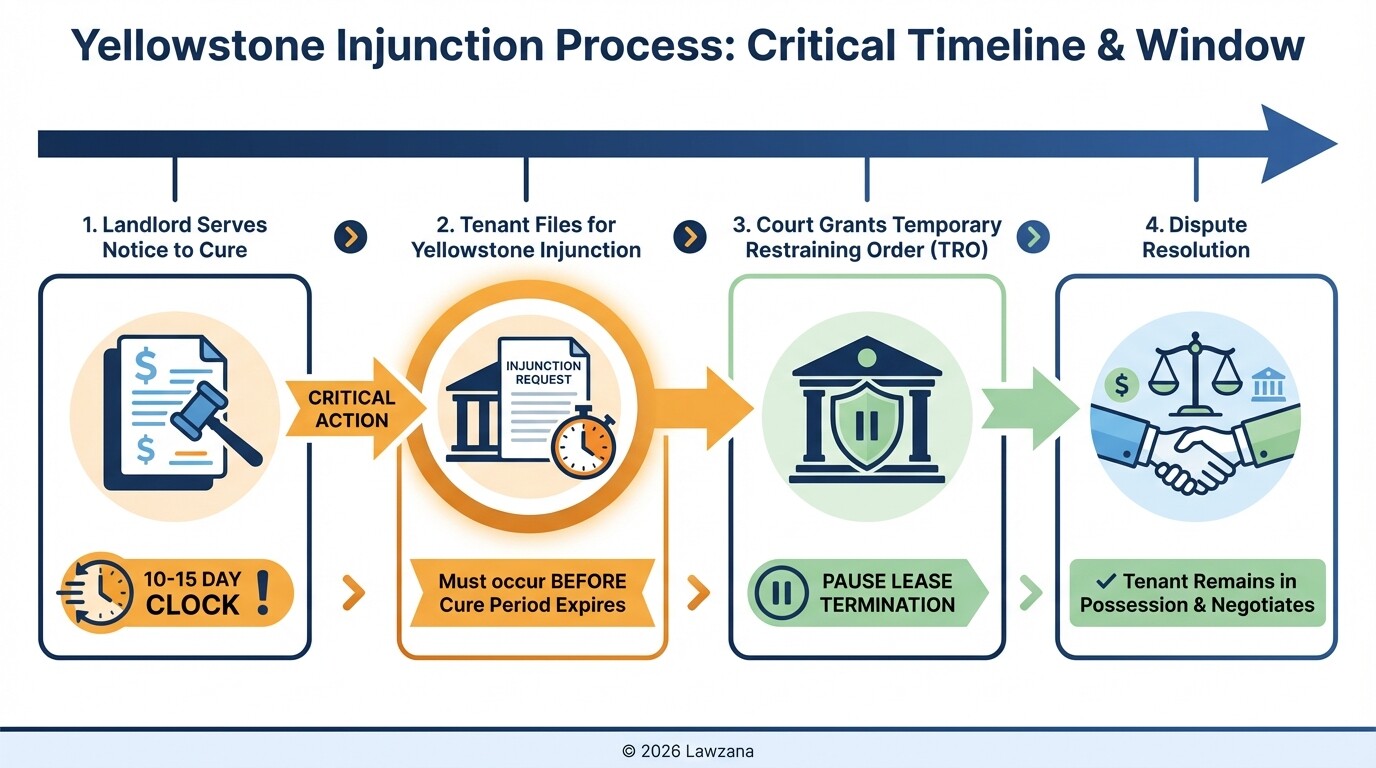
When a commercial tenant receives a "Notice to Cure" or a "Notice of Termination" in NYC, the most urgent legal step is often filing for a Yellowstone Injunction in New York State Supreme Court. This legal maneuver pauses the clock on the eviction process, preventing the landlord from terminating the lease while the court determines if a default actually occurred.
To navigate a commercial eviction, follow these steps:
- Review the Notice to Cure: NYC landlords must typically provide a written notice detailing the alleged lease violation and a specific timeframe (often 10 to 15 days) to fix it.
- File for a Yellowstone Injunction: You must file this before the cure period expires. If granted, it maintains the "status quo," allowing you to stay in the space while the dispute is litigated.
- Verify the Rent Demand: For non-payment cases, ensure the landlord provided a formal "14-day demand" for rent. In NYC, a summary proceeding for non-payment cannot begin until this statutory period has passed.
- Prepare an Answer: If a "Notice of Petition and Petition" is served, you must file a formal response with the New York City Civil Court, asserting defenses such as "constructive eviction" or "breach of the covenant of quiet enjoyment."
How do Good Faith Guaranties function in New York commercial disputes?
A Good Faith Guaranty is a legal agreement where an individual (usually the business owner) personally guarantees the rent, but their liability ends on the date the tenant surrenders the keys and vacates the premises. In NYC, this is a standard compromise that protects the landlord's income while limiting the individual's long-term personal financial exposure if the business fails.
To ensure the "Good Faith" protections apply, the following conditions must typically be met:
- Notice of Surrender: The tenant must provide the landlord with formal written notice (often 60 to 90 days in advance) of their intent to vacate.
- Condition of the Premises: The space must be delivered vacant, free of all occupants, and in "broom clean" condition as defined by the lease.
- Payment of Rent to Date: The guarantor is usually only released from future rent obligations; they remain personally liable for all arrears and "additional rent" accrued up until the day of surrender.
| Feature | Full Personal Guaranty | Good Faith Guaranty |
|---|---|---|
| Liability Limit | Entire length of the lease term | Only until the date of surrender |
| Notice Requirement | None (usually) | Strict (30-120 days) |
| Asset Risk | High (personal assets at risk for years) | Moderate (limited to arrears) |
What is the role of mediation in resolving NYC business tenant disputes?
Mediation serves as a private, faster, and more cost-effective alternative to the backlogged New York court system for resolving commercial lease disputes. In this process, a neutral third party helps the landlord and tenant reach a voluntary settlement, which is particularly effective for disputes involving repair delays or minor rent arrears.
The benefits of choosing mediation in the NYC market include:
- Confidentiality: Unlike court filings, which are public records and can damage a business's reputation or a landlord's ability to attract future tenants, mediation is private.
- Creative Solutions: Courts are often limited to awarding money or possession. Mediation allows for "outside-the-box" settlements, such as lease extensions in exchange for lower rent, or the landlord taking over tenant improvements.
- Speed: A court case in Manhattan or Brooklyn can take 12 to 24 months to reach a resolution. Mediation can often be concluded in one or two sessions.
- Preservation of Relationship: If the tenant intends to stay in the building, mediation fosters a collaborative environment rather than the adversarial one created by litigation.
How have recent changes to New York's commercial tenant protection laws affected disputes?
Recent legislative shifts in New York have introduced more robust protections against "Commercial Tenant Harassment," giving small businesses a cause of action if a landlord uses high-pressure tactics to force a move-out. Under NYC Administrative Code § 22-902, landlords can be fined and ordered to pay attorney fees if they engage in patterns of behavior intended to disrupt a tenant's business.
Key updates to the legal landscape include:
- Non-Residential Tenant Harassment Law: Tenants can now sue for damages if a landlord repeatedly interrupts essential services, files baseless court actions, or interferes with the tenant's ability to use the premises.
- COVID-19 Legacy Protections: While the temporary moratoriums have expired, New York courts are still navigating the fallout. Some "Personal Liability Provisions" (Administrative Code § 22-1005) were struck down by federal courts, but the city continues to provide resources through the NYC Small Business Services (SBS).
- Statutory Rent Demands: The timeframe for rent demands in commercial non-payment proceedings remains strict, and failure to follow the 14-day notice requirement is now a common ground for dismissal of eviction cases.
Common Misconceptions About NYC Commercial Leases
Myth 1: There is a "standard" commercial lease in New York City. There is no such thing as a standard lease. Every clause is negotiable. While many landlords use the "Real Estate Board of New York" (REBNY) form as a starting point, they almost always attach a "rider" that contains dozens of pages of additional, often aggressive, terms that override the standard form.
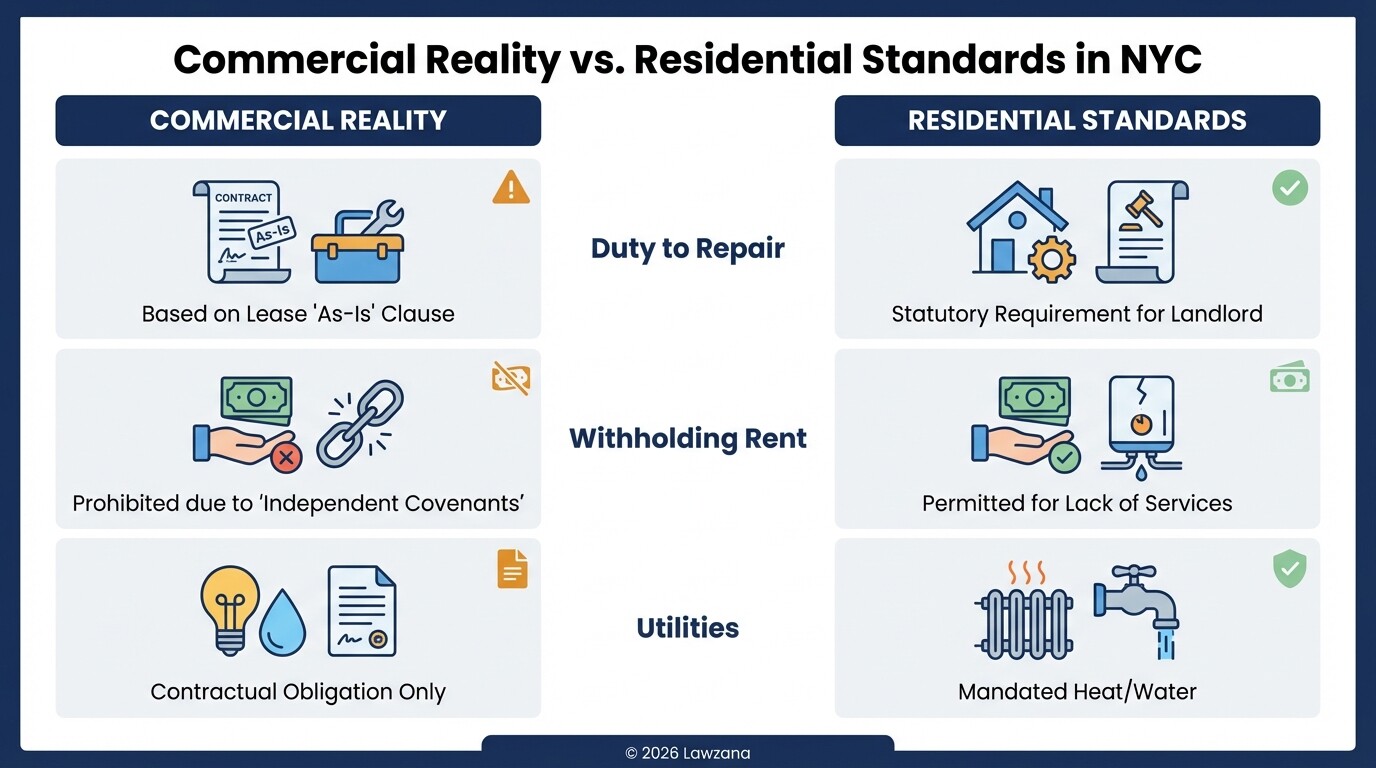
Myth 2: A landlord must provide "Heat and Hot Water" just like in residential apartments. In a commercial context, the landlord's obligation to provide utilities is strictly what is written in the lease. If the lease states the tenant is responsible for the HVAC system and the boiler, the landlord has no legal duty to provide heat, even in the middle of a New York winter.
Myth 3: You can withhold rent if the landlord fails to make repairs. Withholding rent is extremely risky in NYC commercial real estate. Most commercial leases contain "independent covenants" clauses, meaning your obligation to pay rent is independent of the landlord's obligation to repair. Withholding rent usually leads to a swift eviction notice, regardless of the repair issues.
FAQ
Can a NYC landlord lock me out without going to court?
Generally, no. Even though "self-help" is technically permitted in very limited commercial circumstances with specific lease language, most NYC judges strongly disfavor it. A landlord who improperly locks out a tenant can be sued for "treble damages" (triple the actual damages).What is a "Porter's Wage" escalation?
It is a uniquely New York formula where your rent increases based on the hourly wage increases of building service employees (porters). Even if your building doesn't employ porters, your lease might still use this index as a benchmark for rent hikes.How long does a commercial eviction take in NYC?
The process typically takes 6 to 12 months. However, if the tenant files for a Yellowstone Injunction or raises complex defenses regarding the lease's "Notice to Cure," the timeline can extend significantly beyond a year.Are oral agreements for rent reductions binding?
In almost all NYC commercial leases, no. Most contracts contain a "No Oral Modification" clause, meaning any agreement to lower the rent or change lease terms must be in a signed writing to be enforceable in court.When to Hire a Lawyer
You should consult a commercial real estate litigator as soon as you receive any formal "Notice to Cure" or "Notice of Default." In the NYC market, the window to protect your rights-specifically the window to file for a Yellowstone Injunction-is exceptionally narrow (often only 10 days). If you are negotiating a surrender, a lawyer is essential to ensure your Good Faith Guaranty is properly triggered so you aren't pursued for years of future rent after you close your doors.
Next Steps
- Audit Your Lease: Locate your original lease and all subsequent riders or amendments to identify "Notice" requirements.
- Document Everything: Keep a log of all service interruptions, maintenance requests, and communications with the landlord.
- Check Your Insurance: Review your business interruption insurance to see if it covers losses related to premises disputes or closures.
- Seek Professional Counsel: Contact a New York-licensed attorney specializing in commercial landlord-tenant litigation to review your options before the cure period on any notice expires.