


How long do I have to respond to a business lawsuit in California?
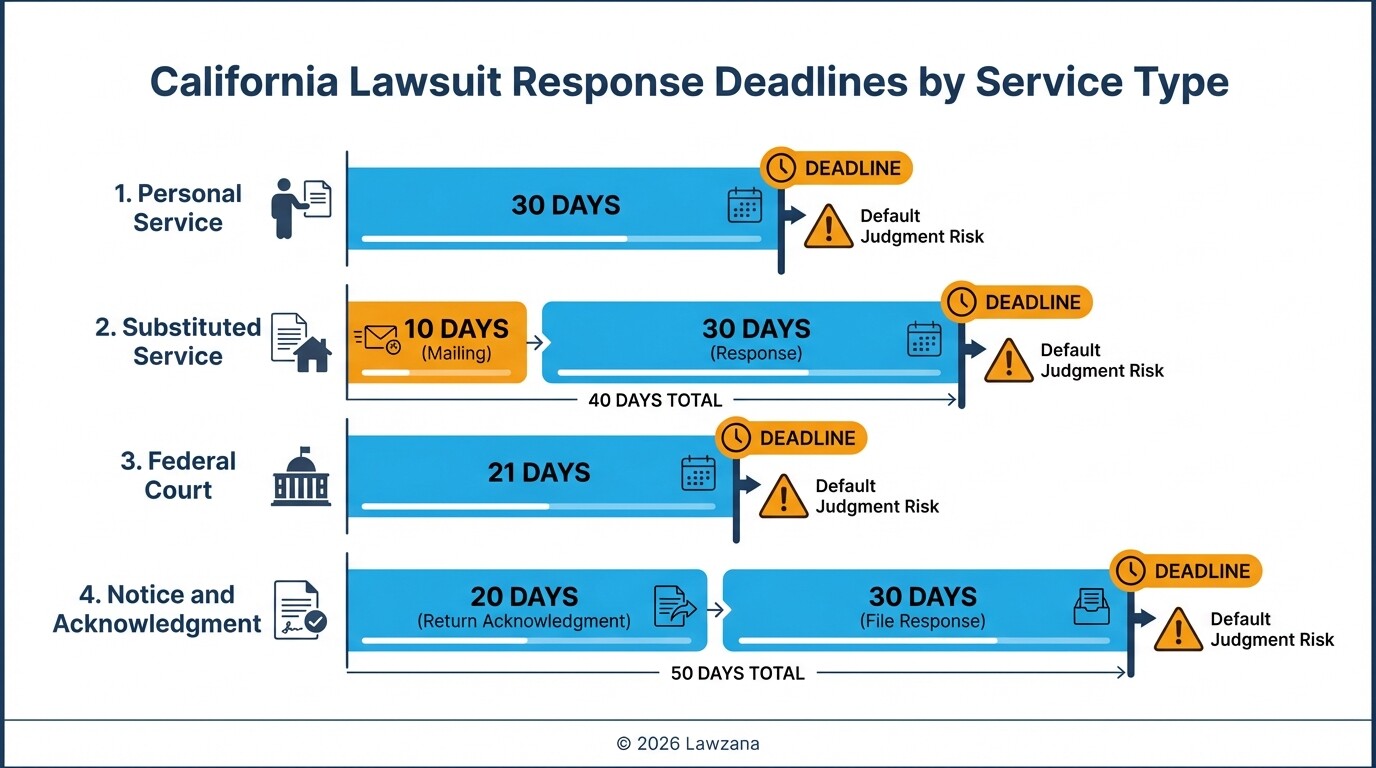
In most California business disputes, you have 30 calendar days from the date you were personally served with the Summons and Complaint to file a formal response with the court. If the documents were left with someone else at your office (substituted service), the 30-day clock typically starts 10 days after the documents are mailed to you following that physical delivery.
Calculating these deadlines is the most critical step in protecting your company. California courts are strict regarding these timelines, and missing the window by even one day can trigger a Request for Entry of Default. Once a default is entered, you lose your right to contest the claims or present a defense unless you can prove "mistake, inadvertence, or excusable neglect," which is a high legal bar to clear.
Critical Deadline Factors:
- Personal Service: 30 days from the day the papers are handed to you.
- Substituted Service: 40 days total (10 days for mailing + 30 days to respond).
- Federal Court: If the lawsuit is in U.S. District Court, the response time is typically 21 days.
- Service by Notice and Acknowledgment: 20 days from the date you sign the acknowledgment form to return it, then 30 days to file a response.
How do I verify the court, case type, and amount claimed?
To identify the specifics of the lawsuit, you must examine the first two pages of the legal package: the Summons and the Complaint. The Summons identifies the court's name and location, while the Complaint outlines the specific legal "causes of action"-such as breach of contract or fraud-and the "Prayer for Relief," which lists the financial damages sought.
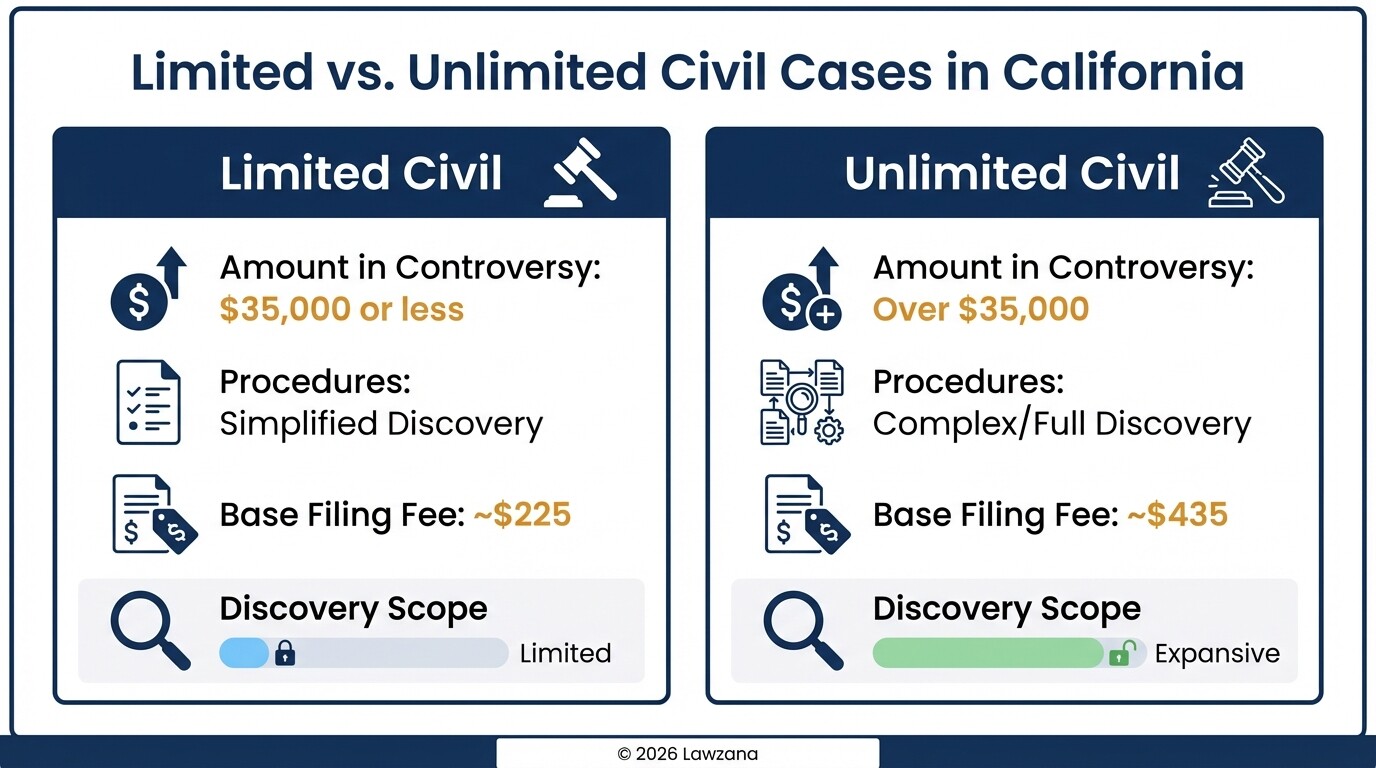
Business owners should first look at the header of the Complaint to see which branch of the California Superior Court is handling the case. If the amount in controversy is $35,000 or less, it is classified as a "Limited Civil" case, which has simplified discovery rules. If it exceeds $35,000, it is an "Unlimited Civil" case, involving more complex procedures and higher potential liability.
Checklist for Reviewing the Complaint:
- The Parties: Are you being sued personally, or is it only your LLC or Corporation?
- The Jurisdiction: Is the case filed in a county where you actually do business or where the contract was signed?
- The Allegations: Which specific paragraphs describe your alleged wrongdoing?
- The Demand: Does the plaintiff ask for "attorney fees" and "punitive damages," or just actual losses?
What if the company name is misspelled on the lawsuit?
Minor clerical errors or misspellings do not usually invalidate a lawsuit. In California, plaintiffs are often allowed to amend the complaint to fix "Doe" defendants or name corrections, so you should still respond to avoid a default judgment.
When should a business negotiate, seek dismissal, or file a counterclaim?
The best strategy depends on whether the lawsuit is legally sound or a tactical move by a competitor or disgruntled vendor. You may choose to file a "Demurrer" if the complaint is legally deficient, file an "Answer" to deny the claims, or file a "Cross-Complaint" if the plaintiff actually owes your business money.
California law allows for several responsive pleadings. A Demurrer argues that even if everything the plaintiff says is true, it does not constitute a legal cause of action. If the plaintiff has violated the "Anti-SLAPP" statute (Strategic Lawsuits Against Public Participation), you might even be able to get the case dismissed and your attorney fees paid if the lawsuit interferes with your rights of free speech or petition.
Common Strategic Moves:
- Negotiation/Mediation: If the debt is valid, an early settlement can save tens of thousands in legal fees.
- Motion to Strike: Used to remove irrelevant, false, or improper matter from a complaint, such as an improper request for punitive damages.
- Cross-Complaint: This is a separate lawsuit filed by the defendant against the plaintiff (or third parties) related to the same transaction.
- General Denial: A standard response for Limited Civil cases that denies every allegation in the complaint at once.
Can I resolve the lawsuit without going to court?
Yes, most California business disputes end in settlement through Private Mediation or Mandatory Settlement Conferences (MSC). These are often more cost-effective than a multi-day trial.
What documents and evidence should I gather before meeting a lawyer?
Before your initial consultation, you should compile a "Case File" that includes every piece of paper or digital record related to the dispute. Providing an organized timeline and supporting evidence allows your attorney to quickly assess the strength of the plaintiff's case and provide an accurate estimate of defense costs.
California's discovery process is broad, meaning the other side will eventually have the right to see most of your business records related to the case. By gathering these early, you prevent "spoliation of evidence" (the destruction of records), which can lead to severe court sanctions.
Essential Documentation Checklist:
- The Contract: All signed agreements, amendments, and addenda.
- Communications: Printed copies of emails, text messages, and logs of phone calls.
- Financial Records: Invoices, receipts, bank statements, and proof of payment or non-payment.
- Marketing Materials: Brochures or website screenshots if the case involves misrepresentation or IP issues.
- Internal Notes: Any memos or project management logs documenting the timeline of events.
How should I handle digital evidence?
Ensure that your "Auto-Delete" settings for emails and Slack messages are turned off immediately. In California litigation, a "Litigation Hold" is expected the moment you reasonably anticipate a lawsuit.
How can a commercial litigation attorney help control risk and costs?
A commercial litigation attorney acts as a shield for your company's bottom line by navigating the complex California Code of Civil Procedure. Beyond just filing paperwork, they perform a risk-benefit analysis to determine if fighting the case is more expensive than settling it early.
Attorneys also provide "Privilege," meaning your discussions about the case are confidential. If you attempt to negotiate with the plaintiff yourself, your statements could potentially be used against you in court. A lawyer ensures that all settlement offers are made under California Evidence Code Section 1152, which generally prevents those offers from being used as evidence of liability.
Ways an Attorney Mitigates Risk:
- Procedural Defense: Identifying if the plaintiff failed to serve you correctly or filed in the wrong court.
- Insurance Coordination: Reviewing your policies to see if your insurance company is required to pay for your legal defense (the "Duty to Defend").
- Discovery Management: Protecting your sensitive trade secrets or private financial data from being exposed during the exchange of evidence.
- Judgment Protection: Negotiating structured settlements to keep your business operational while resolving the debt.
Common Misconceptions About California Business Lawsuits
Myth 1: "I haven't been 'properly' served if I didn't sign anything." In California, process servers can use "substituted service" by leaving papers with a responsible adult at your home or office and mailing a copy. You do not have to sign for the papers for the 30-day clock to start.
Myth 2: "If my business is an LLC, my personal assets are 100% safe." While an LLC provides a "corporate veil," a plaintiff may try to "pierce the veil" if they can prove you commingled personal and business funds or failed to follow corporate formalities. You must defend the business to protect yourself.
Myth 3: "I can wait until the first court date to explain my side." There is no "first court date" where you just show up to talk. If you do not file a written, legal response (the Answer or Demurrer) with the court clerk within 30 days, the judge will never hear your side because a default will be entered.
FAQ
What is the filing fee for responding to a lawsuit in California?
The "First Appearance" filing fee for a defendant in California varies by county but generally ranges from $225 for Limited Civil cases to $435 or more for Unlimited Civil cases. Low-income business owners may apply for a fee waiver.
Can I represent my own business in court?
In California, a corporation or LLC generally cannot represent itself in Superior Court; it must be represented by a licensed attorney. Only individuals (sole proprietors) can represent themselves "pro se."
What happens if I ignore the lawsuit?
If you ignore the lawsuit, the plaintiff will file for a default judgment. Once granted, they can levy your business bank accounts, place liens on your real estate, and seize company equipment to satisfy the debt.
When to Hire a Lawyer
You should consult a commercial litigation attorney immediately if:
- You have been served with a Summons and Complaint.
- The amount being sued for exceeds $10,000 (the Small Claims limit).
- The lawsuit involves complex issues like intellectual property, partnership disputes, or employment law.
- You believe you have a counterclaim against the person suing you.
- Your business is a Corporation or LLC (which requires legal counsel in CA courts).
Next Steps
- Verify the Date: Note exactly when you received the papers to calculate your 30-day deadline.
- Contact Insurance: Call your insurance broker to see if the claim is covered under your liability policy.
- Preserve Evidence: Issue an internal memo to staff to stop deleting any emails or files related to the plaintiff.
- Consult Counsel: Schedule a meeting with a California business litigator to review the Complaint and draft a response before the deadline expires.