
- Strict adherence to the Corrupt Practices and Other Related Offences Act is mandatory for all foreign subsidiaries operating in Nigeria.
- Annual compliance filings with the Corporate Affairs Commission (CAC) are required to maintain good standing and avoid heavy penalties.
- Global firms must implement localized whistleblowing policies that protect employees while aligning with international standards like the FCPA.
- Enhanced due diligence on third-party agents and distributors is the primary defense against vicarious liability for bribery.
- Facilitation payments, often mistaken as "business costs," are illegal under Nigerian law and carry significant prison terms for directors.
Anti-Corruption Compliance Checklist for Multinational Subsidiaries
Foreign entities entering the Nigerian market must establish a localized compliance framework that bridges the gap between global headquarters and local operational realities. This checklist provides a foundational roadmap for legal departments to ensure every base is covered under Nigerian law.
- Appoint a Local Compliance Officer: Designate a senior official who understands both the Nigerian Corrupt Practices Act and your home country's regulations (FCPA/UKBA).
- Establish a Gift and Hospitality Register: Define clear monetary limits for gifts in Nigerian Naira (NGN) and require mandatory logging of all items given to public officials.
- Draft Localized Whistleblowing Guidelines: Create a secure, anonymous channel for reporting misconduct, explicitly stating protections against retaliation under the Whistleblower Protection Policy.
- Conduct Third-Party Due Diligence: Use a standardized vetting process for all "Business Development Consultants" or "Government Liaison Officers" before any contract is signed.
- Implement Anti-Bribery Clauses: Include specific "Right to Audit" and "Termination for Corruption" clauses in all local vendor and distributor agreements.
- Schedule Annual CAC Filings: Mark the calendar for mandatory annual returns and ensure the Persons with Significant Control (PSC) register is updated.
- Training and Certification: Conduct biannual anti-corruption training for all Nigerian-based staff, followed by a signed certification of understanding.
Adhering to the Corrupt Practices and Other Related Offences Act
The Corrupt Practices and Other Related Offences Act (the ICPC Act) is the primary legislation governing ethics and bribery in Nigeria. It prohibits the offering, promising, or giving of any "gratification" to a public officer to influence their official duties, with penalties including imprisonment for up to seven years for offending individuals.
Foreign firms must understand that "gratification" is defined broadly under Nigerian law. It includes not just cash, but also property, employment offers, or any "service or favor" intended to sway a business outcome. The Independent Corrupt Practices and Other Related Offences Commission (ICPC) actively monitors government procurement processes, meaning any interaction with state-owned enterprises (SOEs) carries high risk. To stay compliant, firms should avoid all "facilitation payments"-small payments to speed up routine government actions-as these are explicitly criminalized under Section 10 of the Act.
Developing Internal Whistleblowing Policies for Local Subsidiaries
Effective whistleblowing policies in Nigeria must account for local cultural dynamics while adhering to the Federal Ministry of Finance's Whistleblowing Policy. A robust policy provides a clear mechanism for employees to report financial crimes, bribery, or ethics violations without fear of career-ending retaliation.
For a global firm, the local policy should serve as a bridge. It must be accessible in plain English (and potentially local languages if necessary for the workforce) and offer multiple reporting channels, such as a third-party hosted hotline or an encrypted digital portal.
- Guarantee Anonymity: Ensure the system allows for anonymous reporting to protect the whistleblower's identity.
- Define the Scope: Clearly list what constitutes a reportable offense, including bribery, money laundering, and health and safety violations.
- Establish an Investigation Protocol: Outline how the report will be handled, who will lead the internal investigation, and the timeline for resolution.
- Enforce Non-Retaliation: Publicly state and strictly enforce that any form of victimisation against a whistleblower is a terminable offense for managers.
Due Diligence Protocols for Third-Party Agents and Distributors
In Nigeria, the highest risk of anti-corruption violations occurs through the use of third-party intermediaries, such as customs clearing agents, local consultants, and distributors. Nigerian courts and international regulators often view the actions of these agents as the actions of the parent company if sufficient oversight was not demonstrated.
Firms should adopt a "Know Your Partner" (KYP) approach that goes beyond basic background checks. This involves investigating the beneficial ownership of the partner firm through the Corporate Affairs Commission (CAC) "Persons with Significant Control" register. If an agent is related to a Publicly Exposed Person (PEP), such as a high-ranking government official or their family member, the risk level is automatically classified as "High," requiring enhanced monitoring and possibly board-level approval before engagement.
| Due Diligence Step | Action Required | Risk Addressed |
|---|---|---|
| Entity Verification | Check CAC registration and status of annual returns. | Shell companies/non-existent entities. |
| PEP Screening | Cross-reference directors with lists of current and former government officials. | Political influence and bribery. |
| Reputation Check | Conduct local news searches and interview previous clients. | Past history of unethical conduct. |
| On-Site Visit | Physically verify the agent's office and operational capacity. | "Briefcase" companies used for laundering. |
Comparing Nigeria's Standards with FCPA and UK Bribery Act
Nigerian anti-corruption laws share many similarities with the U.S. Foreign Corrupt Practices Act (FCPA) and the UK Bribery Act 2010, but they differ in enforcement mechanisms and specific definitions. While the FCPA focuses heavily on "accounting provisions" and payments to foreign officials, the Nigerian ICPC Act and the EFCC Act cover both public and private sector bribery with equal weight.
For a global firm, a "highest common denominator" approach is best. If your policy satisfies the UK Bribery Act's requirement for "adequate procedures" to prevent bribery, it will likely meet most Nigerian requirements. However, Nigeria's Money Laundering (Prevention and Prohibition) Act of 2022 adds layers of reporting for "Designated Non-Financial Businesses and Professions" (DNFBPs), which may include certain multinational operations not typically covered under U.S. or UK law.
Timeline: Mandatory Annual Compliance Filings
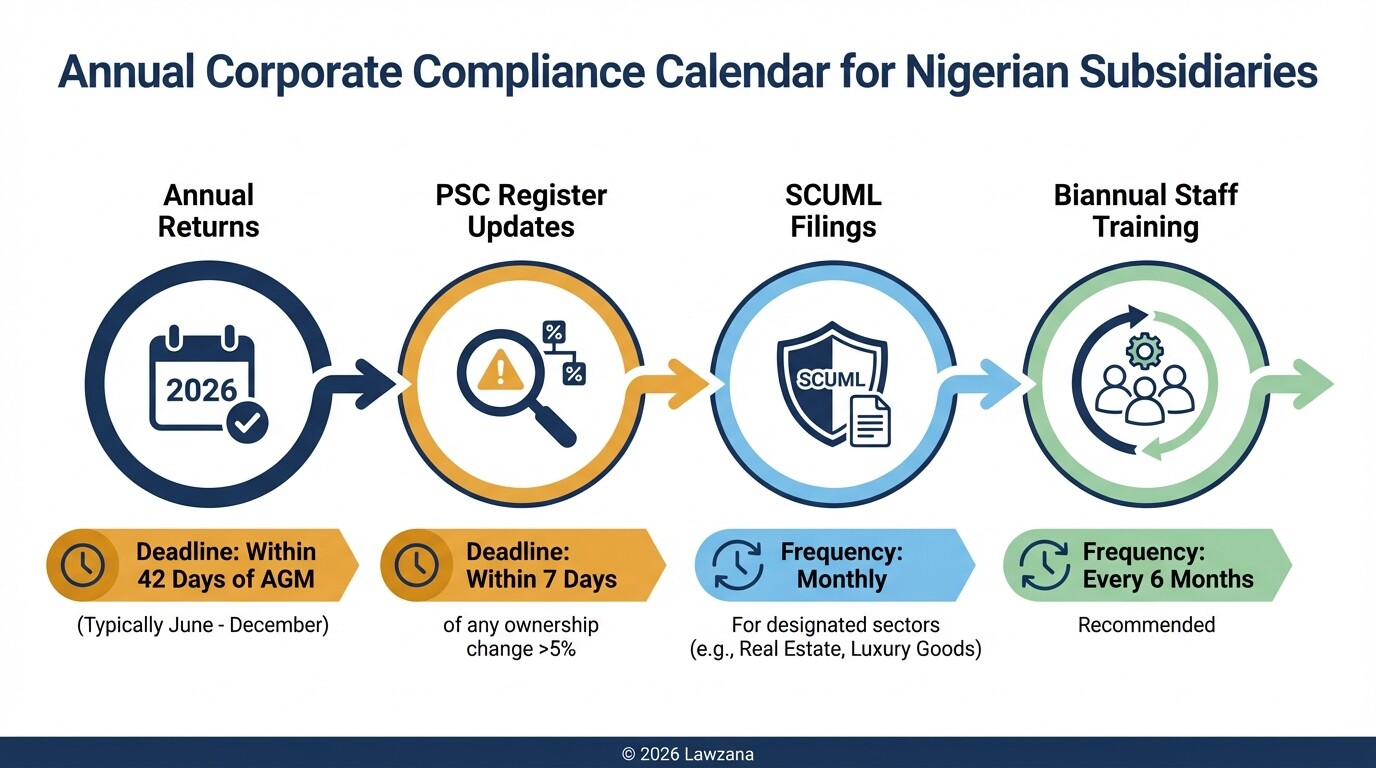
Compliance in Nigeria is not a one-time setup; it requires an ongoing calendar of filings to remain in good standing with the Corporate Affairs Commission (CAC). Failure to file these returns can lead to the company being "struck off" the register, effectively making its operations in Nigeria illegal.
- Annual Returns: Must be filed within 42 days of the company's Annual General Meeting. For most firms, the deadline falls between June and December of each year.
- Filing Fees: The cost for a private company is generally around NGN 5,000 to NGN 10,000, while public companies pay NGN 10,000. Late filing penalties accrue daily and can reach NGN 25,000 or more per year of default.
- Beneficial Ownership Disclosure: Updates to the "Persons with Significant Control" register must be made within 7 days of any change in ownership exceeding 5%.
- SCUML Registration: Firms in specific sectors (like real estate or luxury goods) must file monthly reports with the Special Control Unit Against Money Laundering (SCUML).
Common Misconceptions
Myth 1: Facilitation payments are legal if they are small.
In some jurisdictions, small payments to speed up paperwork are tolerated; in Nigeria, they are illegal. Both the giver and the receiver can be prosecuted under the ICPC Act regardless of the amount involved.
Myth 2: Having a global policy is enough for the Nigerian subsidiary.
Global policies often lack the specific statutory references (like the EFCC Act or the ICPC Act) required by Nigerian regulators. A "localized" version of the global policy is essential for legal defensibility in Nigerian courts.
Myth 3: If an agent commits bribery, the parent company isn't liable.
Under the principle of vicarious liability and the "failure to prevent bribery" standard, a parent company can be held responsible for the actions of its Nigerian agents if it failed to perform adequate due diligence or oversight.
FAQ
What is the difference between the ICPC and the EFCC?
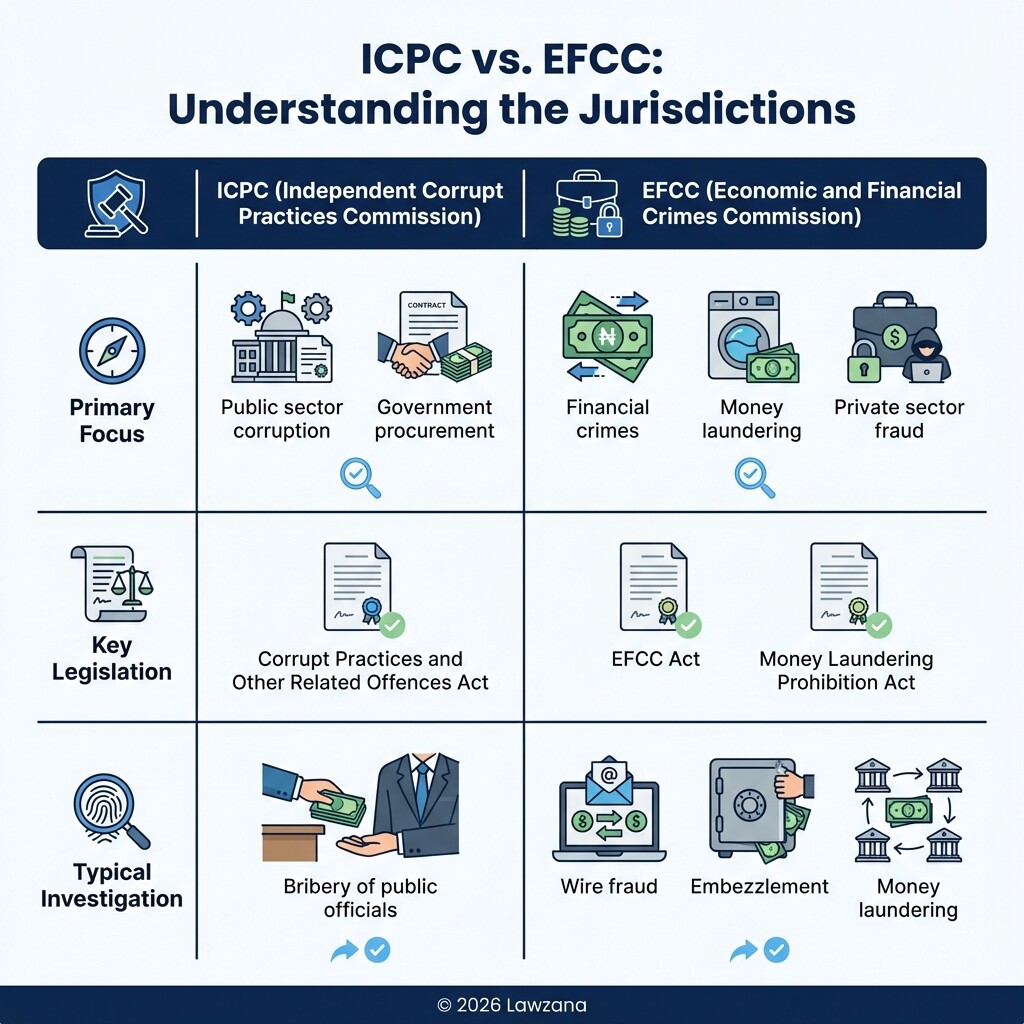
The ICPC (Independent Corrupt Practices Commission) focuses primarily on corruption within the public sector and government procurement. The EFCC (Economic and Financial Crimes Commission) handles a broader range of financial crimes, including money laundering, wire fraud, and private-sector embezzlement.
Are corporate gifts allowed under Nigerian law?
Yes, but they must be reasonable, proportionate, and transparent. Gifts should never be given during a sensitive period, such as during a tender process or contract negotiation, and should always be recorded in the company's gift register.
How much are the penalties for non-compliance with CAC filings?
While the filing fees are low (approx. NGN 5,000), the penalties for late filing are significant and can lead to the "inactive" status of the company, preventing it from bidding on contracts or processing visa applications for foreign staff.
When to Hire a Lawyer
Navigating the Nigerian regulatory landscape requires local expertise, especially when dealing with government contracts or complex supply chains. You should consult a Nigerian legal expert if:
- You are establishing a new subsidiary or branch office in Nigeria.
- Your firm is participating in a high-value government procurement tender.
- An internal whistleblower has raised allegations of bribery or financial misconduct.
- You are conducting due diligence on a high-risk local partner or politically exposed person.
- You have received an inquiry or "invitation" for questioning from the EFCC or ICPC.
Next Steps
- Audit Your Current Policies: Review your global anti-corruption policy to ensure it cites the Nigerian Corrupt Practices Act.
- Verify Your CAC Status: Confirm that your Nigerian subsidiary is listed as "Active" on the CAC portal and all annual returns are up to date.
- Train Your Local Team: Schedule a compliance workshop specifically for your Nigerian management team and third-party agents.
- Update Your Contracts: Insert robust anti-corruption and audit clauses into all active and future local vendor agreements.