How to Respond to a Breach of Contract by a Supplier in Nigeria
In the Nigerian business environment, supply chain disruptions are a common reality. Whether it is a delay in delivering raw materials to a factory in Lagos or the supply of substandard equipment to a construction site in Abuja, a breach of contract can paralyze your operations. Understanding your legal rights under Nigerian law allows you to move from a position of frustration to one of strategic recovery.
What constitutes a breach of contract under Nigerian law?
A breach of contract in Nigeria occurs when a supplier fails to perform any term of a signed agreement without a valid legal excuse. This can range from a "minor breach," such as a slight delay that does not derail the project, to a "fundamental breach," which is so severe that it renders the contract's purpose unattainable. Nigerian courts look at the "conditions" and "warranties" of the contract to determine if the violation allows for termination or merely compensation.
Common examples of supplier breaches in Nigeria include:
- Non-delivery: Failing to supply the goods or services entirely.
- Substandard Quality: Delivering items that do not meet the specifications outlined in the purchase order or the standards set by the Sale of Goods Act.
- Late Delivery: Missing "time is of the essence" deadlines, which are critical in industries like hospitality or manufacturing.
- Partial Performance: Delivering only a fraction of the agreed-upon quantity.
How do you determine if a breach is "fundamental" enough to end the contract?
How do you send a demand letter and offer a "cure" period?
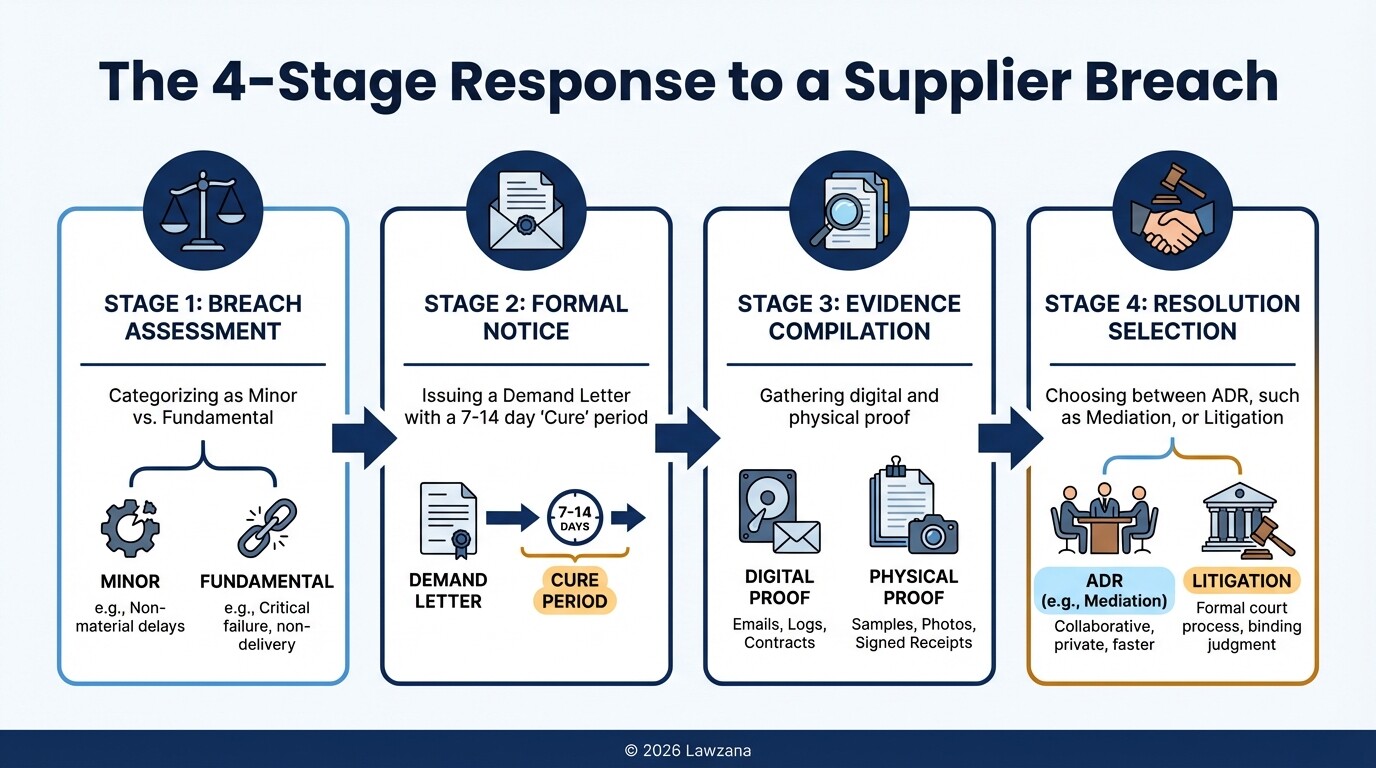
A demand letter is a formal notice that informs the supplier of their specific default and requests a remedy within a set timeframe. In Nigeria, this letter serves as a crucial foundation for any future litigation, proving to the court that you acted in good faith and attempted to mitigate your losses. If the contract includes a "cure clause," you are legally obligated to give the supplier this opportunity to fix the mistake before seeking damages.
When drafting your demand letter, follow these steps:
- Reference the Agreement: Cite the specific date of the contract and the clause number that has been violated.
- Detail the Breach: State exactly what went wrong (e.g., "The 500 units of Grade-A cement were not delivered by the August 10th deadline").
- Set a Deadline: Provide a specific window for the "cure"-typically 7 to 14 days depending on the urgency.
- State the Consequences: Clearly mention that failure to remedy the breach will result in legal action or contract termination.
- Method of Service: Send the letter via a courier service that provides a proof-of-delivery receipt or via a formal process server.
What happens if the supplier ignores the demand letter?
What evidence must you collect to prove a supplier breach?
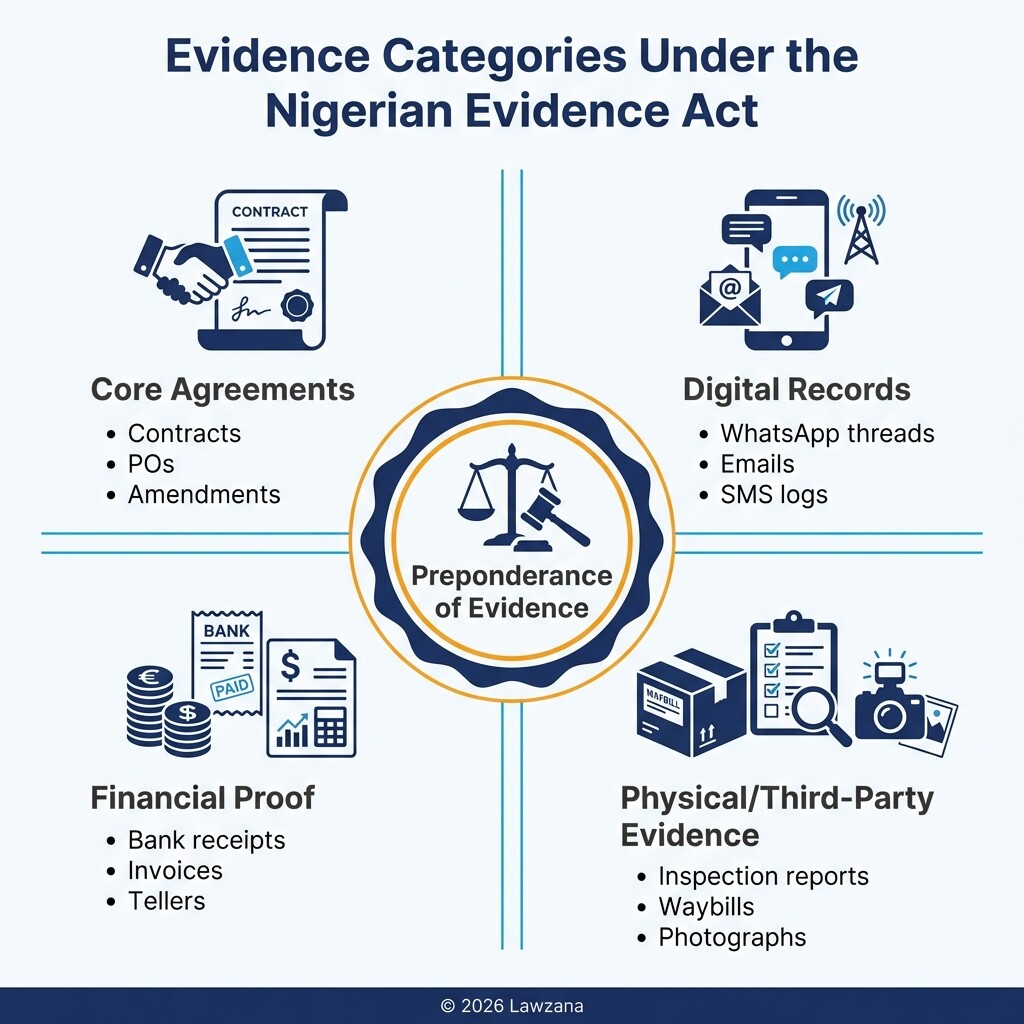
To succeed in a breach of contract claim in Nigeria, you must satisfy the "preponderance of evidence" standard, meaning you must prove it is more likely than not that the breach occurred. This requires a comprehensive paper trail that links the original promise to the current failure. Under the Evidence Act 2011, Nigerian courts recognize digital evidence, provided you can prove the integrity of the device used to produce the records.
You should organize your evidence into the following categories:
- The Core Agreement: The signed contract, purchase orders, and any written amendments.
- Communication Logs: Printed copies of emails, SMS, and WhatsApp threads discussing delivery and performance.
- Proof of Payment: Bank transfer receipts, tellers, or invoices marked "paid."
- Physical Evidence: Inspection reports from independent third parties, photographs of defective goods, or "Waybills" showing shortfalls in delivery.
- Witness Statements: Notes from employees or warehouse managers who received the delivery.
How do you authenticate WhatsApp messages for use in a Nigerian High Court?
Should you choose negotiation, mediation, or court action?
Choosing the right forum for dispute resolution in Nigeria depends on the value of the contract and the desired speed of resolution. While the High Court is the traditional route, many Nigerian businesses now prefer Alternative Dispute Resolution (ADR) because it is confidential and significantly faster. In states like Lagos and Kano, "Multi-door Courthouses" offer court-connected mediation that can settle a supplier dispute in weeks rather than years.
| Option | Speed | Cost | Relationship Preservation |
|---|---|---|---|
| Negotiation | Very Fast | Low | High (Preserves partnership) |
| Mediation | Fast (Weeks) | Moderate | Moderate |
| Arbitration | Moderate (Months) | High | Low |
| Litigation | Slow (Years) | Variable | Very Low |
If your contract contains an "Arbitration Clause," you are generally barred from going straight to court. You must follow the procedures outlined in the Arbitration and Mediation Act 2023.
Can a supplier be forced to deliver the goods instead of just paying damages?
Common misconceptions about contract breaches in Nigeria
"I don't have a written contract, so I can't sue."
This is a common myth. While a written contract is easier to prove, Nigerian law recognizes oral contracts and agreements formed through conduct. If you paid for goods and the supplier accepted the money, a contract exists. You can use bank statements and text messages to prove the terms of the deal.
"I can stop all payments to the supplier immediately."
Withholding payment can sometimes put you in breach of contract. Unless the supplier's breach is "fundamental," your obligation to pay for goods already received may still stand. Always consult a lawyer before "self-helping" by stopping payments, as this could hurt your position in court.
When to hire a lawyer
Navigating a supplier breach in Nigeria requires more than just a firm email; it requires a strategic understanding of the Sale of Goods Law (which varies slightly by state, such as the Sale of Goods Law of Lagos State).
You should contact a commercial lawyer if:
- The financial loss exceeds 2,000,000 NGN.
- The supplier is a foreign entity with no local assets.
- The supplier is threatening a counter-suit for unpaid invoices.
- Your contract involves complex intellectual property or specialized machinery.
- You need to apply for an "injunction" to stop the supplier from selling goods meant for you to someone else.
Next steps
- Audit Your Documents: Gather every piece of paper and digital record related to the transaction.
- Issue a Formal Notice: Do not rely on phone calls; send a written notice of breach via a trackable method.
- Quantify Your Damages: Calculate not just what you paid, but the "consequential losses" (e.g., lost profits because you couldn't fulfill your own customers' orders).
- Consult Counsel: Speak with a Nigerian legal expert to determine if your case should go to the Multi-door Courthouse or the High Court.
Frequently Asked Questions
What is the statute of limitations for contract breach in Nigeria?
Under the various Limitation Laws of Nigerian states, you generally have six years from the date the breach occurred to file a lawsuit. If the contract involves land or is under seal, different timelines may apply.
Can I claim "General Damages" for the stress caused by the breach?
In Nigerian commercial litigation, "General Damages" are often awarded at the court's discretion to compensate for losses that flow naturally from the breach. However, you must specifically prove "Special Damages" for any exact monetary losses.
How much does it cost to sue a supplier in Nigeria?
Costs include court filing fees (which vary by the claim amount), service fees, and legal fees. Many Nigerian lawyers charge a combination of a retainer fee and a success fee (contingency), though pure contingency fees are subject to specific ethical rules in Nigeria.
Federal High Court of Nigeria Lagos State Ministry of Justice