


Why do US small and mid-sized businesses need an antitrust compliance plan?
Antitrust compliance protects small and mid-sized businesses (SMBs) from catastrophic fines, criminal prosecution, and civil lawsuits that can arise from anti-competitive behavior. While many owners believe these laws only target "Big Tech" or massive monopolies, the Department of Justice (DOJ) frequently prosecutes smaller firms for local price-fixing or bid-rigging schemes. A proactive plan ensures that your sales and management teams do not accidentally cross legal boundaries during routine interactions.
Under federal statutes like the Sherman Act and the Clayton Act, the cost of non-compliance is steep. Individual executives can face prison time, and corporations can be fined up to $100 million or twice the gain/loss from the crime. Even if your business is innocent, the cost of defending against a federal investigation can reach hundreds of thousands of dollars, making prevention the most cost-effective strategy.
What are the main federal agencies that oversee antitrust in the US? How much can a business be fined for a Sherman Act violation?
What everyday business practices trigger US antitrust investigations?
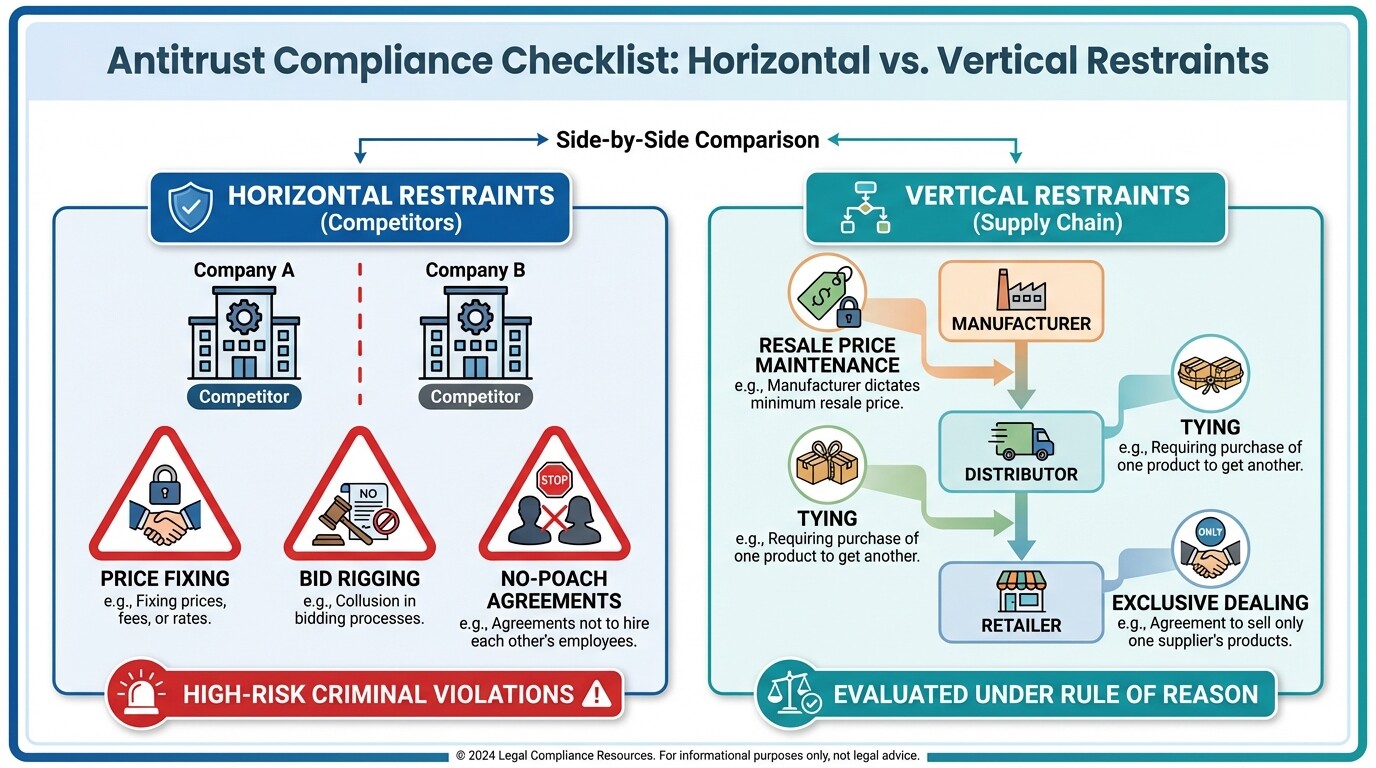
The most common triggers for antitrust investigations are informal communications between competitors regarding pricing, customers, or geographic territories. Even casual "shop talk" at a trade association meeting or a local chamber of commerce event can be interpreted by federal regulators as an illegal agreement to restrain trade. If two competitors decide, even without a written contract, to not "poach" each other's clients or to keep prices at a certain level, they have likely committed a federal crime.
Common high-risk scenarios include:
- Trade Association Meetings: Discussing future pricing trends or collective boycotts of a specific supplier.
- Benchmarking Groups: Sharing highly specific, non-anonymized data about wages, profit margins, or production costs.
- Joint Purchasing: Small businesses pooling resources to buy from a supplier is often legal, but it becomes an issue if the group uses its power to squeeze suppliers unfairly or fix resale prices.
- Hiring Practices: "No-poach" agreements, where two companies agree not to hire each other's employees, are currently a top enforcement priority for the DOJ.
What is the difference between horizontal and vertical restraints? Can a business legally match a competitor's price?
Which red-flag clauses should you look for in distribution and supply agreements?
Red-flag clauses in commercial contracts often involve "vertical restraints" that limit how goods are sold or who they are sold to. While many vertical agreements are legal under the "rule of reason"-meaning the court looks at whether the agreement helps or hurts overall competition-certain terms can invite immediate scrutiny. Businesses must be particularly careful with clauses that dictate pricing or restrict a buyer's ability to deal with other parties.
Watch for these specific terms in your agreements:
- Resale Price Maintenance (RPM): Any clause that forces a retailer to sell a product at a specific price (though "Minimum Advertised Price" or MAP policies are often legal if structured correctly).
- Most Favored Nation (MFN) Clauses: Provisions that guarantee a buyer the lowest price the seller offers to anyone else; these can sometimes be seen as a tool to discourage discounting.
- Exclusive Dealing: Agreements that prevent a distributor from carrying a competitor's products, especially if the company has significant market power.
- Tying Arrangements: Requiring a customer to buy a second "tied" product as a condition of buying the "tying" product they actually want.
Are Minimum Advertised Price (MAP) policies legal in all 50 states? How does "market power" affect the legality of an exclusive contract?
How do you design internal competition-law policies and staff training?
Designing an effective antitrust compliance policy requires creating a clear, written document that is endorsed by the company's highest leadership and distributed to all employees. The policy must go beyond a simple "do not break the law" statement and provide specific examples of what employees should and should not do in their specific roles. For example, the rules for a sales representative visiting a trade show will differ from those for an HR manager handling recruitment.
A robust internal program includes:
- The "Golden Rule" of Communication: A strict prohibition on discussing prices, bids, or territories with competitors.
- Annual Training: Interactive sessions where employees walk through real-world scenarios, such as how to exit a conversation if a competitor starts talking about pricing.
- Reporting Mechanism: An anonymous way for employees to report suspicious behavior or potential violations without fear of retaliation.
- Documentation Standards: Training staff to avoid "loose language" in emails, such as using terms like "destroy the competition" or "this agreement will give us a monopoly," which look incriminating in court.
How often should antitrust training be updated for staff? What is the role of a "compliance officer" in a mid-sized business?
What should you do immediately if your company receives a subpoena or dawn raid?
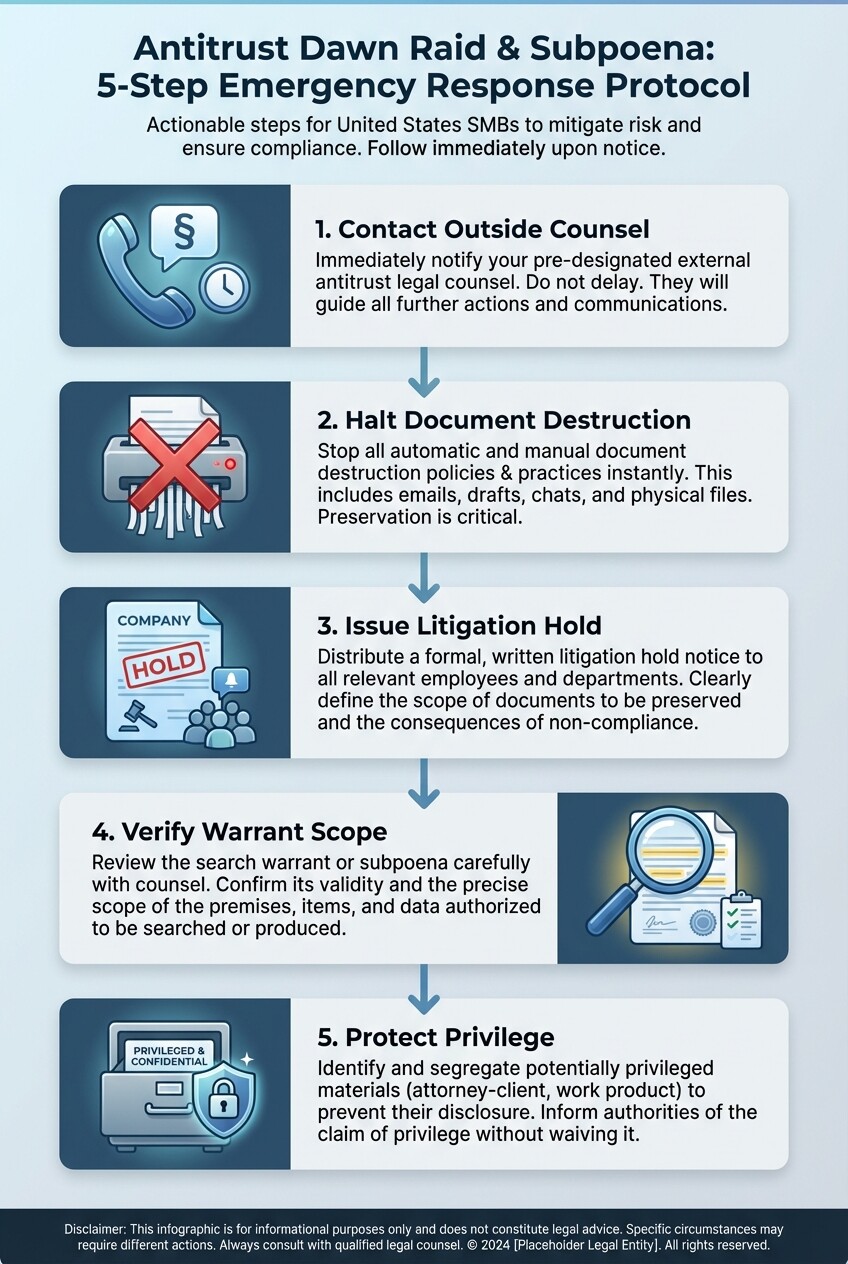
If your company receives an antitrust subpoena or is the subject of a "dawn raid" (an unannounced search by federal agents), you must immediately contact your legal counsel and halt all document destruction. Do not attempt to "clean up" files or delete emails, as this can lead to separate criminal charges for obstruction of justice. You are required to cooperate with the search warrant, but you also have the right to have your attorney present and to protect privileged communications.
Immediate action steps include:
- Issue a Litigation Hold: Send a company-wide memo (drafted by counsel) instructing everyone to preserve all digital and physical records.
- Designate a Point Person: Only one person should communicate with the agents to ensure a consistent and managed response.
- Do Not Volunteer Information: Employees should be polite but should not submit to interviews or offer explanations without an attorney present.
- Request a Copy of the Warrant: Ensure the agents are staying within the geographic and topical scope defined in the warrant.
What is a Civil Investigative Demand (CID) in the US? Does the DOJ offer leniency for companies that self-report violations?
Common Misconceptions About US Antitrust Law
"We are too small for the government to care about us." Federal authorities, particularly the DOJ's Antitrust Division, regularly prosecute small businesses. In industries like construction, landscaping, or local medical services, small firms are frequently targeted for bid-rigging or market-sharing agreements.
"If we didn't sign a contract, it isn't an illegal agreement." Antitrust law does not require a written contract or even a verbal "handshake." A "knowing wink" or a pattern of behavior following a conversation is enough for a jury to find that an illegal conspiracy existed.
"Sharing price lists with competitors helps us stay competitive." Exchanging non-public, current, or future price lists with competitors is one of the fastest ways to trigger a criminal investigation. This is almost always viewed as a prelude to price-fixing.
FAQ
What are the main federal antitrust laws in the United States?
The primary laws are the Sherman Act, which prohibits unreasonable restraints of trade and monopolies; the Clayton Act, which addresses mergers and specific practices like tying; and the Federal Trade Commission Act, which prohibits "unfair methods of competition." More information can be found at the Federal Trade Commission website.
Can my business be sued by a consumer for antitrust violations?
Yes. In the United States, private parties (customers or competitors) can sue for "treble damages," which means they can recover three times the actual financial harm caused by the antitrust violation, plus attorney's fees.
What is "bid-rigging" and why is it illegal?
Bid-rigging occurs when competitors coordinate their bids on a contract to ensure a specific company wins at a predetermined price. It is a "per se" violation of the Sherman Act and is prosecuted criminally by the Department of Justice.
When to Hire a Lawyer
You should engage an antitrust litigation and counseling lawyer if you are:
- Entering into a joint venture or collaboration with a competitor.
- Drafting a new distribution agreement that includes exclusive territories or pricing restrictions.
- Planning a merger or acquisition, even if you believe you are below the Hart-Scott-Rodino (HSR) filing thresholds.
- Received a subpoena, Civil Investigative Demand (CID), or any inquiry from the DOJ or FTC.
- Concerned that a competitor's behavior is unfairly preventing you from entering a market.
Next Steps
- Conduct a Risk Audit: Review your current contracts and communication habits to identify "red-flag" areas.
- Draft a Compliance Policy: Work with counsel to create a formal written policy tailored to your industry.
- Train Your Leaders: Ensure your executive team understands the risks of informal competitor contact.
- Establish a File: Keep records of how you independently determined your prices and business strategies to prove they were not the result of a conspiracy.