


- Victims have two years from the date of the accident to initiate a lawsuit against the at-fault driver in Ontario.
- Ontario uses a hybrid system where you receive immediate "no-fault" benefits regardless of who caused the crash, while also retaining the right to sue for additional damages.
- To successfully sue for pain and suffering, your injuries must meet a specific legal "threshold" defined as a permanent and serious impairment.
- Most pain and suffering awards are subject to a statutory deductible, which is a specific amount (roughly $46,000) taken out of your settlement and kept by the insurance company.
- Consistent medical documentation is the single most important factor in proving the severity of your injuries and securing a fair settlement.
Step-by-Step Personal Injury Claim Checklist
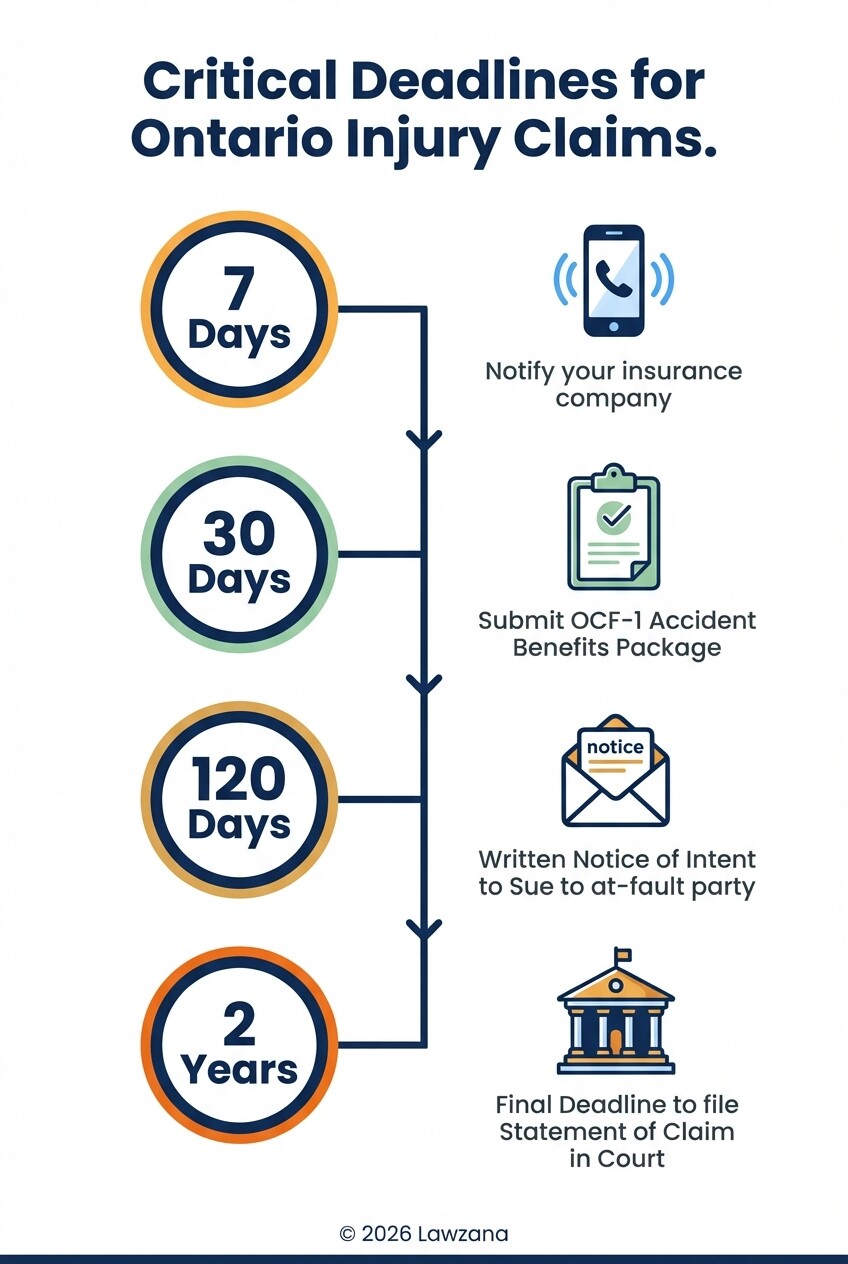
Claiming damages in Ontario requires following a strict chronological order to protect your right to compensation. Failure to meet these deadlines can result in the permanent loss of your right to recover money for your injuries.
- Immediate Notification (7 Days): Notify your own car insurance company about the accident and any injuries. This is required even if you were not at fault.
- Application for Benefits (30 Days): Complete and submit the Accident Benefits Application Package (OCF-1) to your insurer to start receiving medical and rehabilitation payments.
- Notice of Intent to Sue (120 Days): Provide written notice to the at-fault driver and their insurance company that you intend to file a lawsuit.
- Medical Stabilization: Focus on treatment and ensure all symptoms are documented by specialists, not just a family doctor.
- Evidence Gathering: Obtain the Motor Vehicle Accident Report from the police and collect contact information for any witnesses.
- Filing the Statement of Claim (2 Years): Formally file your lawsuit in the Ontario Superior Court of Justice before the two-year anniversary of the accident.
- Discovery Process: Participate in "Examinations for Discovery," where lawyers for both sides ask questions under oath.
- Mediation: Attend a mandatory or voluntary mediation session to attempt a settlement before going to trial.
Statutory Accident Benefits vs. Tort Claims
Ontario car accident victims are entitled to two separate streams of compensation known as Statutory Accident Benefits (SABS) and Tort claims. While SABS provides immediate relief through your own insurance, a Tort claim allows you to seek additional money from the person who caused the accident.
| Feature | Statutory Accident Benefits (SABS) | Tort Claim (Lawsuit) |
|---|---|---|
| Who Pays? | Your own insurance company. | The at-fault driver's insurance company. |
| Fault Required? | No, available even if you caused the crash. | Yes, you must prove the other driver was negligent. |
| What is Covered? | Medical rehab, caregiving, and income replacement. | Pain and suffering, lost earning capacity, and future care. |
| Deadlines | Application due within 30 days of receiving forms. | Lawsuit must be filed within 2 years. |
| Standard of Proof | Medical necessity of the specific treatment. | Meeting the "Threshold" of serious/permanent injury. |
Meeting the Threshold for Pain and Suffering Damages
In Ontario, you cannot sue for pain and suffering (non-pecuniary damages) unless your injury meets a specific legal "threshold" set by the Insurance Act. This threshold requires the victim to prove that their injury resulted in a permanent, serious impairment of an important physical, mental, or psychological function.
Proving you meet the threshold is a significant hurdle that often requires expert medical testimony. A "permanent" impairment is one that is expected to last for the remainder of the victim's life, while "serious" refers to the impact the injury has on the victim's ability to work or perform activities of daily living. If a judge determines your injuries are "minor" or temporary, your claim for pain and suffering may be dismissed entirely, regardless of the other driver's fault.
Critical Limitation Periods for Filing a Claim
The most important deadline in Ontario personal injury law is the two-year limitation period established by the Limitations Act, 2002. If you do not file a formal Statement of Claim in court within two years of the date of the accident, you are generally barred from seeking compensation forever.
There are shorter, "notice" periods that are equally vital. You must notify the at-fault party of your intent to sue within 120 days of the accident. While missing the 120-day notice is not always fatal to a case, it can result in losing the right to claim "pre-judgment interest," which is the interest that accumulates on your settlement amount from the time of the accident until the time of payment.
Importance of Medical Documentation and Expert Testimony
The success of an Ontario personal injury claim depends almost entirely on the quality and consistency of your medical records. Insurance adjusters and defense lawyers look for "gaps in treatment" to argue that your injuries have healed or were never serious.
To maximize recovery, you must:
- Attend all scheduled appointments with physiotherapists, massage therapists, and doctors.
- Be specific with your doctors about how the pain affects your work and hobbies.
- Seek referrals to specialists such as neurologists, orthopedic surgeons, or chronic pain experts.
- Maintain a "pain journal" to track daily struggles that might not appear in a standard medical chart.
In a lawsuit, your lawyer will likely hire independent medical experts to provide a "Medico-Legal Report." These experts review your history and provide a professional opinion on whether your injuries meet the legal threshold for a permanent and serious impairment.
Common Tactics Used by Insurance Adjusters
Insurance adjusters are trained to minimize the amount of money their company pays out, often using specific strategies to devalue your claim early in the process. Understanding these tactics can help you avoid making mistakes that could jeopardize your settlement.
One common tactic is placing claimants into the "Minor Injury Guideline" (MIG). If an adjuster decides your injury is just a strain or sprain, your medical benefits are capped at $3,500. Another tactic involves requesting a recorded statement shortly after the accident. They may use your words against you later if you describe your pain as "okay" or "getting better" during a moment of temporary relief. Finally, adjusters often make low-ball settlement offers very early, hoping you will sign away your rights before the full extent of your long-term injuries is known.
Common Misconceptions About Ontario Injury Claims
Myth: If the police didn't charge the other driver, I can't sue.
Police charges and civil lawsuits are entirely separate. A driver might not be charged with a crime or traffic offense, but they can still be found "liable" (legally responsible) in a civil court for failing to drive with reasonable care.
Myth: The "No-Fault" system means I can't sue for my pain.
"No-fault" simply means your own insurance company pays your medical bills and a portion of your lost wages immediately. It does not prevent you from suing the at-fault driver for damages that exceed what your own insurance covers, such as pain, suffering, and the full loss of your future income.
Myth: I will receive the full amount the jury awards me.
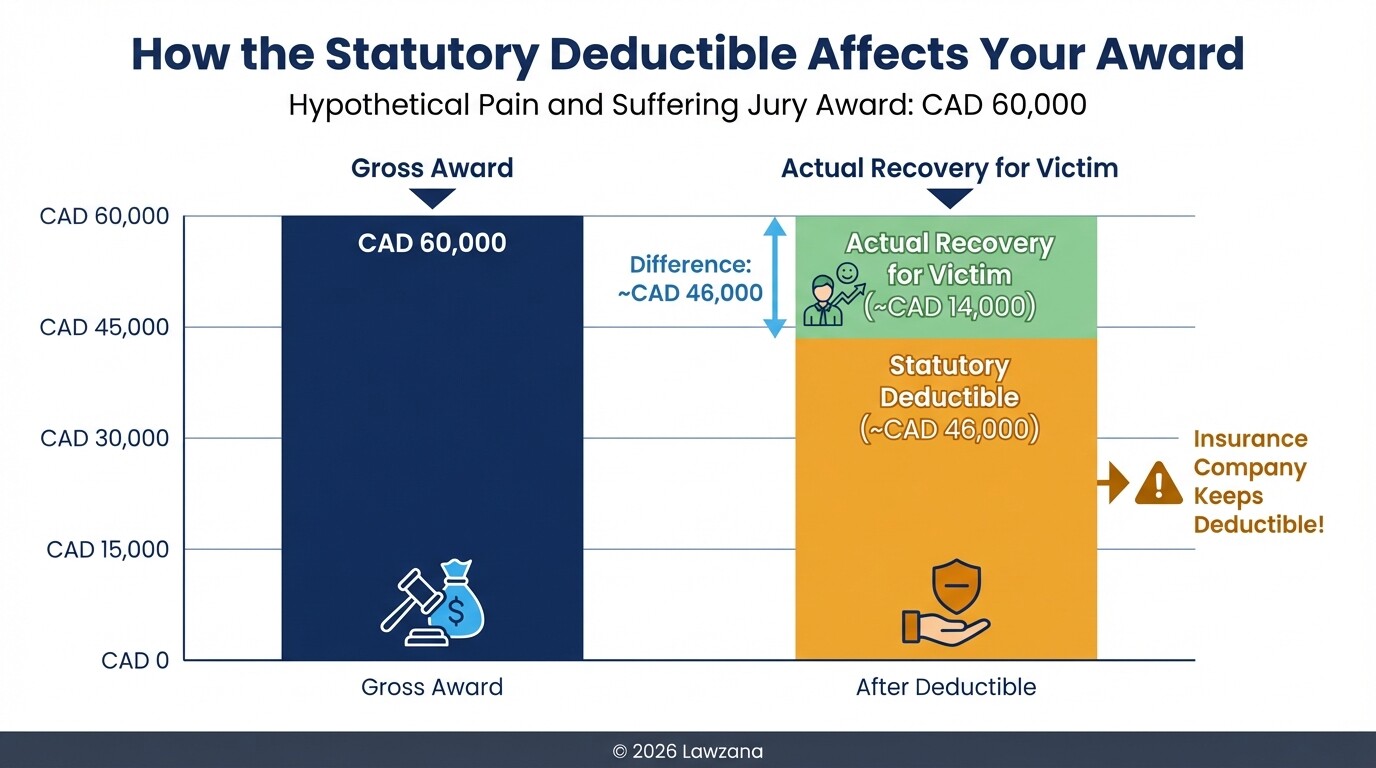
In Ontario, if a jury awards you $50,000 for pain and suffering, you do not get $50,000. Under the Insurance Act, there is a statutory deductible (currently over $46,000) that is subtracted from awards below a certain amount (roughly $153,000). If your award is $50,000, you might only receive about $4,000 after the deductible is applied.
FAQ
How much is my personal injury claim worth?
The value depends on the severity of your injuries, your age, your loss of income, and whether you meet the "threshold." While minor injuries may settle for under $20,000, catastrophic injuries can result in multi-million dollar settlements.
How long does a car accident lawsuit take in Ontario?
Most cases take between two and four years to resolve. The timeline depends on how long it takes for your injuries to "plateau" so that doctors can determine your long-term prognosis.
Do I have to pay my lawyer upfront?
Most personal injury lawyers in Ontario work on a "contingency fee" basis. This means they do not charge hourly fees upfront; instead, they take a percentage (usually 25% to 33%) of the final settlement or court award.
What if I was partially at fault for the accident?
You can still claim damages under the principle of "contributory negligence." If you were 25% at fault, your total compensation would simply be reduced by 25%.
When to Hire a Lawyer
You should consult a personal injury lawyer if your injuries prevent you from returning to work, if you require surgery, or if the insurance company has denied your claim for benefits. Legal representation is particularly critical if the insurance company has categorized your injury under the Minor Injury Guideline (MIG), as a lawyer can help move your claim into a higher category of funding. Because of the complex interaction between SABS, Tort law, and statutory deductibles, navigating these claims alone often results in significantly lower settlements.
Next Steps
- Request your police report: Visit the Ontario Ministry of Transportation website to learn how to obtain an official collision report.
- Review your insurance policy: Check your "OAP 1" (Owner's Policy) to see if you have optional increased benefit limits.
- Consult the FSRA: Visit the Financial Services Regulatory Authority of Ontario for information on your rights regarding accident benefits.
- Book a consultation: Contact a qualified personal injury lawyer for a free case evaluation to determine if you meet the threshold for a lawsuit.